Toyota GRMN Corolla 2026: The Track-Built Hatch That Carries a License Plate
Toyota stripped the rear seats, had its president sign the dashboard, and called it street-legal. The GRMN Corolla 2026 was born on a racetrack — and dealers are already adding markup.
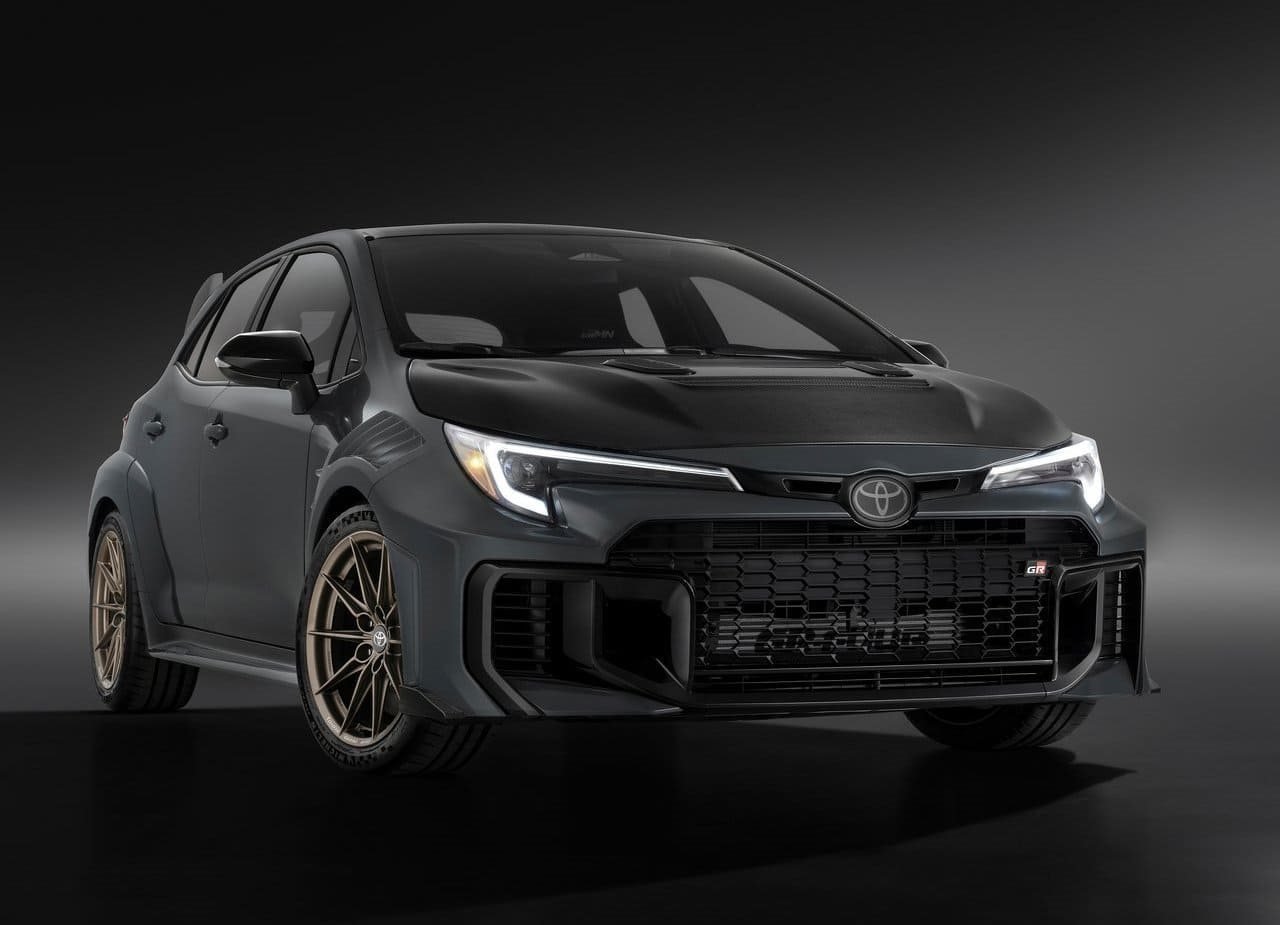
2026 Toyota GRMN Corolla: The Hand-Built Hatch That Refuses to Be Civilized
Toyota yanked the rear seats, stamped a serial number on the dash, had its president sign the carbon panel, and called the result the 2026 GRMN Corolla. This is not a sporty trim package. This is a factory endurance racing car that reluctantly agreed to wear a license plate.
GRMN stands for Gazoo Racing Masters of Nürburgring — a badge Toyota reserves strictly for machinery developed from the ground up on racing circuits. The car was announced globally in Q3 2025 and is assembled entirely by hand at the GR Factory inside Toyota’s legendary Motomachi complex in Japan.
Its direct rivals are the Honda Civic Type R and the Volkswagen Golf R. But the comparison only goes so far. Where the Golf R pursues balance and refinement, the GRMN pursues brutality. Allocation in the U.S. will be severely limited — and dealer markups are already being discussed before the first unit ships.
Quick Specs: 2026 Toyota GRMN Corolla
| Spec | Details |
|---|---|
| Category | Hot Hatch / Sports Compact |
| Engine | 1.6L Turbocharged 3-Cylinder, D-4S Dual Injection |
| Output | 300 HP at 6,500 rpm |
| Torque | 302–306 lb-ft (415 Nm) between 3,600 and 4,800 rpm |
| Transmission | 6-Speed Manual (close-ratio, exclusive to GRMN) |
| Drivetrain | GR-Four permanent AWD, dual Torsen differentials |
| 0–60 mph | ~4.9 seconds (Market Estimate) |
| Top Speed | 143 mph (electronically limited) |
| Fuel Economy | 19–21 city / 27–28 highway mpg (manual, EPA certified) |
| Range | Not applicable (combustion-only powertrain) |
| On Sale | Announced Q3 2025, model year 2026 production |
The spec sheet tells you what this car is on paper. What it doesn’t capture is the level of engineering obsession Toyota’s Gazoo Racing division poured into every single component. Read on — the details are where this car gets genuinely interesting.
The Aerodynamics Are Not a Styling Exercise — Every Piece Has a Job
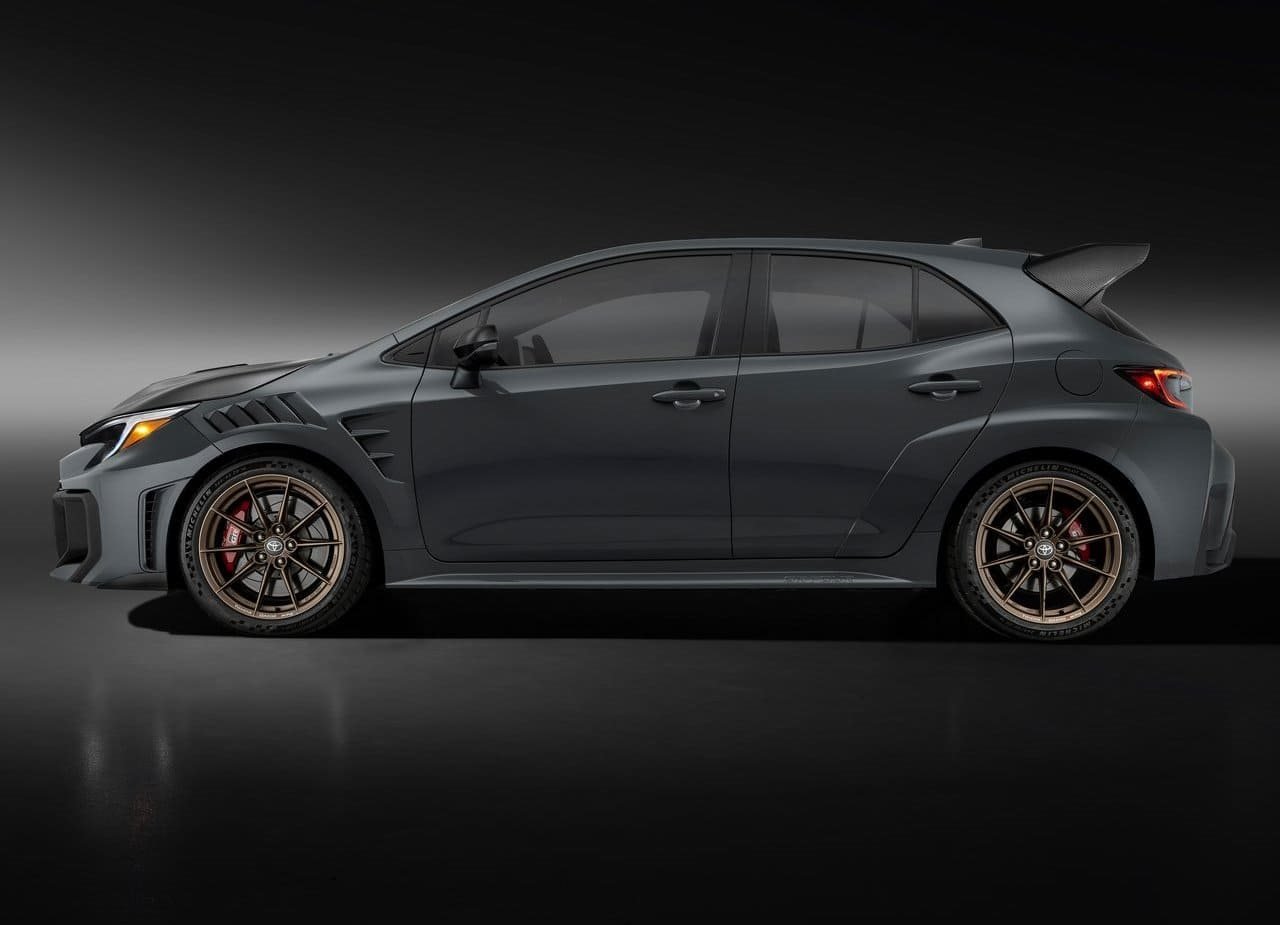
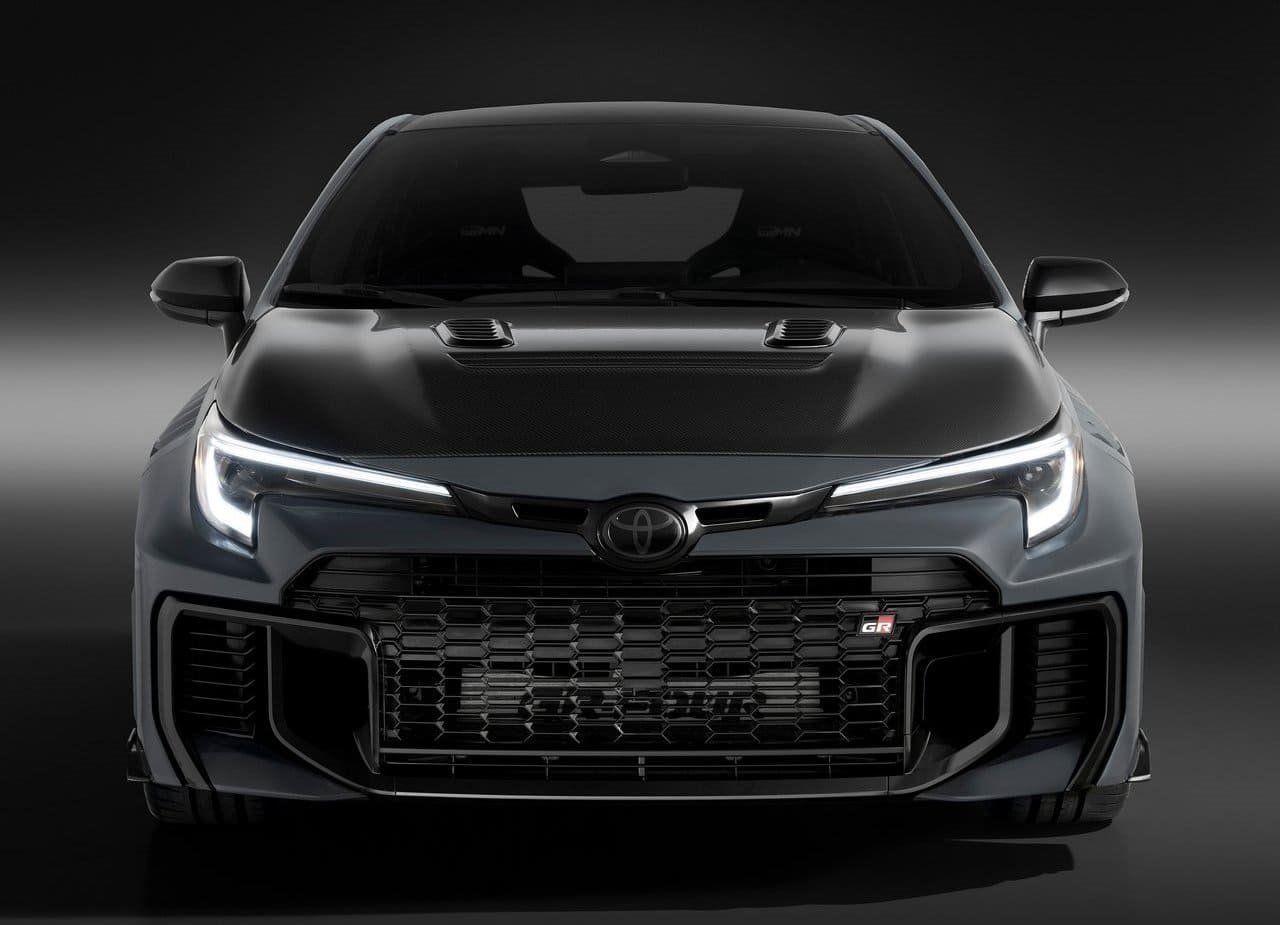
Standing in front of the GRMN Corolla is less of an aesthetic experience and more of a physics lesson. The exclusive carbon fiber hood features a horizontal air extraction duct that doesn’t exist for looks — it evacuates high-pressure buildup inside the engine bay that would otherwise generate front-axle lift at speed.
The front fenders are flared 1.18 inches wider than the standard GR Corolla, also in CFRP, and reshaped with trailing-edge fender ducts that extract turbulent air spun up by the rotating wheels before it disrupts airflow along the doors. The front side spoilers channel air curtains that seal around the tire faces, cutting induced drag.
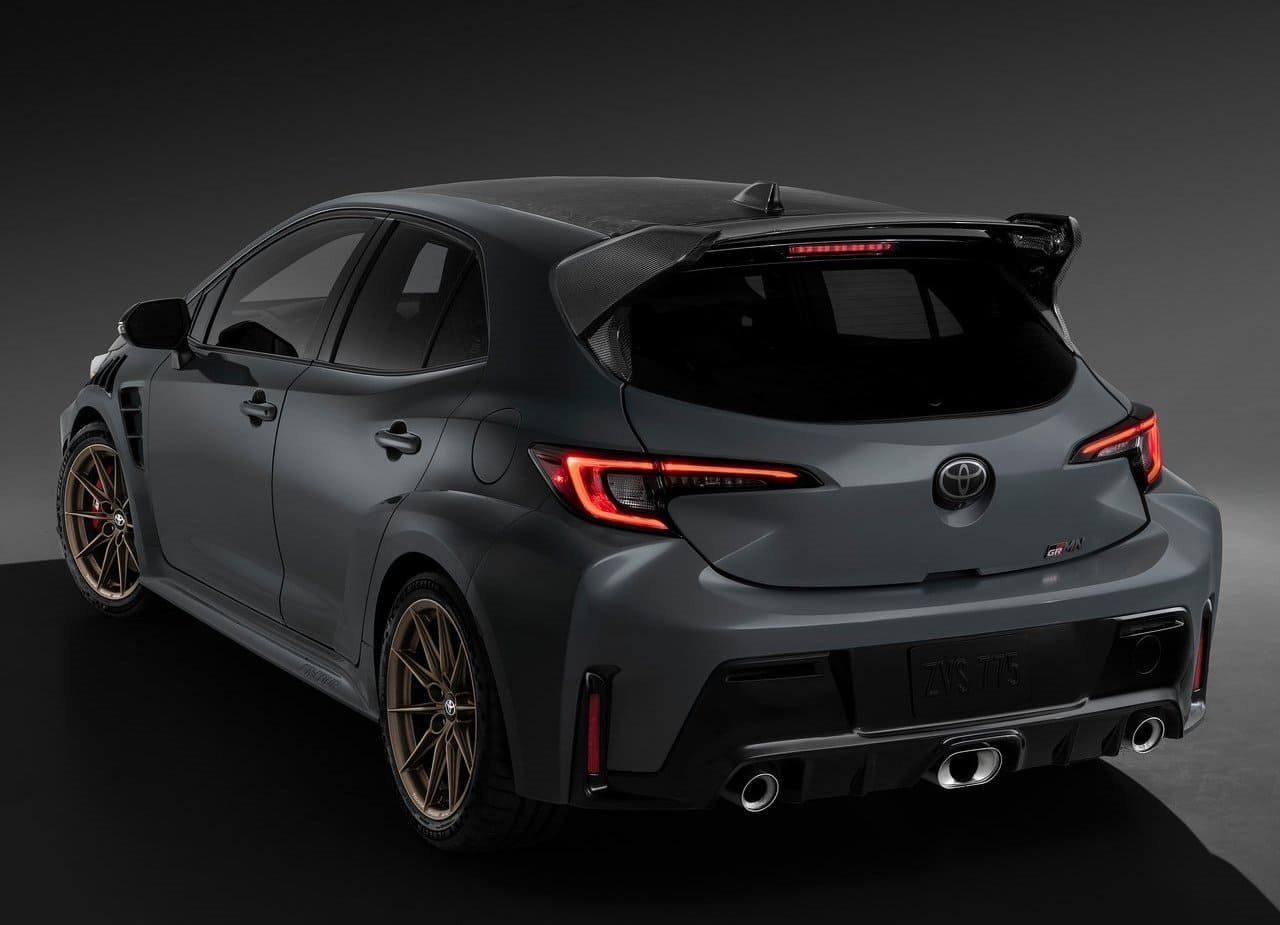
The roof panel is full forged carbon fiber — pulling mass from the highest point of the car lowers the center of gravity and reduces the polar moment of roll. It’s weight reduction you can see from across a parking lot.
Out back, a massive CFRP wing mounted on swan-neck supports dominates the tail. That mounting architecture — fixed from the top — keeps the wing’s lower surface completely unobstructed, which is where the downforce actually generates. The angle of attack adjusts manually across five positions in single-degree increments, letting owners dial in for long straight-line circuits or high-downforce technical tracks.
Every surface on this car communicates one thing: this came from a racetrack and was made street-legal as an afterthought.
A Cockpit Built Around the Driver — Everyone Else Was Dismissed
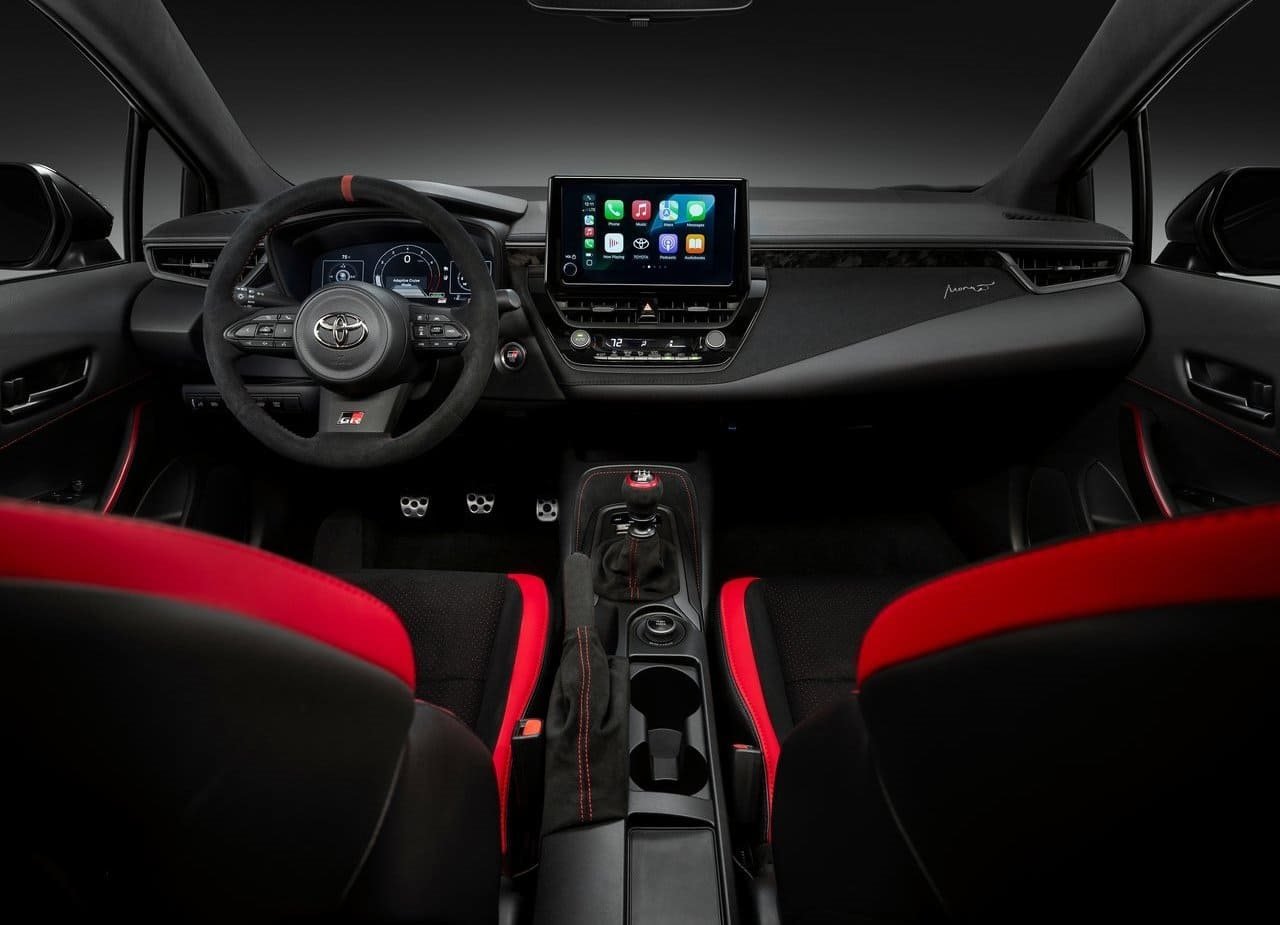
Step inside the GRMN and Toyota’s priorities become immediately clear. Soft-touch plastics are gone. The instrument panel and A-pillars are finished in a specialized flocked coating — that dense, matte velvet-like texture — engineered with a single purpose: eliminating sunlight glare from reflecting off the windshield during blind crests on circuit. It looks unique. It’s actually a safety feature.
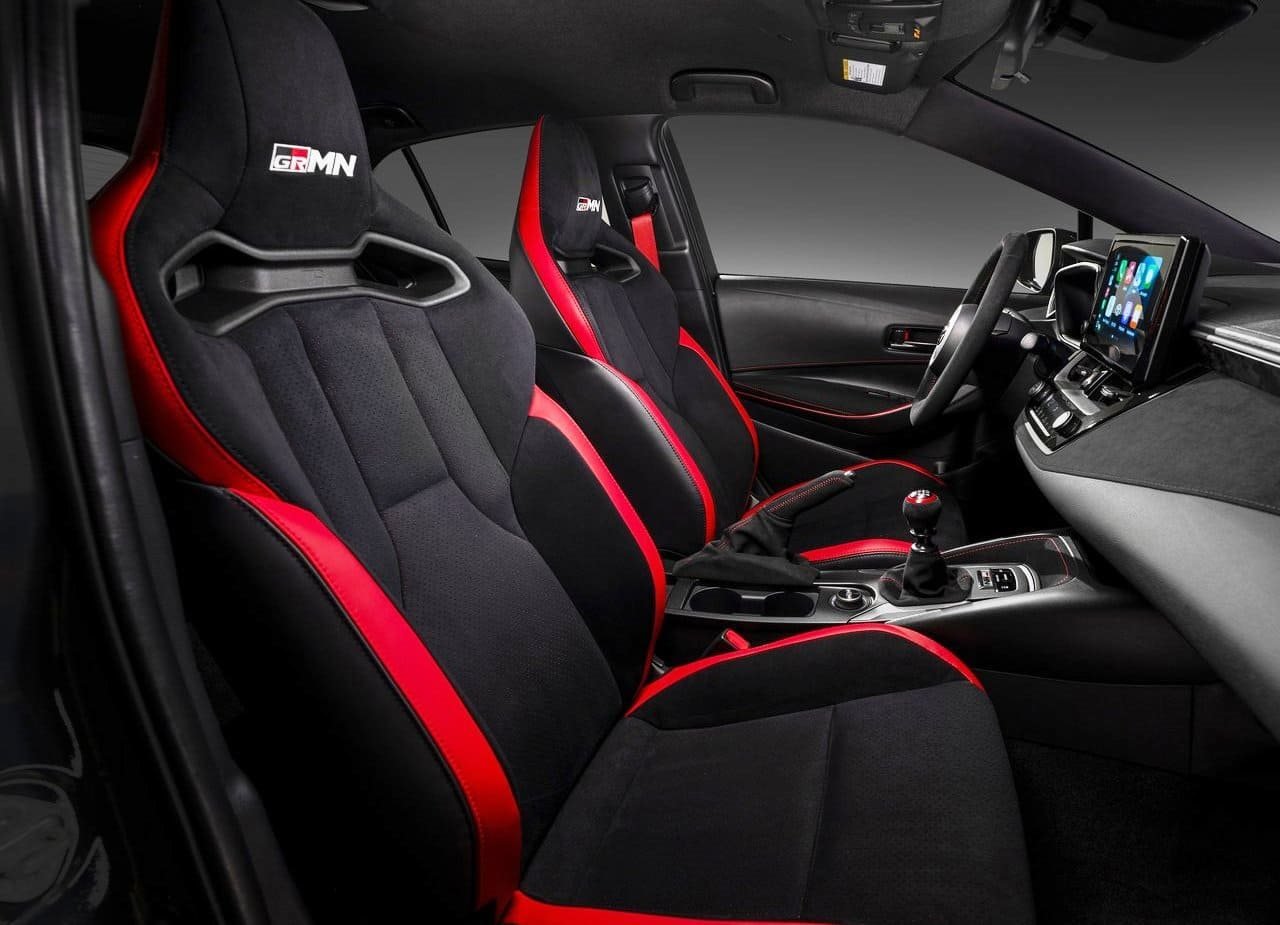
The front seats are exclusive GRMN semi-bucket units upholstered in Brin Naub, a high-friction synthetic technical fabric that locks the driver in place under sustained lateral g-forces. Red contrast stitching and synthetic leather accents provide the only concession to visual warmth in an otherwise strictly functional environment.
The cabin details signal exclusivity without screaming luxury. Red anodized aluminum (Alumite) trim, a hand-stamped serial number plate, and Akio “Morizo” Toyoda’s personal signature engraved into a carbon fiber panel ensure no two cars are identical in character.
Track-Grade Data, Zero Rear Accommodations
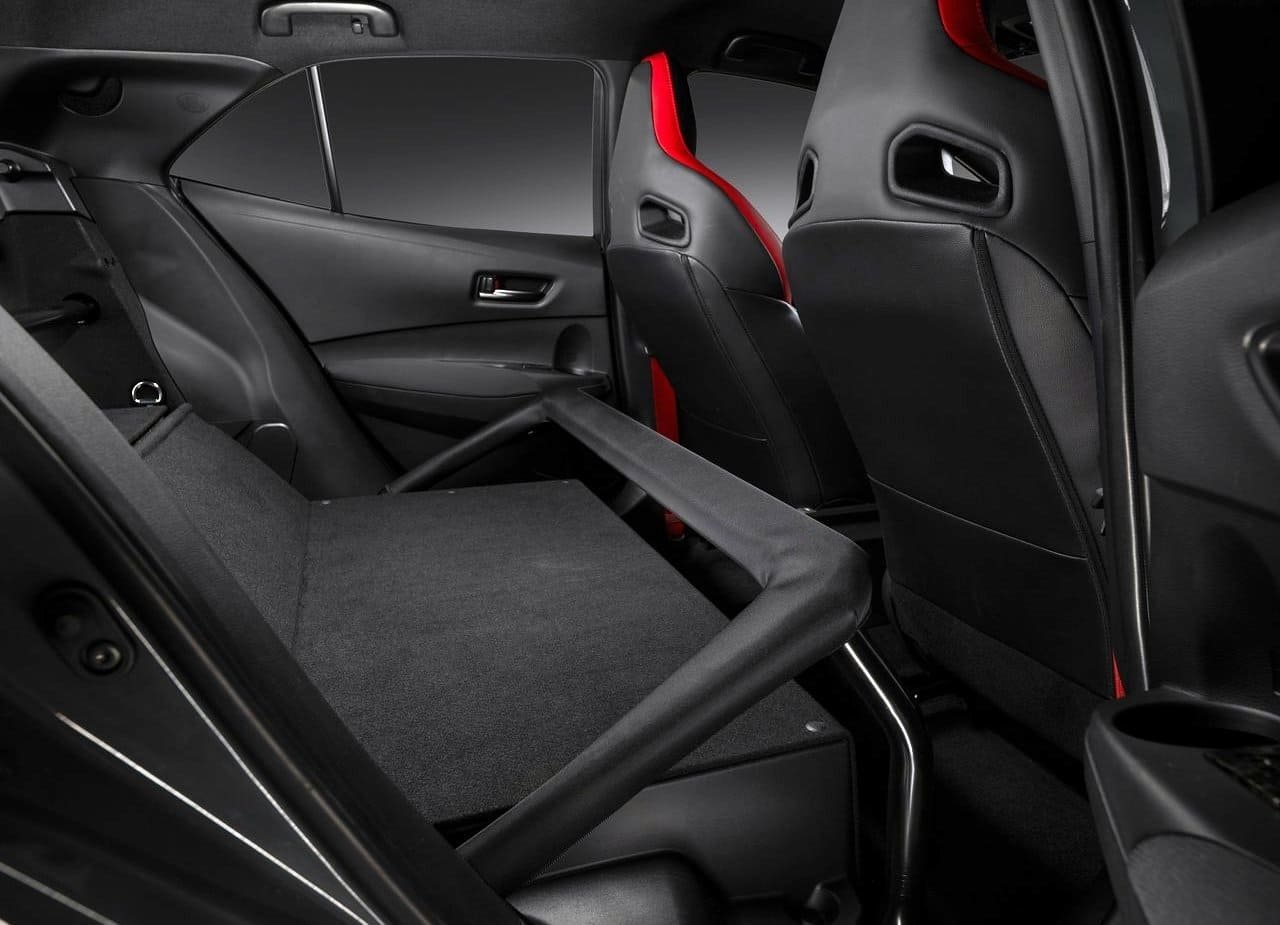
The rear seats are gone. That’s 66 lbs removed from behind the rear axle, replaced by structural reinforcement and flat cargo floor. Useful for helmets and track gear. Non-negotiable for rear passengers.
The 12.3-inch TFT digital instrument cluster displays individual tire pressures per corner, oil temperature and pressure, coolant temperature monitoring, and a three-axis G-force meter. This is the kind of telemetry data that used to require a separate data logger clipped to the roll cage.
The 8-inch touchscreen infotainment unit handles wireless Apple CarPlay and Android Auto — the minimum connectivity Toyota was willing to include before the engineering team called it done.
Cabin strength: the telemetry display is genuinely functional on track, not decorative.
Real limitation: if you need to carry anyone in the back seat, this is structurally the wrong car.
Under the Hood: What a 3-Cylinder Turbo Does That Rivals Can’t Match
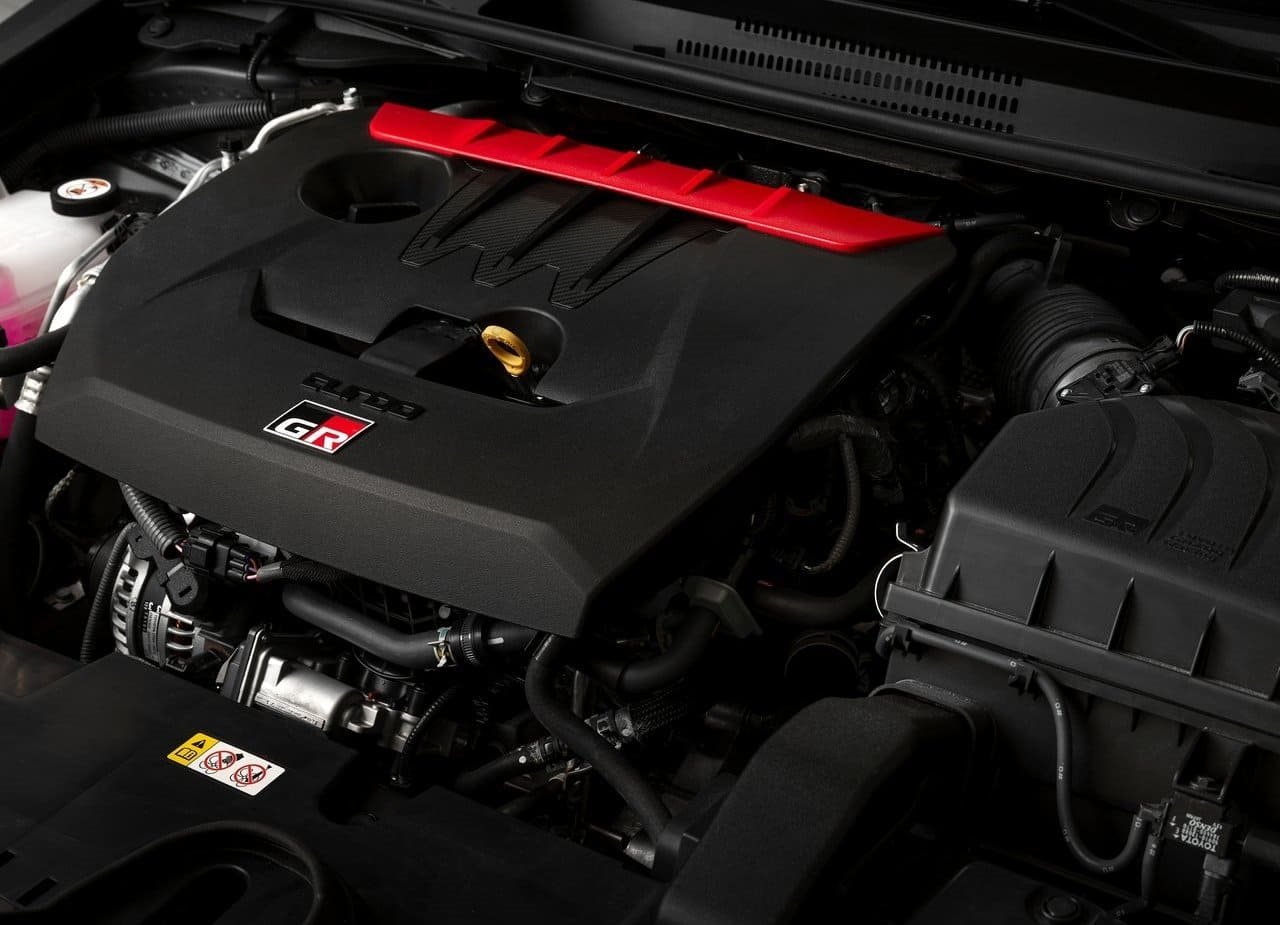
Three cylinders. 1.6 liters. 300 horsepower. On paper, that sounds like a compromise. On track, it’s a statement.
The G16E-GTS block is all aluminum with a ball-bearing single-scroll turbocharger mounted close to the exhaust port to minimize lag, D-4S dual injection combining direct and port delivery, and an intercooler water spray system pulled directly from Group A rally competition. When the driver activates it, atomized distilled water hits the intercooler core — the instant evaporation absorbs latent heat and keeps compressed air dense even after thirty sustained minutes at full load on a circuit.
Peak output is 300 hp at 6,500 rpm. The meaningful upgrade over previous editions is torque: 302–306 lb-ft arriving between 3,600 and 4,800 rpm — 11 lb-ft more than the prior Morizo Edition. Exiting a mid-speed corner in second or third gear, the turbo builds early and pulls hard through the rev range with no hesitation gap.
The six-speed close-ratio manual is GRMN-exclusive — no automatic option exists at this trim level, and none was ever considered. The GR-Four AWD system offers three torque split modes: 60:40 for normal driving, 50:50 for maximum traction on smooth tarmac, and 30:70 rear-biased for controlled oversteer. The rear coupling ECU has been recalibrated for sharper exit traction and more composed behavior under high lateral load.
Front and rear Torsen mechanical limited-slip differentials come standard. Unlike reactive clutch-pack systems that require initial wheelspin before sending torque across the axle, the Torsen units respond organically — mechanical traction without electronic delay.
The run from 0–60 mph is estimated at approximately 4.9 seconds (Market Estimate). Top speed is electronically capped at 143 mph — the aerodynamic drag generated by that fixed high-downforce package makes anything beyond that a losing equation.
Fuel economy sits at 19–21 mpg city and 27–28 mpg on the highway under EPA manual certification. Efficiency was never the objective. Thermal durability under sustained abuse was.
Sticker Price to Total Cost of Ownership: The Full Financial Picture
The base 2026 GR Corolla Core (manual) opens at around $41,115 in the U.S. market. The GRMN — with its full carbon fiber body panels, hand-assembled Motomachi construction, and Morizo’s signature — is projected by analysts to carry an MSRP between $55,000 and $60,000. With the production run severely limited, dealer markups on new releases at U.S. franchised stores will push real transaction prices toward $70,000–$80,000 without much resistance from the market.
At that price point, the GRMN sits in uncomfortable but honest territory: above the Golf R and Civic Type R, and knocking on the door of entry-level Porsche sports car pricing. The question buyers have to answer for themselves is whether the hand-built provenance, the signed carbon panel, and the numbered serial plate justify the premium over a standard GR Corolla.
Insurance premiums on this vehicle will be aggressive by any actuarial standard. The CFRP hood and swan-neck rear wing are not repairable through conventional bodywork methods. Any low-speed impact requiring panel replacement means ordering parts directly from Japan — at corresponding costs. Expect insurance carriers to price that risk accordingly, with annual premiums reflecting the exotic repair exposure.
Maintenance costs run well above the sports compact segment average. The Michelin Pilot Sport Cup 2 tires in 245/40ZR18 wear rapidly once brought up to operating temperature on track — full four-corner replacement represents a recurring four-figure expense. Brake dust accumulation on the forged wheels after aggressive street driving is a documented ownership irritant, not a reliability concern, but consistent with the car’s operating philosophy.
Financing a low-production limited edition at this price requires buyers to account for elevated loan-to-value ratios that many lenders will flag. Cash transactions and pre-approved specialty automotive lending are the cleaner paths.
The long-term ownership equation has a meaningful offset: depreciation on the GRMN is projected to trend near zero and potentially invert. As one of the last purpose-built combustion-manual-AWD hot hatches from a major manufacturer operating under a numerically serialized limited production run, collector demand among Japanese performance enthusiasts should sustain residual values well above standard market curves.
Frequently Asked Questions: What to Know Before You Write the Check
How limited is the 2026 GRMN Corolla production run in the U.S.?
Toyota has not confirmed specific U.S. allocation numbers. Based on prior GR special editions, total North American units are expected to be extremely restricted — likely in the hundreds, not thousands.
What is the real-world fuel economy of the GRMN Corolla?
EPA certification lands at 19–21 mpg city and 27–28 mpg highway in manual configuration. On track under sustained full load, those numbers drop sharply — the intercooler spray system alone signals this engine was not engineered for economy mode.
Are maintenance costs on the GRMN Corolla significantly higher than a standard GR Corolla?
Yes. The Cup 2 tire replacement cycle, carbon fiber panel repair costs requiring factory-sourced parts, and brake system demands under track use push annual maintenance costs well above the sports compact segment average.
Who are the GRMN Corolla’s closest direct competitors in the U.S. market?
The Honda Civic Type R (front-wheel drive, 2.0L turbo) and Volkswagen Golf R (AWD, Grand Touring orientation) are the benchmark references. The GRMN diverges fundamentally from both: no rear seats, full CFRP aero package, and a track-first philosophy that neither rival attempts at any price point.
Does the 2026 GRMN Corolla Justify Its Price Tag?
This is a fully emotional purchase — and Toyota engineered it that way deliberately. Nobody signing a check for $60,000-plus on a hatchback with no rear seats is running a rational cost-benefit analysis. They’re paying for one of the last combustion-manual-AWD sport compacts that a major manufacturer will ever build at scale.
For daily commuters, families, or anyone who values acoustic comfort and usable rear accommodations: this car is explicitly not built for you, and Toyota made that decision without apology.
For the driver who tracks on weekends, understands what 302 lb-ft at 3,600 rpm means in the context of a corner exit, and wants a Morizo signature as part of the ownership document — the GRMN is the closing argument of an era.
A $60,000 hatchback with no rear seats is an absurd proposition. That’s precisely why the waiting list already exists.
And you — does paying $60,000-plus for a track-focused hatch with no rear seats make any sense to you, or is this Toyota taking the “limited edition” concept too far? Drop your honest take in the comments below.
Share this article

Por: Danniel Bittencourt
04/06/2026
Related posts