Bugatti W16 Mistral “Blanc Éternel”: The Priciest Farewell in Automotive History
Bugatti’s W16 Mistral “Blanc Éternel” arrives as a one-off finished in porcelain, built alongside Germany’s KPM Berlin. Here’s why it’s the most artistic send-off the W16 engine could get.
Bugatti W16 Mistral “Blanc Éternel”: The Farewell to the W16 Engine Becomes a Porcelain Masterpiece
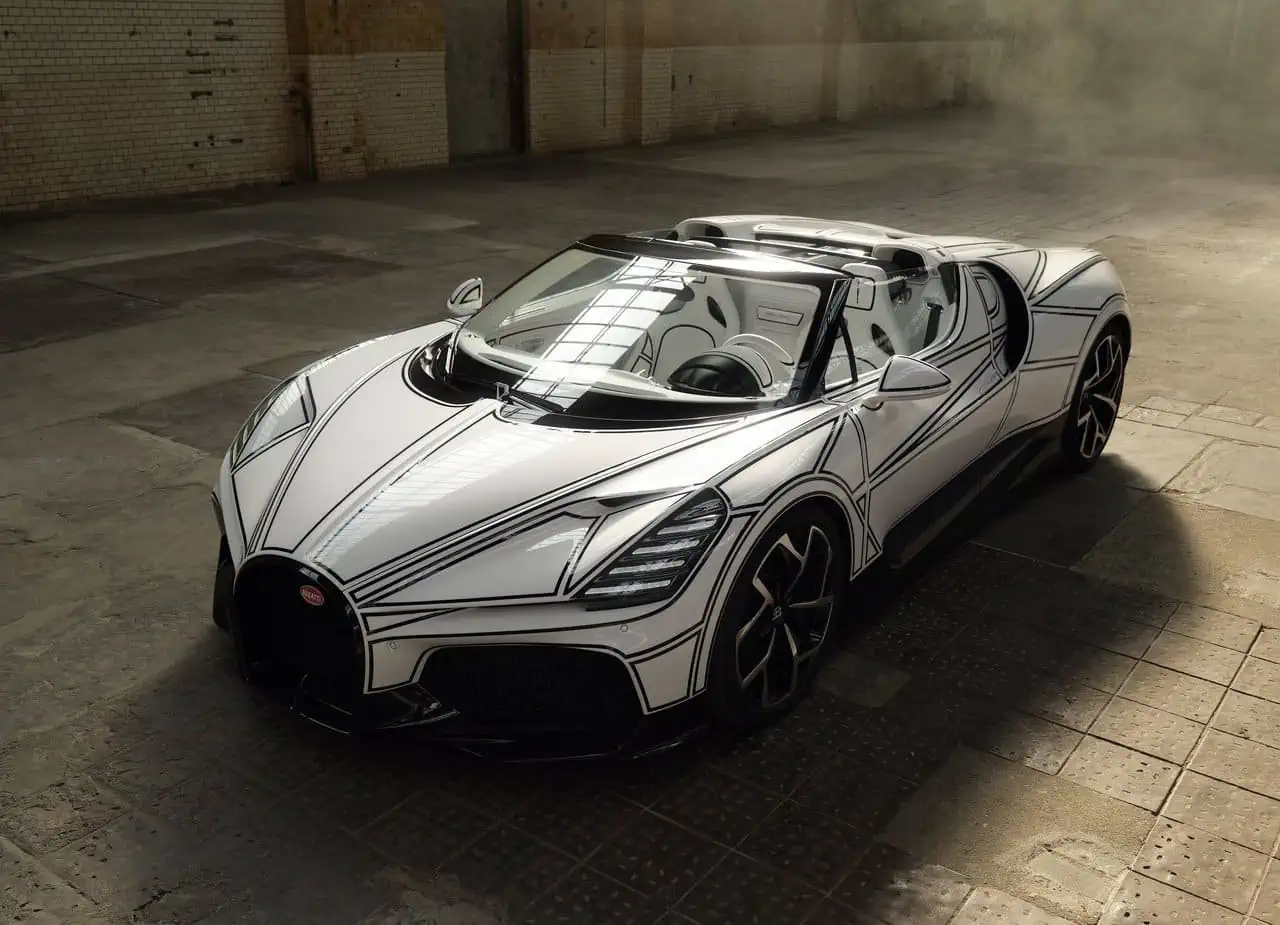
Bugatti has just unveiled the most artistic example in the entire Mistral lineup. It’s called “Blanc Éternel,” and it’s a one-off built in partnership with the German porcelain house KPM Berlin.
This is a Sur Mesure edition based on the production W16 Mistral — the roadster whose 99-unit run already sold out. Mechanically, it’s identical to the standard car; the difference lies entirely in finish and symbolism.
It marks the end of the W16 engine era at Bugatti, as the brand shifts toward the hybrid V16 found in the Tourbillon. Direct rivals in this space include the Koenigsegg Jesko Absolut and the Lamborghini Revuelto, both fighting for the same ultra-wealthy collector base.
There’s no indication in available reporting that this particular example will reach American shores — and since it’s a one-of-one already spoken for by a single buyer, that possibility is essentially off the table.
Quick Facts
| Spec | Details |
|---|---|
| Category | Hypercar roadster |
| Engine | 8.0L quad-turbo W16, gasoline |
| Horsepower | 1,578 hp (~7,050 rpm) |
| Torque | 1,180 lb-ft (2,250–7,000 rpm) |
| Transmission | 7-speed dual-clutch automatic (DSG) |
| Drivetrain | Permanent all-wheel drive (AWD) |
| 0-60 mph | 2.3 seconds |
| Top Speed | 261 mph (standard limit); record of 282 mph |
| Average Fuel Economy | 10.8 mpg combined |
| Range | Estimate based on preliminary data: ~270-280 miles on a 25.6-gallon tank |
| Release Date | Unveiled June 2026 |
Those numbers are impressive on paper, but it’s on the road — or rather, on the track — that this powertrain truly makes its case. Here’s how the design and engineering come together.
A Porcelain Roadster: Bodywork That Reveals Its Own Blueprint
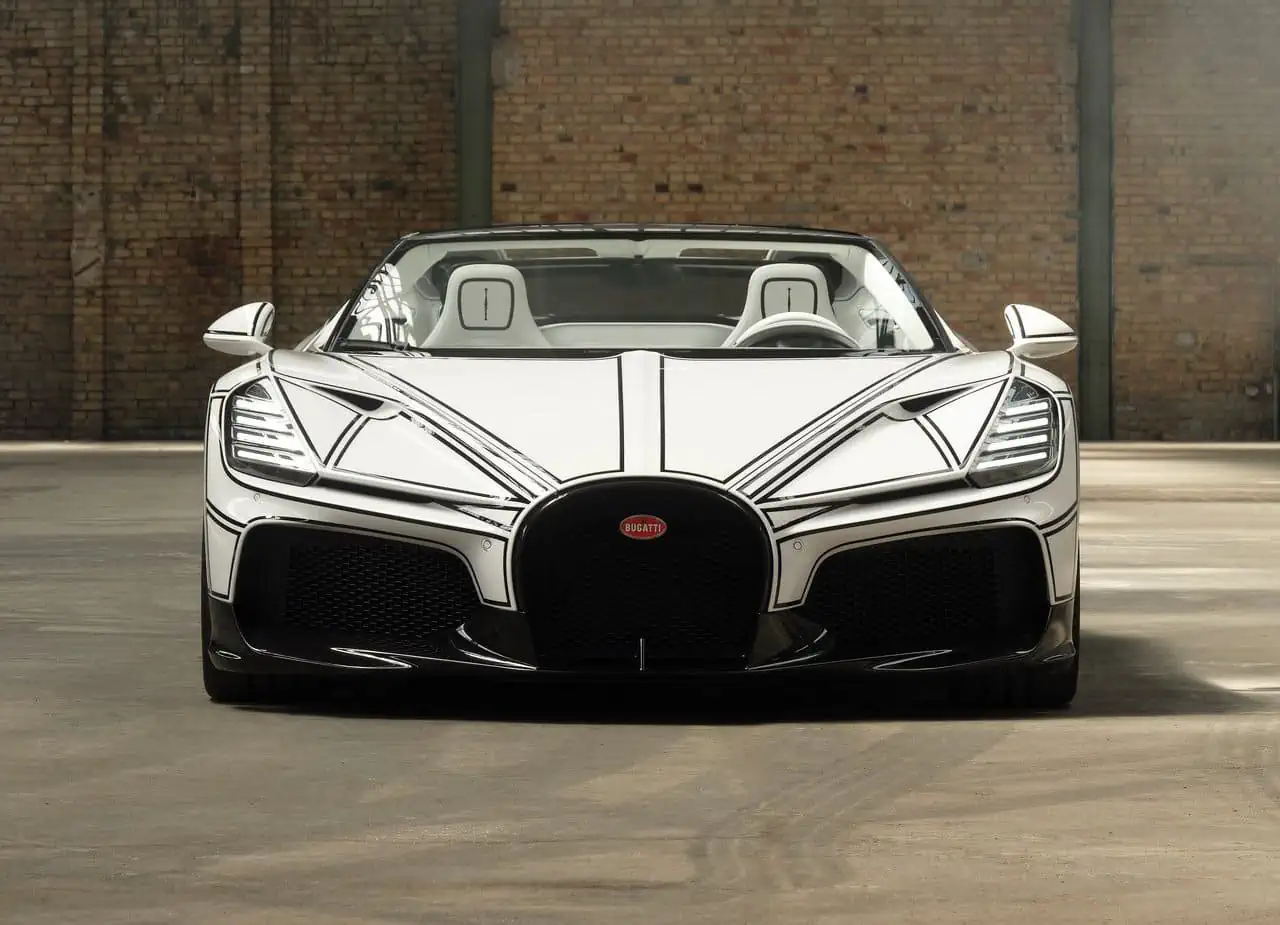
Up front, the Mistral commands attention with an enlarged horseshoe grille and massive intakes, essential for cooling that mid-mounted engine. The LED headlights are sculpted to reduce drag at extreme speeds.
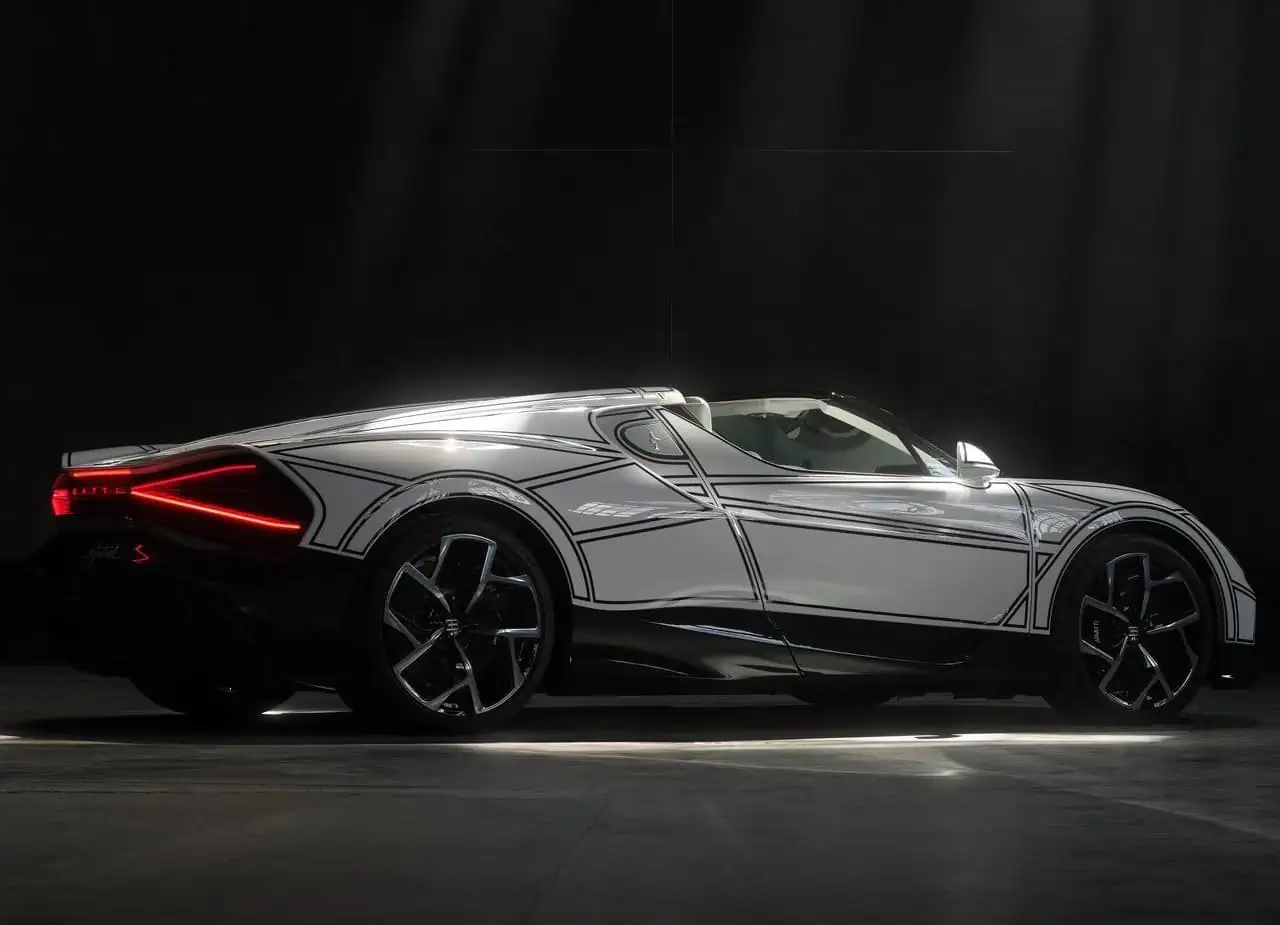
Along the side, the “C-line” arch nods to classics like the Type 57 Roadster Grand Raid, a direct callback to the brand’s history. Around back, the X-shaped taillight signature reinforces Bugatti’s current design language.
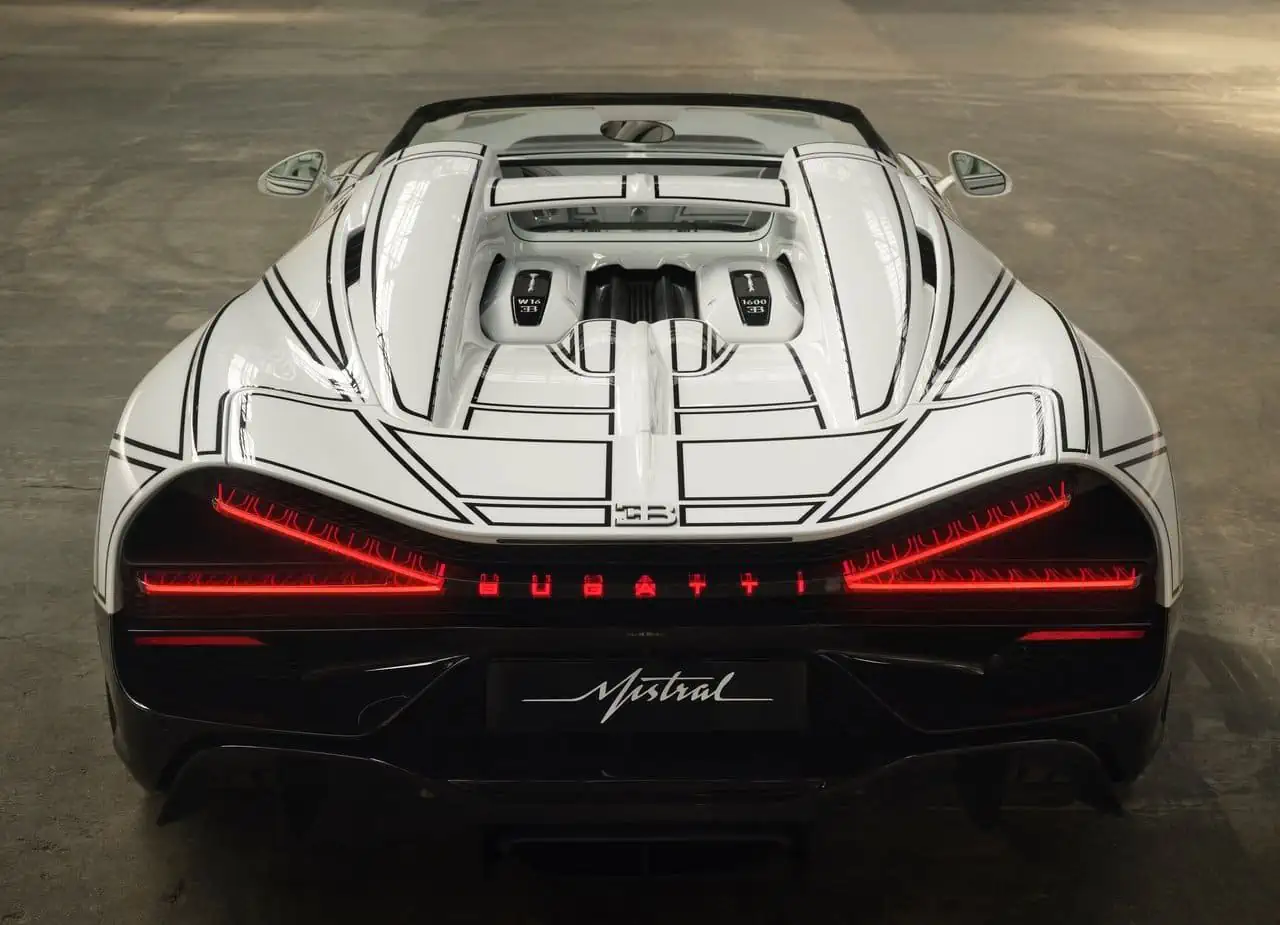
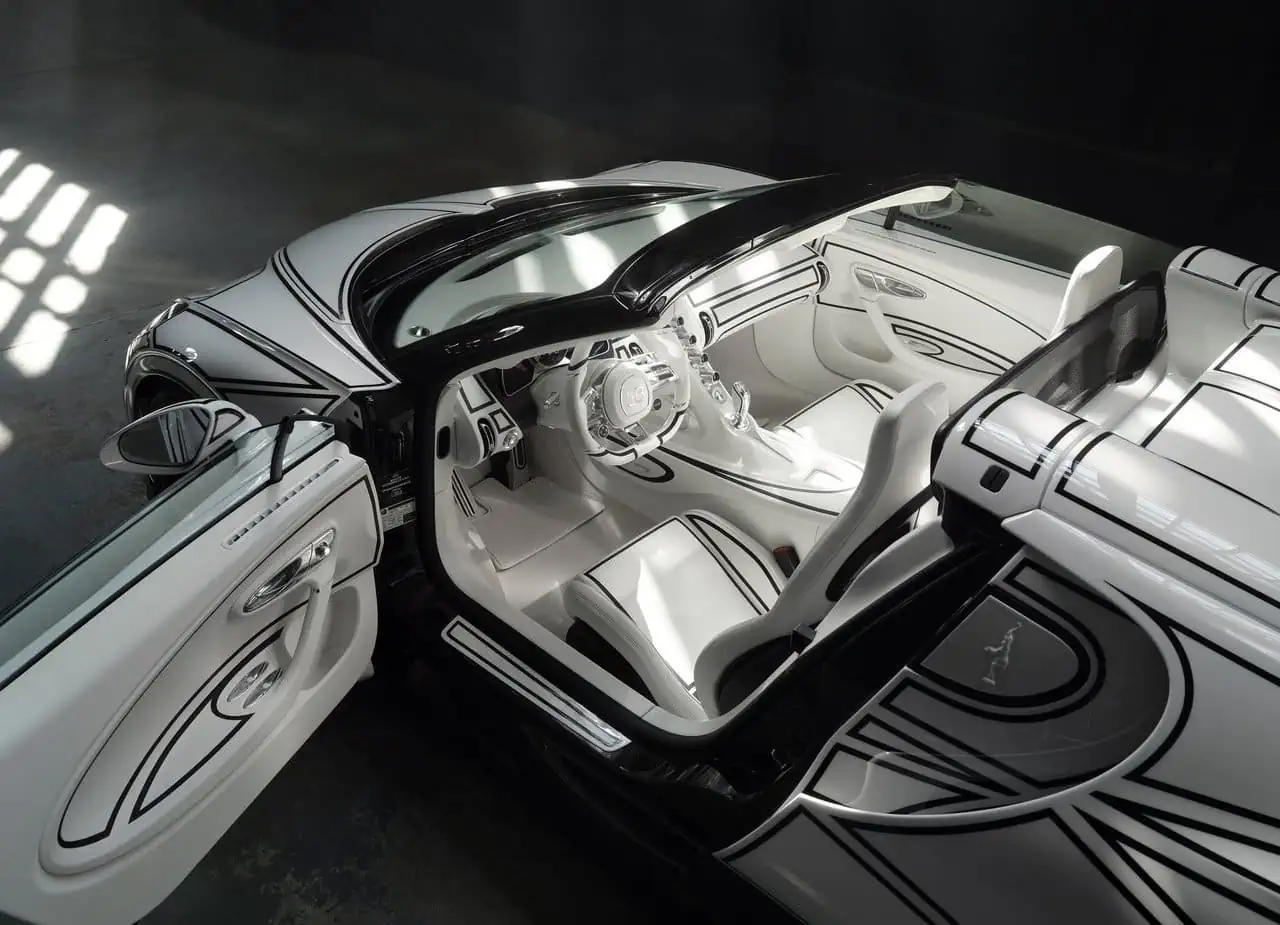
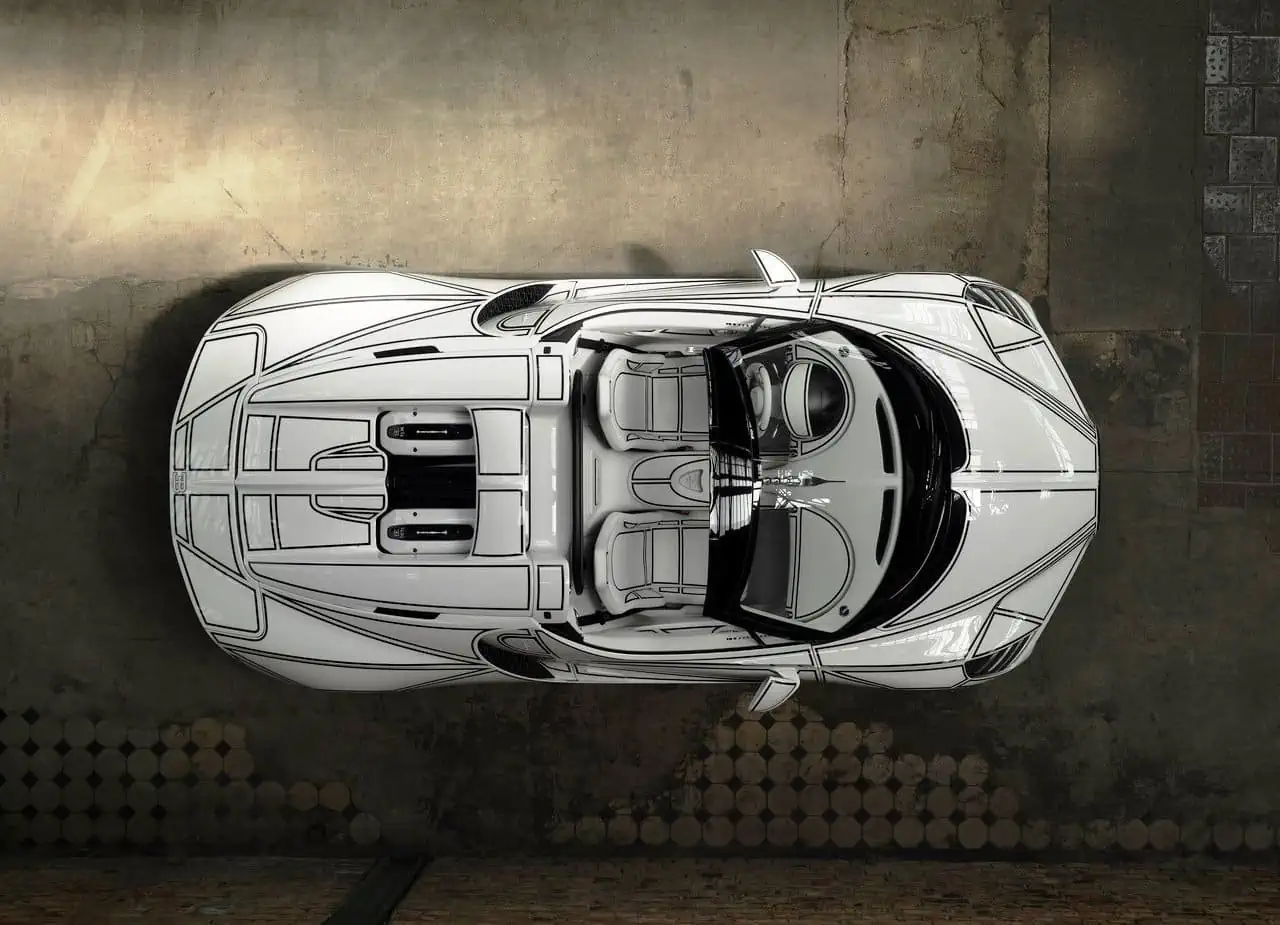
On the “Blanc Éternel,” though, everything gets an extra layer. The white paint is crossed with fine black lines that trace the digital NURBS mesh used to develop the bodywork — as if the car were exposing its own design skeleton.
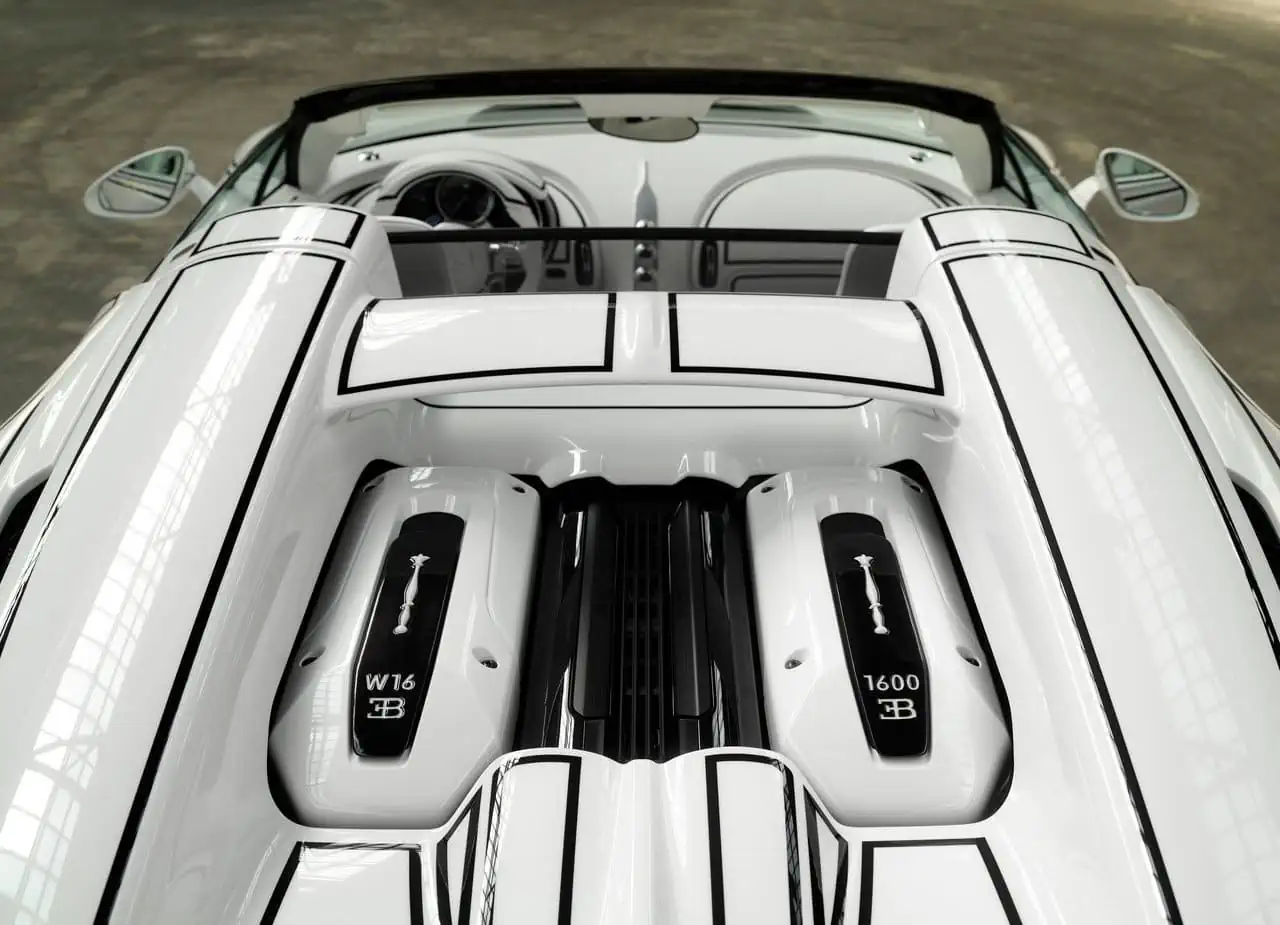
Details like the EB emblem, the fuel and oil caps, and inserts on the engine cover are made of white porcelain, bearing the KPM Berlin scepter mark. It’s a sculptural exercise on wheels, closer to a museum piece than a conventional vehicle.
Hand-Painted Leather: Luxury Turned Into Art Inside the Cabin
The cabin architecture follows Bugatti’s philosophy of extreme craftsmanship, with exposed carbon fiber, machined aluminum, and solid controls — already a hallmark praised across the production lineup.
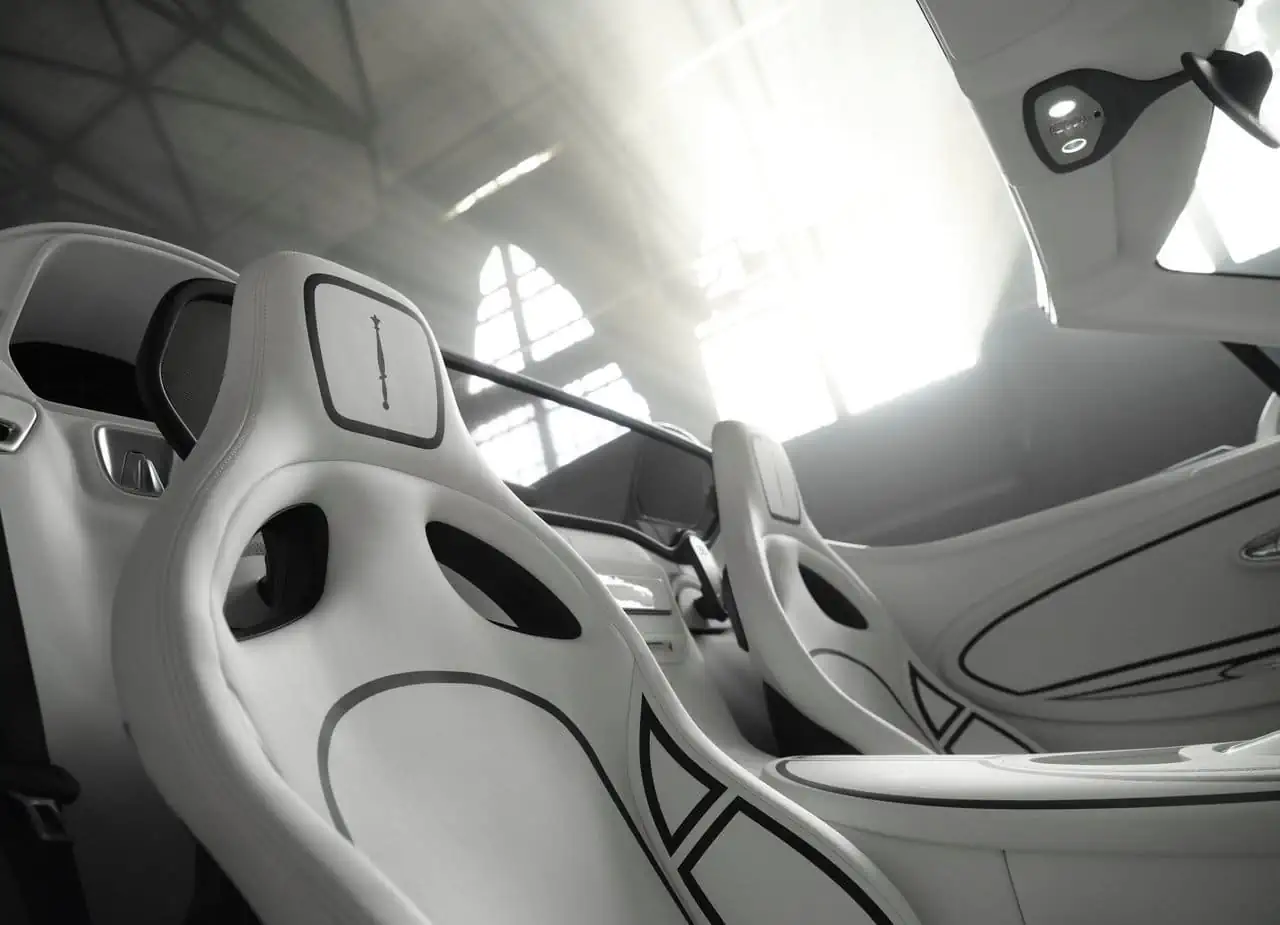
The seats are wrapped in premium leather, and on the “Blanc Éternel,” they carry the same black-line graphic pattern found on the bodywork — hand-painted directly onto the white leather using a process developed specifically by Bugatti.
The finish doesn’t just copy what rivals are doing; it pushes what the brand already did well into near-collector-piece territory.
Screens, Gauges, and What’s Missing on Cargo Space
The instrument cluster combines an analog central tachometer with digital displays for speed and driving modes. The priority here is fast readability at high speed, not a deep menu system.
The infotainment setup is described as minimal, function-first — navigation, audio, and telemetry — without emphasis on features like streaming. Screen resolution and connectivity protocols haven’t been officially disclosed.
On active safety, the car relies on electronic stability control, traction control, and electronically managed dampers. Modern ADAS features like adaptive cruise control aren’t listed in the official spec sheet.
As a two-seat roadster, there’s no back seat, and cargo capacity hasn’t been officially disclosed — expected for this class of car. The cabin’s clear strength is its craftsmanship; its real limitation is near-zero everyday practicality.
Horsepower and Fuel Economy: The Numbers Behind a Retiring W16
The heart of the Mistral is the same 8.0-liter quad-turbo W16 used across the entire lineup — no alternate or hybrid versions exist. Power runs through permanent all-wheel drive with electronically controlled differentials.
That setup produces 1,578 hp at roughly 7,050 rpm and 1,180 lb-ft of torque between 2,250 and 7,000 rpm. In practical terms, that means near-instant throttle response even at triple-digit speeds — thanks in part to a two-stage turbo behavior, where the system shifts from two to four active turbos above 4,500 rpm.
0-60 mph comes in 2.3 seconds, and the official top speed sits at 261 mph in Top Speed mode. One specially configured unit has already topped 282 mph in a record run, making it the fastest roadster in the world.
Efficiency isn’t the point here: combined fuel economy lands at 10.8 mpg. This is clearly a car built around outright performance rather than economy — the 25.6-gallon tank delivers roughly 270 miles of range under normal driving.
Pricing and Ownership: What to Expect From a Car Almost No One Can Buy
Overseas, the production-run W16 Mistral has already sold out all 99 units, with pricing around $5.3 to $6.3 million before taxes. The “Blanc Éternel” goes even further: it’s a one-off, with no official MSRP disclosed.
There’s no formal Bugatti dealer network offering this specific build stateside, and any American ownership would depend on independent import channels. Since this particular example is already spoken for by a single buyer, the odds of it appearing in U.S. garages are essentially nonexistent.
Talking about insurance premiums and maintenance costs here calls for caution: there are no public insurance tables for this model, and Bugatti doesn’t release service pricing. What’s known is that maintenance runs through specialized in-house teams or authorized partners, historically carrying steep costs — but no confirmed dollar figure exists for this car. Traditional financing barely applies in this segment; these sales get negotiated directly with collectors.
On depreciation, industry sources suggest the Mistral behaves more like a collector’s item than a typical depreciating asset, though there isn’t enough public transaction data to back that up with hard numbers. The buyer profile is clear: ultra-high-net-worth collectors, often already owning a Veyron or Chiron, who value automotive art as much as raw performance.
Frequently Asked Questions: What to Know Before Considering This Car
What’s the real-world fuel economy on the Bugatti W16 Mistral?
Testing shows real-world economy close to official ratings under moderate driving, around 10.8 mpg, dropping noticeably under hard use.
Is maintenance expensive on the Mistral?
No confirmed figures exist, but service runs through specialized Bugatti-authorized teams, historically tied to high costs.
Who are the main direct competitors?
The Koenigsegg Jesko Absolut and the Lamborghini Revuelto, alongside multimillion-dollar roadsters from Pagani and Ferrari.
Will more “Blanc Éternel” units be built?
No. It’s a Sur Mesure one-of-one — a single example within the already sold-out Mistral series.
Verdict: Does the “Blanc Éternel” Justify Its Exclusivity?
There’s no cost-benefit question here — this is a purely emotional purchase, driven by status, artistry, and history. Rationally, no number justifies the investment.
It’s not built for anyone chasing practicality, fuel economy, or daily usability. It’s also not the pick for pure acceleration bragging rights — today’s electric hypercars already outrun it off the line.
The “Blanc Éternel” isn’t trying to win a numbers game. It closes out an era with the delicacy of a museum piece and the violence of a W16 engine at its most extreme.
So, does turning a hypercar into a porcelain sculpture make sense to you, or would you rather see Bugatti stick to its raw, no-frills roots? Drop your honest take in the comments below!
Share this article

Por: Danniel Bittencourt
02/07/2026
Related posts