Spectre Black Badge Series II: The Most Expensive Electric Car You Can Buy in 2027
670 HP in near-total silence, 308 miles of EPA-rated range and a sticker price pushing past $550,000. The Black Badge Spectre Series II redefines what an ultra-luxury EV is allowed to be.
Rolls-Royce Spectre Black Badge Series II: The 670-HP Electric Super Coupe That’s Rewriting Ultra-Luxury
The biggest update to Rolls-Royce’s best-selling electric model brings 670 HP, 308 miles of EPA range and a steering wheel button that most owners won’t find for months.
The Spectre Black Badge Series II isn’t a cosmetic refresh. It’s a surgical revision of the two loudest complaints against the first generation: range anxiety and charging speed. And it does all of that while maintaining a cabin silence that embarrasses professional anechoic chambers.
This is a mid-cycle update — referred to internally by the BMW Group as a Life Cycle Impulse. The closest indirect competitors in the US market are the Bentley Continental GT Speed and the Lucid Air Sapphire. But neither one operates in quite the same philosophical universe as a Rolls-Royce.
In the American market, the Spectre Series II arrives with native NACS charging compatibility, giving owners unrestricted access to the Tesla Supercharger network — a meaningful upgrade over the CCS1 dependency of the first generation.
Spectre Black Badge Series II — Quick Specs
| Spec | Details |
|---|---|
| Category | Ultra-Luxury Electric Super Coupe |
| Powertrain | Dual Separately Excited Synchronous Motors (SSM) |
| Output | 670 HP (Infinity mode active) |
| Torque | 811 lb-ft (Spirited mode) |
| Transmission | Single-speed direct drive |
| Drive | All-Wheel Drive (AWD), on-demand |
| 0–60 mph | 4.1 seconds (3.7 s in independent instrumented tests) |
| Top Speed | 155 mph (electronically governed) |
| Efficiency | 3.1 miles/kWh (approx. 117 MPGe) |
| Range | Up to 308 miles per full charge (EPA est.) |
| On Sale | Model Year 2027 |
The numbers look impressive in a table. What happens when you translate them to real American roads — and to the financial reality of US ownership — is where the story gets genuinely complicated.
A Monument in Motion: How This British Super Coupe Commands Every Room It Enters
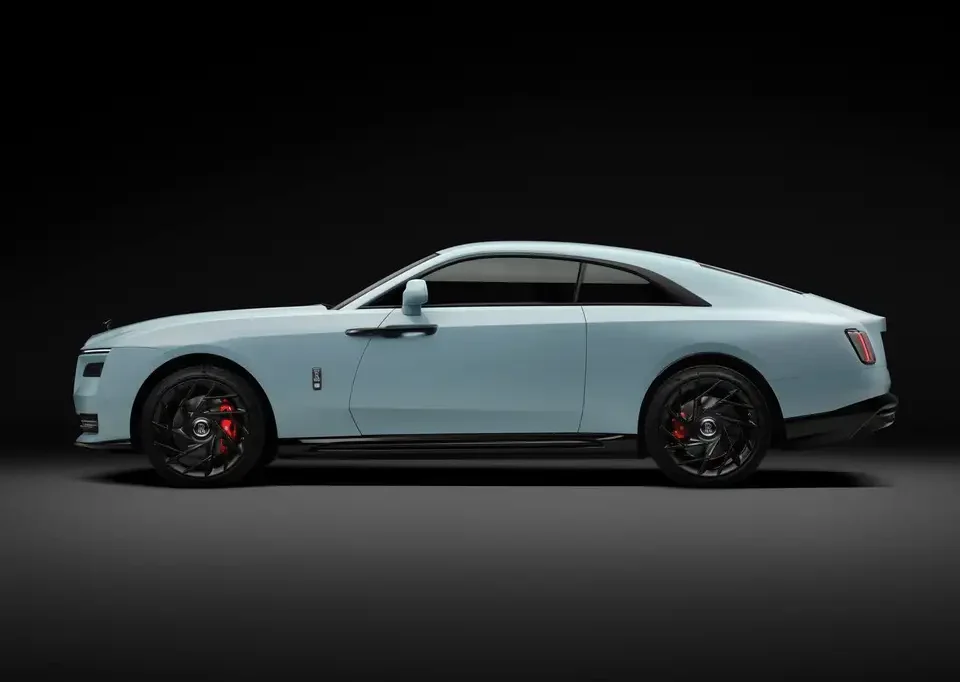
At 215.6 inches long, the Spectre is literally larger than a full-size pickup truck. That registers the moment you walk around it for the first time.
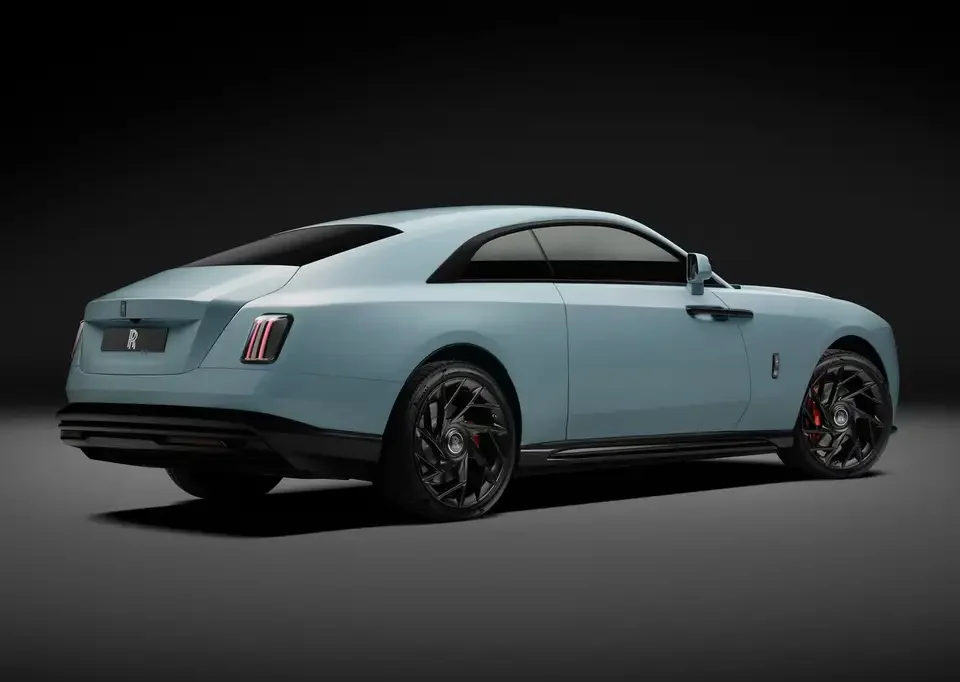
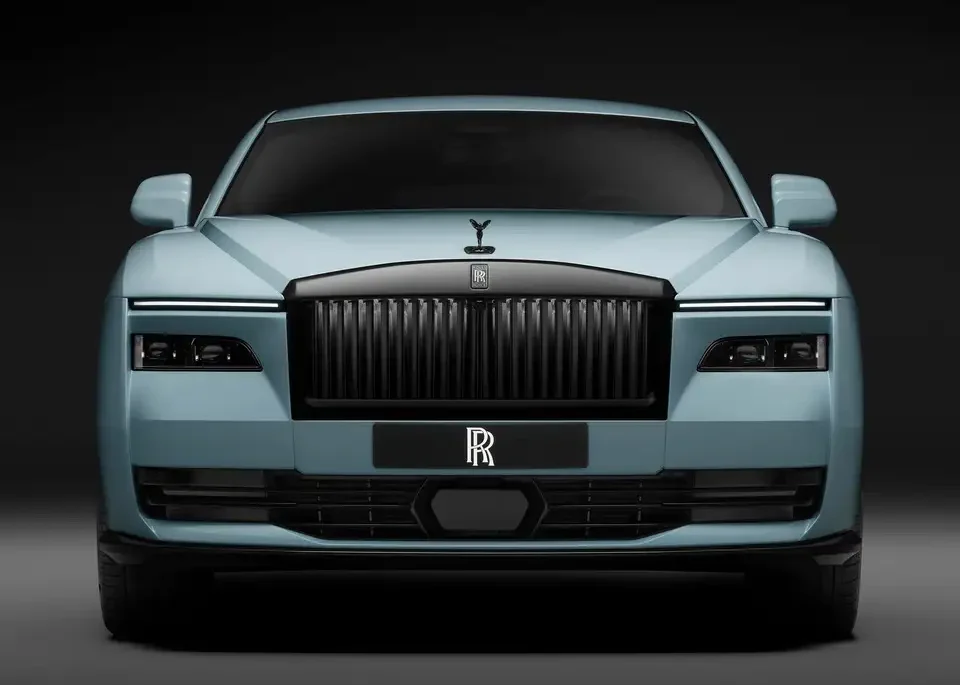
The front end anchors on the Pantheon grille — the widest ever fitted to a modern Rolls-Royce — with illuminated vanes engineered as much for aerodynamic efficiency as for visual drama. The Spirit of Ecstasy hood ornament was reshaped in wind tunnel testing to optimize the drag coefficient without compromising its iconic silhouette.
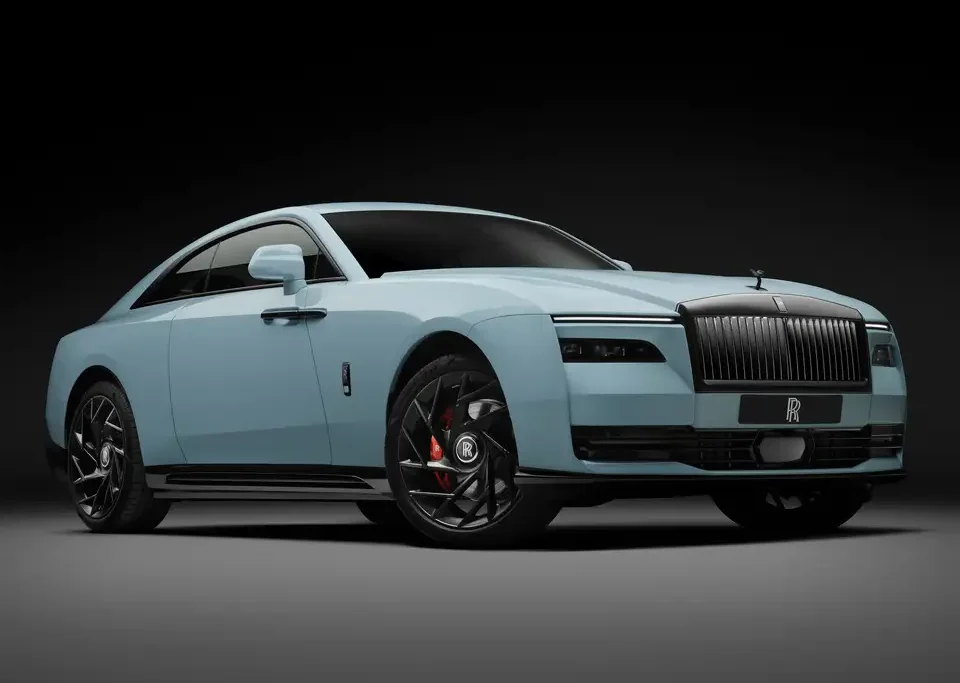
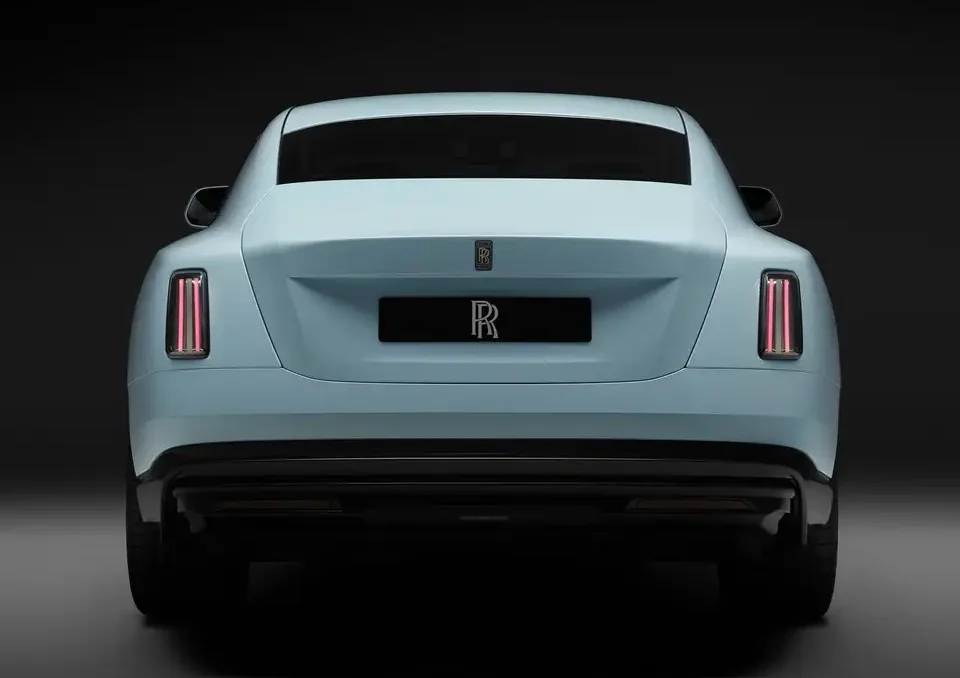
On the Black Badge, the Iced Black Exterior Detailing package replaces the traditional high-gloss chrome with a satin matte lacquer finish. The grille surround, window moldings, door handles and even the Spirit of Ecstasy itself go dark. The one deliberate exception: the vertical inner vanes of the Pantheon grille stay in reflective chrome, ensuring instant brand recognition even in low light.
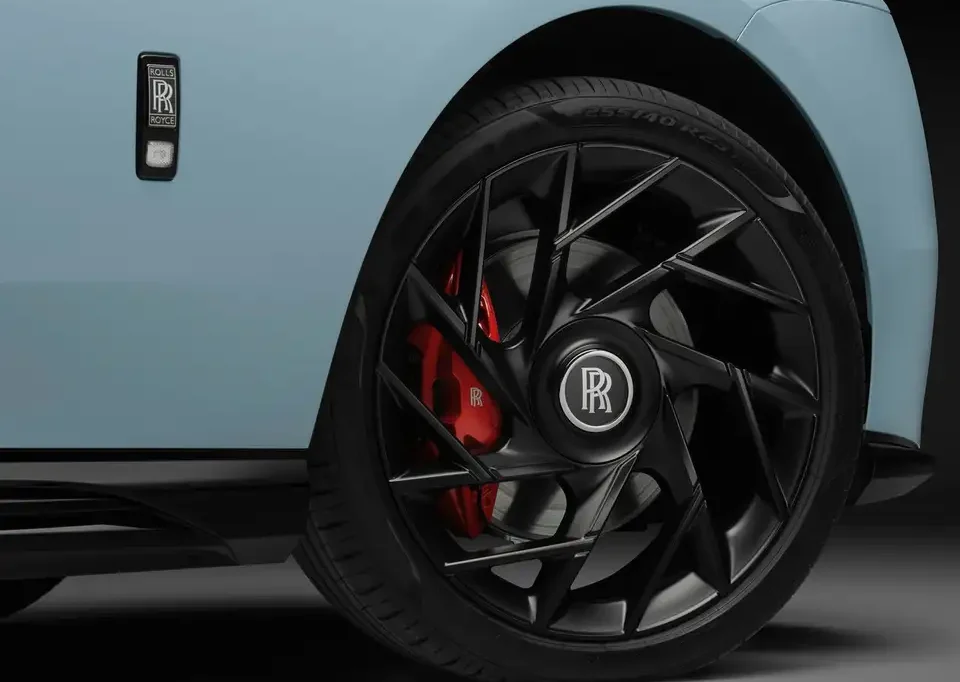
The new Ethereal Blue paint was developed specifically to contrast with the Iced Black trim and to emphasize the vast flat surfaces of the coach doors. On the flanks, new 23-inch forged wheels with edge radii of just 0.1 inches deliver a diamond-faceted optical clarity that takes up to six hours of hand polishing per unit to achieve.
The fastback silhouette didn’t change. It didn’t need to.
Handcrafted at Industrial Scale: The Cabin That Takes 25 Hours Just to Weave
Stepping into the Spectre is confronting a paradox: everything feels simultaneously human and impossible to produce by human hands.
The instrument panel unifies the driver and passenger displays into a single uninterrupted glass band. On the passenger side, the Illuminated Fascia sits dormant until the motors are activated — at which point 8,108 individual LEDs come to life displaying cascading patterns that evoke morning mist over England’s South Downs. The central clock takes its design language from classic British aviation instrument dials and shares the panel with a Clock Cabinet Vitrine — a miniature illuminated display housing a precision-machined stainless steel Spirit of Ecstasy figure.
Every interaction button is machined from cooled metal. No textured plastic, no soft-touch simulation. The tactile quality is a deliberate part of the ownership proposition.
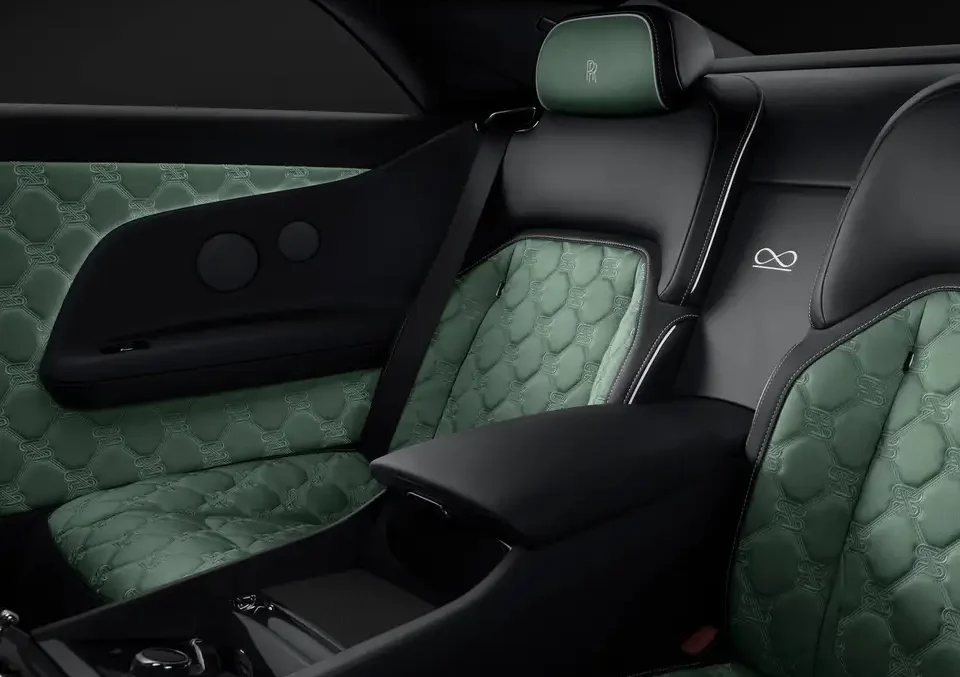
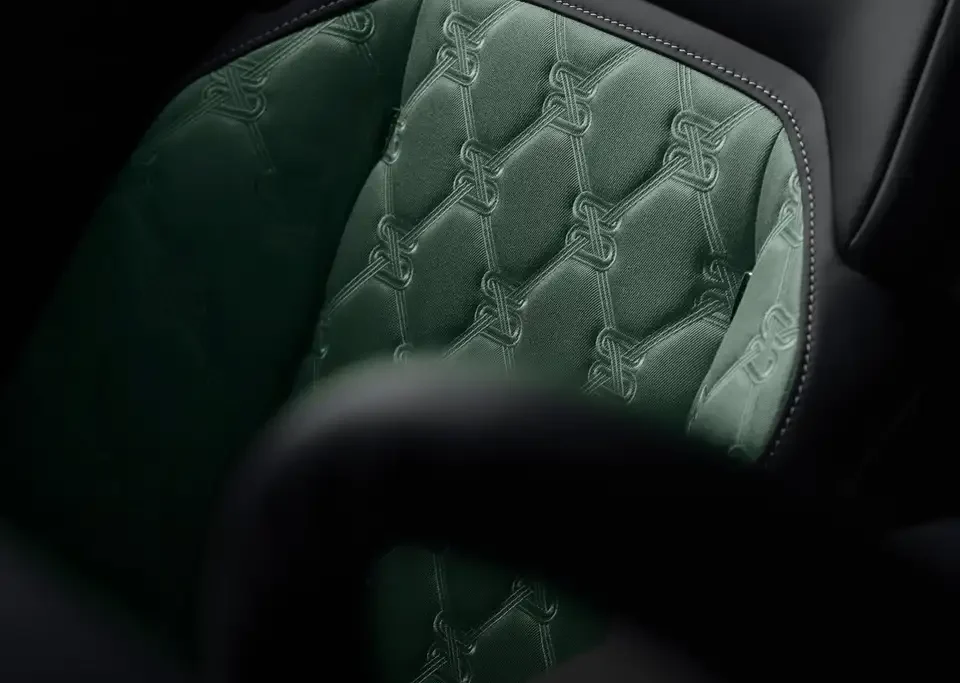
The seats introduce the new Duality Twill upholstery — a sustainable rayon fabric derived from bamboo, requiring 2.6 million individual embroidery stitches and 11 miles of mercerized cotton thread per complete interior. Available in Black, Chocolate, Lilac and the new Sage Green, it represents a significant philosophical shift away from the brand’s traditional highland-altitude bovine leather.
Screens, Safety Tech and the Space Tax That a Fastback Always Charges
The SPIRIT architecture governs the entire digital ecosystem. Beyond the fully integrated Apple CarPlay and Android Auto, it communicates bidirectionally with the Whispers app — a closed, verified-owners-only social and concierge network — enabling remote climate preconditioning and direct destination input to the native navigation system.
The Level 2 ADAS suite covers Adaptive Cruise Control, Autonomous Emergency Braking, active lane centering and lane-change assist with autonomous steering input. The calibration philosophy prioritizes whispered alerts and organic vibration feedback — no sharp audio alarms interrupting the cabin composure.
The cabin’s undisputed strength is the depth of its craftsmanship: the Placed Perforation leather work — 78,138 individual perforations in three micro-diameters forming lunar shadow patterns — and the Starlight Doors with nearly 5,000 fiber optic points deliver an experience with no direct competitor.
The real limitation is the trunk: just 13.4 cubic feet of usable cargo space. Less than a Honda Civic. And there’s no frunk — the entire front hood is occupied by thermal management systems and HVAC hardware.
Under the Aluminum Floor: What 811 lb-ft Actually Feels Like at Highway Speed
Two Separately Excited Synchronous Motors — one per axle — fed by a Gen6 cylindrical cell pack with 112.4 kWh of usable capacity. That’s the propulsion equation of the Black Badge Spectre Series II.
In standard configuration, the car delivers 592 HP and 749 lb-ft. That’s enough for the 4.5-second 0–60 mph run of the standard Spectre.
On the Black Badge, there’s a button marked “∞” on the steering wheel. Press it and Infinity mode unlocks 670 HP with sharpened throttle response and weighted steering. Spirited mode goes further: it vectorizes the magnetic drag forces across both rotors and drops 811 lb-ft instantaneously. The official 0–60 mph claim is 4.1 seconds. In independent instrumented testing by Car and Driver, 3.7 seconds has already been recorded.
But the brutality of the numbers contrasts sharply with the sensation from the driver’s seat. The torque delivery reads like a maritime advance: immense, relentless and strangely smooth in the initial push. There’s no nervous lurch off the line. It’s violence wearing a cashmere glove.
The EPA-rated efficiency lands at 3.1 miles/kWh — approximately 117 MPGe — with a maximum range of 308 miles per full charge. Connected to a DC fast charger at the 195 kW peak absorption limit, the 10–80% state-of-charge window closes in 28 to 29 minutes. With native NACS compatibility in the US, that means full access to the Tesla Supercharger network — a genuine quality-of-life upgrade over the original Spectre’s CCS1 dependency. The 400V architecture, however, remains the most technically criticized decision in the entire package.
MSRP, Insurance and Maintenance: The True Cost of Owning the Spectre Black Badge in America
The Rolls-Royce Spectre Series II carries a base MSRP of approximately $397,750. The Black Badge variant starts between $467,750 and $470,000. In practice, no Spectre leaves Goodwood without meaningful Bespoke specification — Ethereal Blue paint, Starlight Doors, Duality Twill interiors and Iced Black detailing consistently push real transaction prices above $500,000 to $550,000 in the American market.
Maintenance costs tell a more nuanced story than the sticker price suggests. Without a combustion engine, there are no turbochargers to rebuild, no eight-speed automatic fluid changes and no thermally stressed components to replace on a fixed schedule. Routine service concentrates on high-voltage cooling systems, Planar suspension calibration and ADAS camera alignment. The financial exposure reverses on the cosmetic and structural side: any damage to the Iced Black forged wheels or the Duality Twill cabin requires climate-controlled parts shipments directly from England. Structural repairs to the Architecture of Luxury aluminum spaceframe routinely exceed six figures before labor.
Insurance premiums for the Spectre sit entirely outside standard carrier actuarial tables. Because the battery pack replacement cost and handcrafted aluminum bodywork trigger total-loss thresholds at collision speeds that would be minor incidents in a mainstream vehicle, underwriting is handled exclusively by specialty wealth management insurers. Annual premiums in the US market are not publicly benchmarked, but industry analysts consistently describe them as significant multiples of any production sedan policy.
Financing is technically available but rarely the transaction structure of choice. The documented buyer profile — averaging seven to twelve vehicles in a private collection — typically routes purchase through private banking.
The case for buying at launch is financially defensible within the segment’s own logic. Global allocation waitlists of 15 to 18 months protect near-term resale values and generate measurable premiums for immediate-delivery units. The medium-term risk is structural: as 800V and emerging 1,200V EV architectures become the segment baseline within the next product cycle, the 400V foundation of the Series II may accelerate secondary-market depreciation more aggressively than historical combustion-era Rolls-Royce models ever experienced.
What to Know Before You Place a Bespoke Order
What is the real-world range of the Spectre Series II in the US?
The EPA-certified range is 308 miles per full charge — a roughly 16% improvement over the first-generation Spectre.
Are maintenance costs high on the electric Spectre?
Powertrain maintenance is significantly lower than a V12 Cullinan. The financial risk concentrates in cosmetic and structural repairs, which require Goodwood-sourced parts and specialist labor.
Who are the Spectre Black Badge’s closest competitors in the US market?
The Spectre operates largely without a direct rival. Indirect competitors include the Bentley Continental GT Speed and the Lucid Air Sapphire, but the positioning gap between them and a Rolls-Royce is more philosophical than technical.
How different is the Black Badge to drive compared to the standard Spectre?
Substantially. Infinity mode adds 78 HP over the standard car, and Spirited mode delivers 811 lb-ft with a calibrated chassis response that’s meaningfully sharper — while the Magic Carpet Ride suspension character remains intact.
Verdict: Does the Spectre Black Badge Justify Nearly Half a Million Dollars?
The Black Badge Spectre Series II is an emotional purchase that arrives supported by a genuinely strong technical argument.
For drivers: the NVH refinement, the 308-mile EPA range and the torque delivery are class-leading without qualification. For investors: the 400V architecture risk is real, documented and should factor into any five-year ownership calculation.
This car is not right for anyone who regularly drives long highway distances without pre-planned charging stops, anyone needing practical cargo capacity or anyone applying conventional cost-benefit logic to the transaction.
The Spectre Black Badge Series II doesn’t compete on rational terms. It competes by making rationality feel irrelevant.
Do you think a $470,000 base price for an electric coupe with 13.4 cubic feet of trunk space is Rolls-Royce genius — or calculated arrogance? Drop your honest take in the comments below.
Share this article

Por: Danniel Bittencourt
03/06/2026
Related posts