Kia EV2: Everything You Need to Know About the Most Affordable Kia EV
The Kia EV2 promises 281 miles of range, a cabin that shames larger cars and a price that puts rival EVs on notice. Does it actually deliver?
Kia EV2: The Affordable Electric SUV That’s Rewriting the Rules of Entry-Level EVs
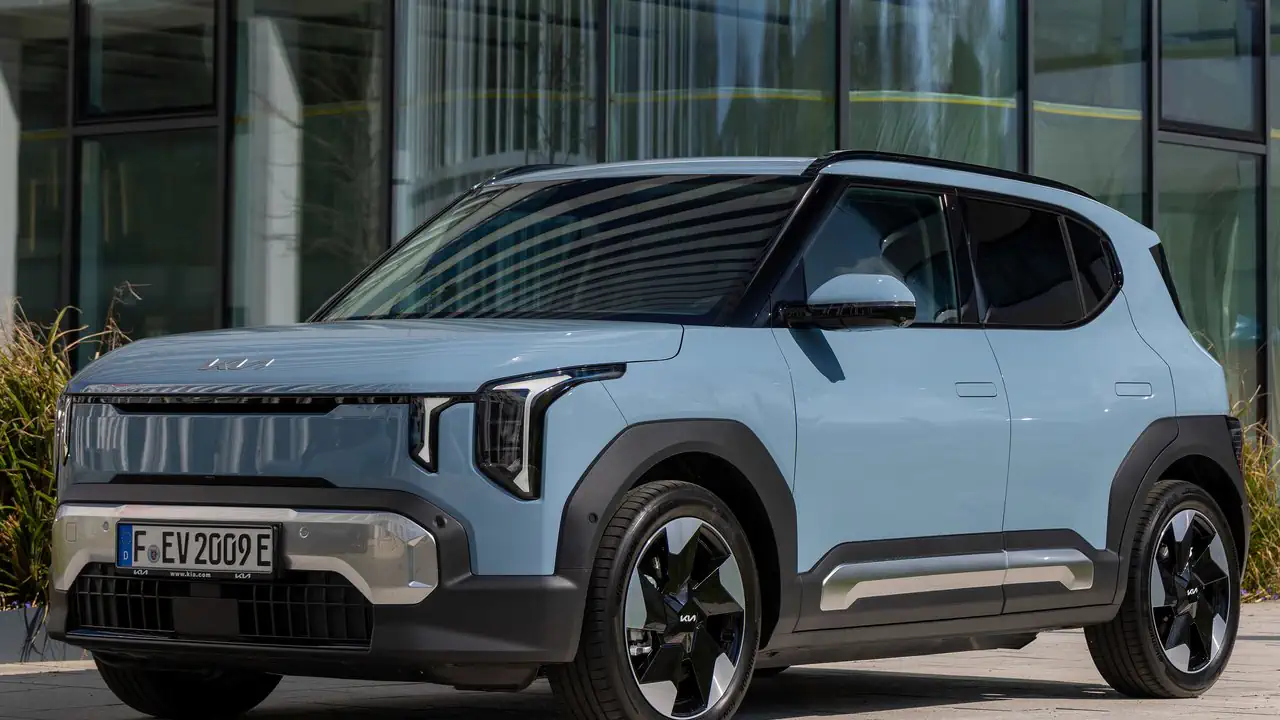
The Kia EV2 made its global debut at the Brussels Motor Show in January 2026 with a straightforward proposition: deliver over 280 miles of real-world range in a compact SUV at a price no European rival could match.
It’s the sixth model in Kia’s dedicated EV lineup and the most accessible one yet. The EV2 was built for buyers who want to make the switch to electric without sacrificing interior space, technology or everyday practicality.
Its closest competitors in Europe are the Volkswagen ID. Polo and the Renault 5. Kia has confirmed the EV2 will not be sold in the United States, citing American consumer preference for larger SUVs and the current tariff environment as the primary reasons.
Quick Specs
| Spec | Details |
|---|---|
| Category | Subcompact Electric SUV (B-Segment) |
| Powertrain | Front-mounted permanent magnet synchronous motor (PMSM), FWD |
| Horsepower | 147 hp / 108 kW (LFP battery) or 135 hp / 99.5 kW (NMC battery) |
| Torque | 184 lb-ft — both versions |
| Transmission | Single-speed reduction gearbox |
| Drive | Front-wheel drive (FWD) |
| 0–60 mph | ~8.2 sec (LFP) / ~9.5 sec (NMC) |
| Top Speed | 100 mph |
| Efficiency | ~4.1 mi/kWh (combined) |
| Range | 197 miles WLTP (42.2 kWh LFP) / 281 miles WLTP (61.0 kWh NMC) |
| Launch Date | January 2026 (Europe) — U.S.: Not offered |
The numbers tell part of the story. But what really separates the EV2 from the competition reveals itself the moment you open the door and climb in.
The Compact Crossover That Looks Smaller Than It Actually Is
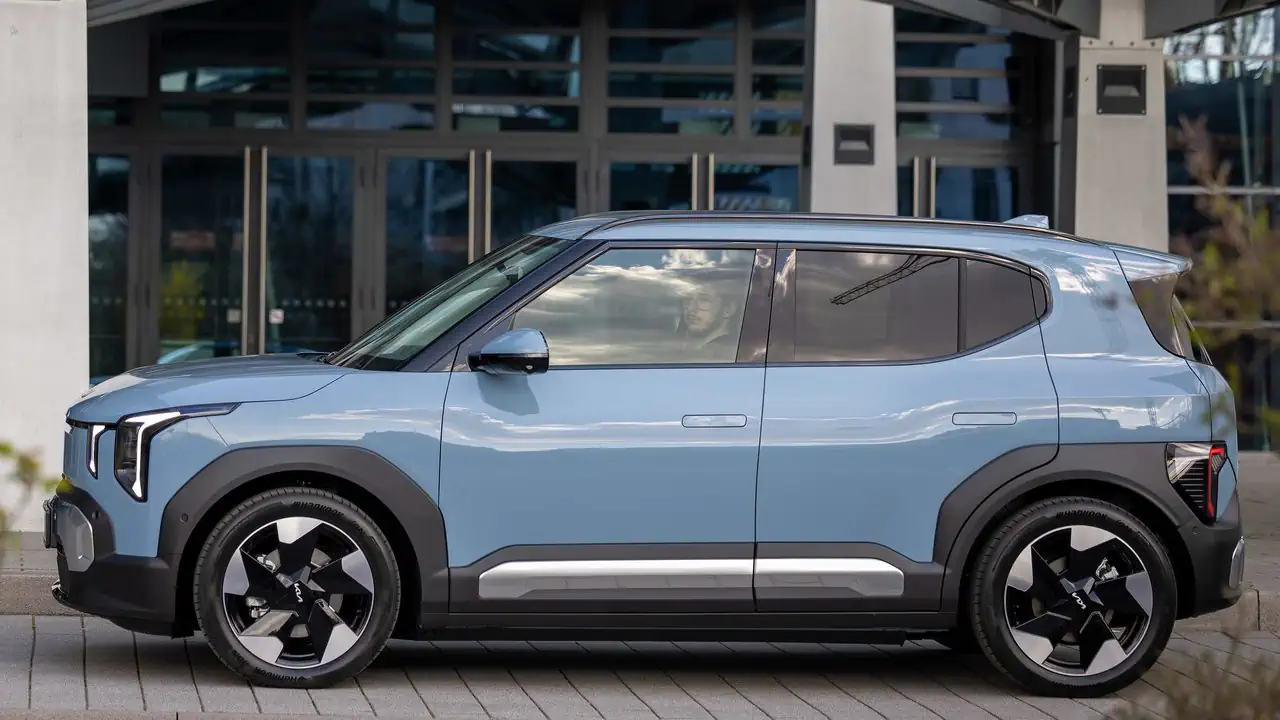
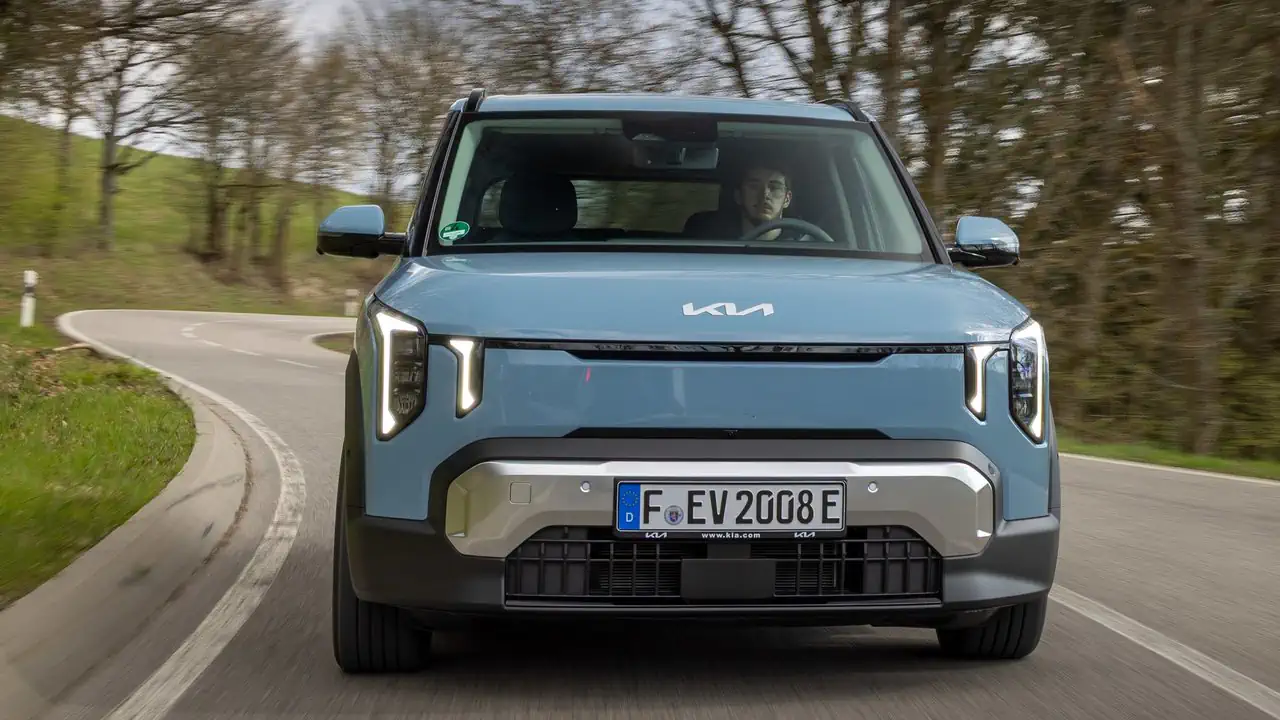
At 159.8 inches long, the EV2 is a genuinely compact machine. From the outside, it reads like a city car, with a tall rectangular silhouette engineered to maximize interior volume without pushing the footprint beyond what narrow European and urban streets can handle.
Up front, the EV2 carries Kia’s “Star Map” light signature, featuring vertical DRL elements that trace back directly to the EV9 flagship. It’s a deliberate move that ties the entry-level model to the same visual family as the brand’s more expensive offerings.
Along the sides, flared wheel arches and a perfectly level beltline give the body a planted, confident look. Wheel sizes range from 16 to 19 inches depending on trim, with the 19-inch option exclusive to the GT-Line.
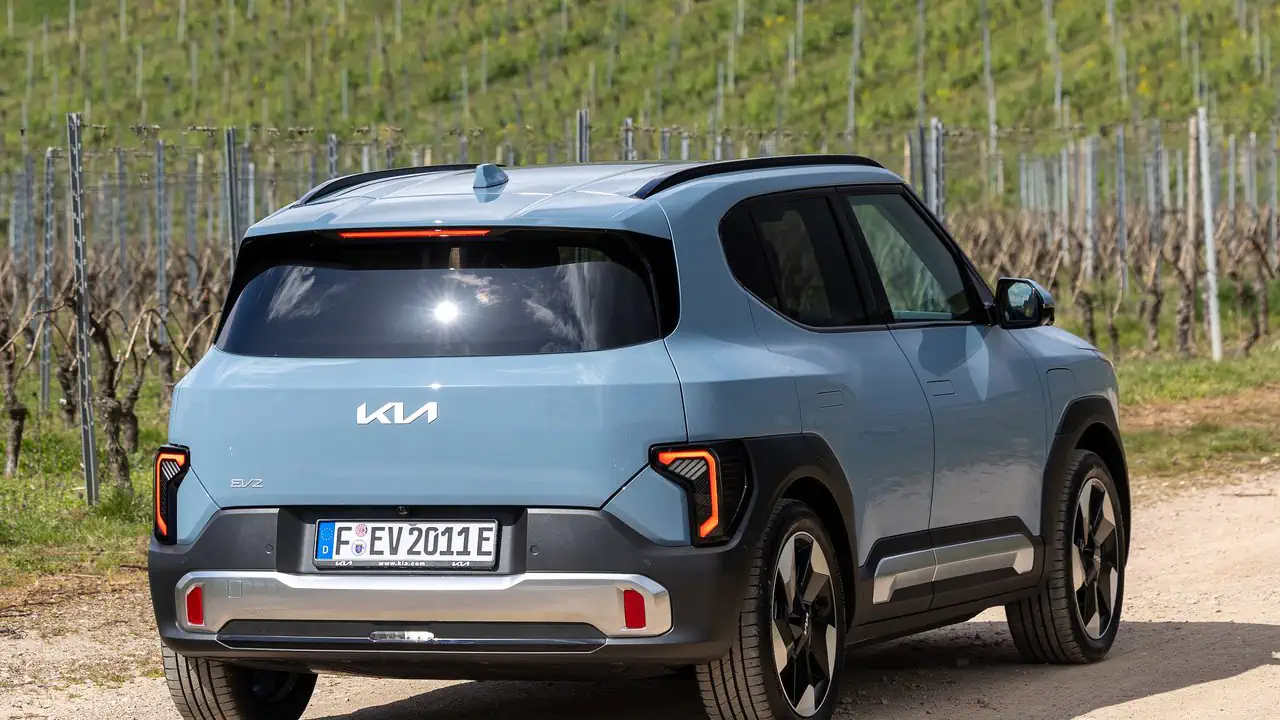
Out back, the taillights are pushed to the outer edges of the body, a trick that makes the 70.9-inch-wide car appear broader than it is. The rear bumper is clean and uncluttered, consistent with the EV-only platform underneath.
The drag coefficient of 0.29 comes from flat underbody panels and carefully shaped bumper corners. It’s invisible engineering that you’ll never see but will notice at every charging stop.
The GT-Line trim swaps the black plastic exterior trim for body-colored pieces with gloss black accents. The result reads as refined rather than sporty, a deliberate choice for a car aimed at urban commuters.
The Interior Nobody Expected From a Car This Size
The biggest surprise about the EV2 has nothing to do with its motor. It’s the cabin.
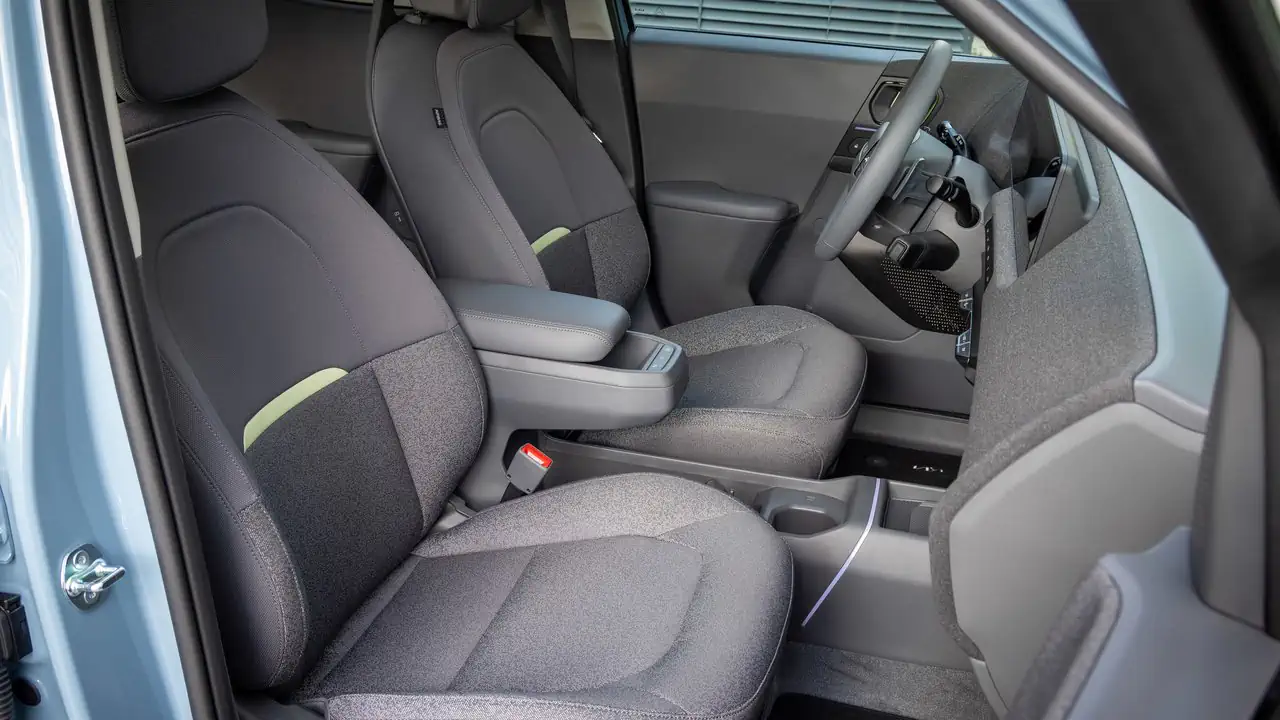
The completely flat floor — a direct result of building on a native EV platform rather than adapting an ICE architecture — transforms the interior into what Kia calls the “Picnic Box.” The shift-by-wire selector moves to the steering column, freeing up the center console for cupholders, wireless charging and storage cubbies.
The dashboard uses recycled PET fabric textures and Bio-PU foam upholstery throughout, steering clear of the hard, shiny plastics that cheapen the look of most entry-level cars. The overall feel is closer to a compact living space than a budget commuter.
The front seats offer better lateral support and material quality than the price point suggests, holding up well during long daily commutes.
Three Screens, Physical Buttons and Up to 37.7 Inches of Rear Legroom
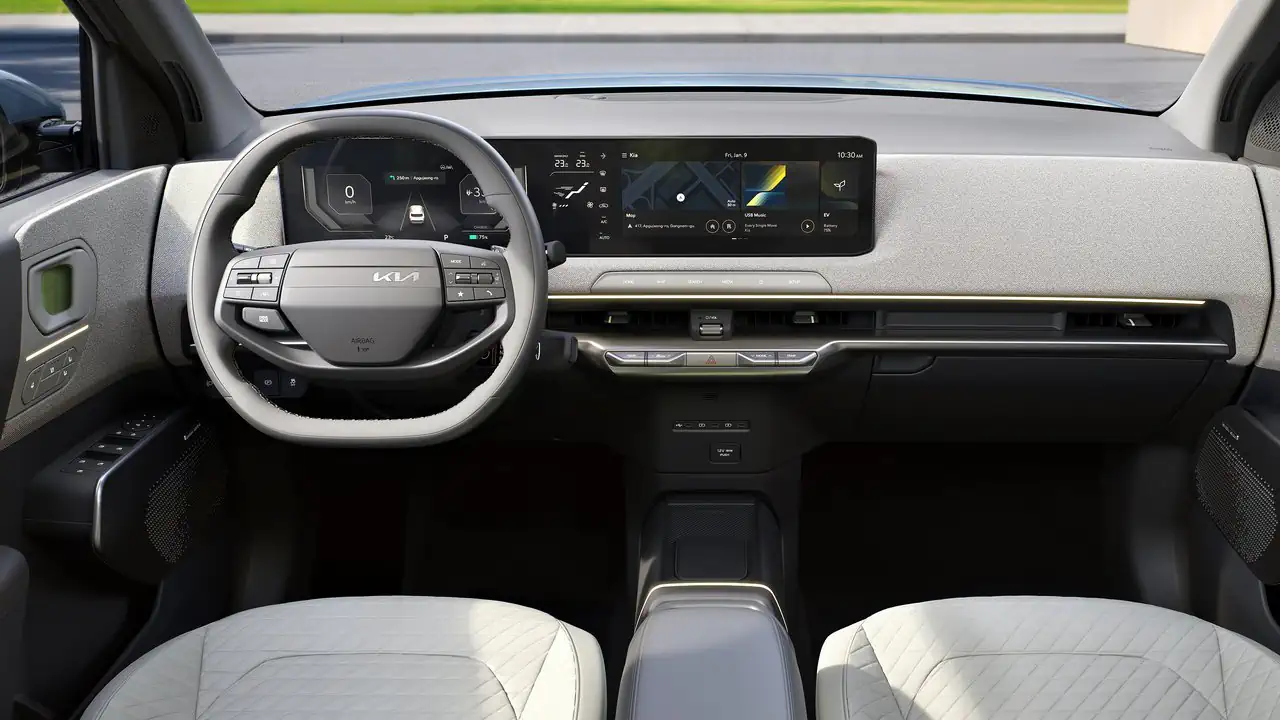
The 12.3-inch digital instrument cluster and 12.3-inch touchscreen infotainment display share a single floating panel, joined by a dedicated 5.3-inch climate control screen. That third screen is a key detail: temperature adjustments never require digging through menus, which keeps eyes on the road where they belong.
Physical climate control buttons were retained, a decision that European automotive press widely praised during the launch period. It sounds minor until you’ve spent time in a car where everything lives three taps deep.
The ccNC system supports over-the-air software updates, and the “Kia Upgrades” function unlocks additional features post-purchase through a software-as-a-service model. Digital Key 2.0 enables NFC and Bluetooth-based entry via smartphones and smartwatches.
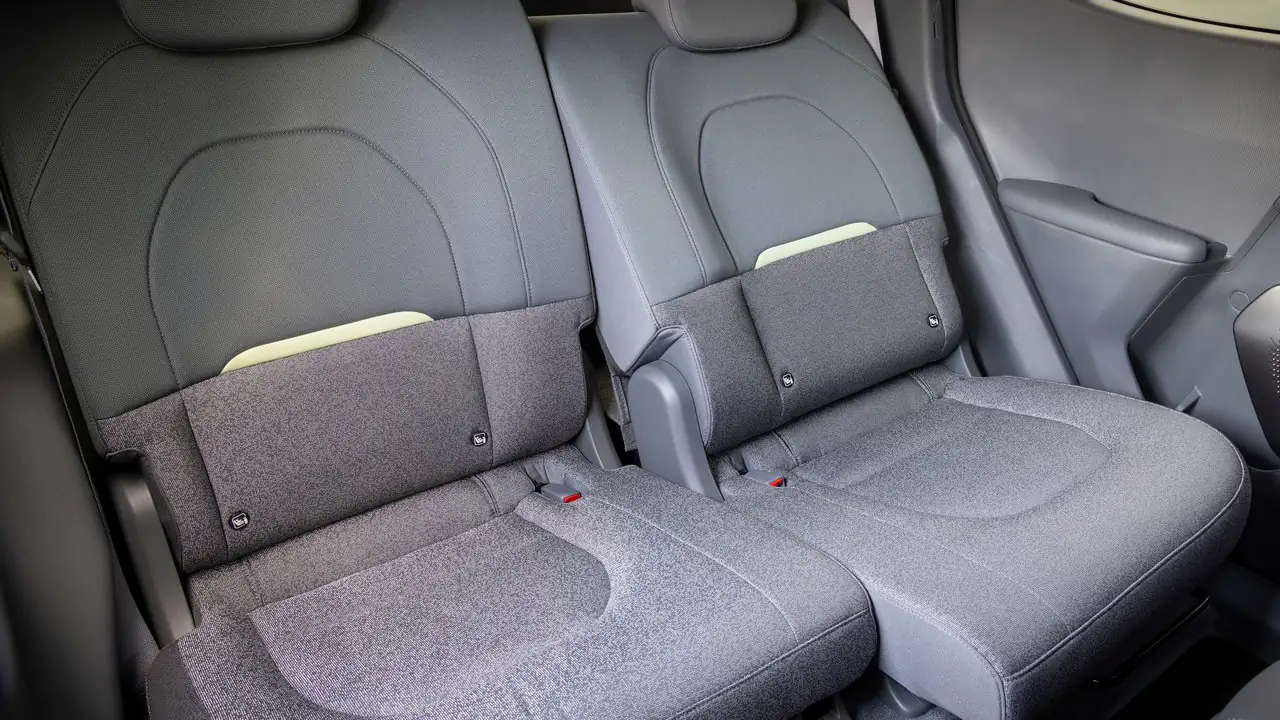
In the rear, the available four-seat configuration is where things get genuinely impressive. With individually sliding rear seats pushed fully back, rear legroom stretches to 37.7 inches, a figure that competes directly with midsize executive sedans. In the standard five-seat layout, rear space is competitive but not exceptional.
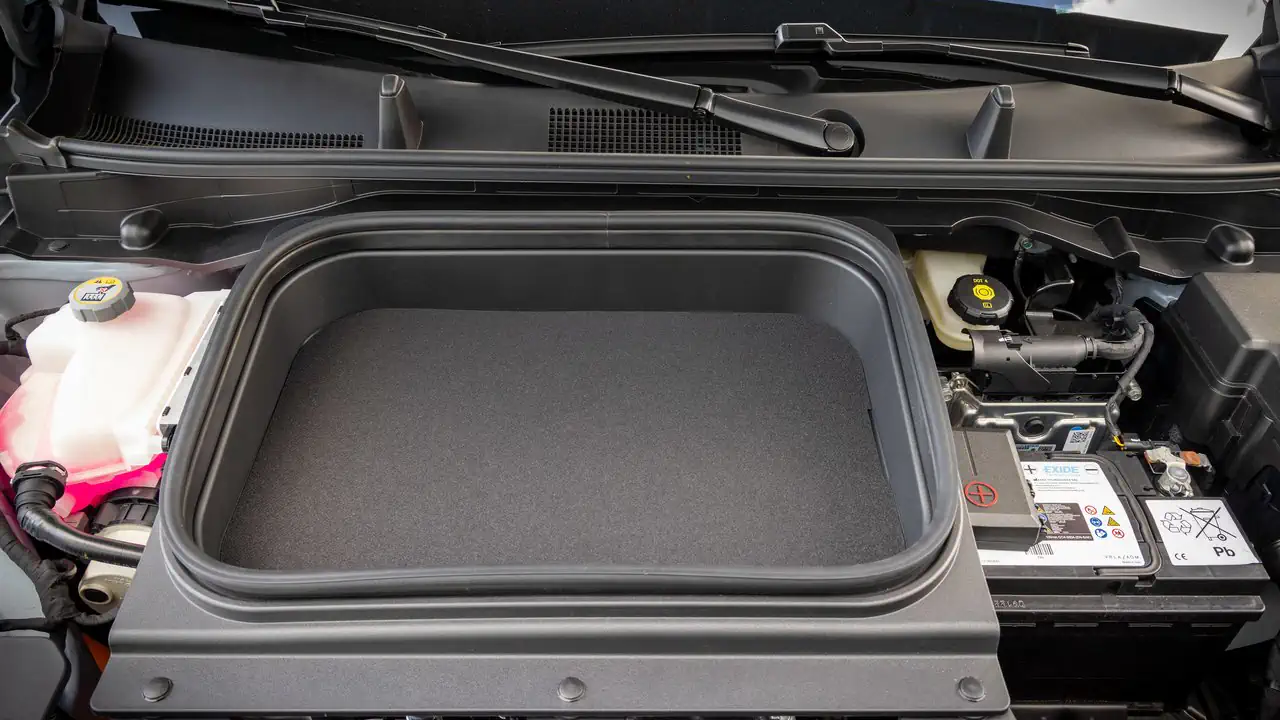
Cargo capacity reaches 12.8 cubic feet in the five-seat setup, growing to 14.2 cubic feet in the four-seat version with seats forward. There’s also a front trunk under the hood offering 0.53 cubic feet, purpose-built to store the charging cable.
Standout strength: The interior volume genuinely exceeds what the exterior dimensions imply. Most people climbing in for the first time do a double take.
Real limitation: The 12.8 cubic feet of cargo space in the standard European five-seat layout falls short of what rivals like the Skoda Epiq offer at a similar price point.



Performance and Efficiency: The EV2’s Counterintuitive Power Strategy
The EV2’s mechanical setup runs against conventional logic, and it’s worth understanding before picking a version.
The smaller 42.2 kWh LFP (lithium iron phosphate) battery unlocks the motor’s full output: 108 kW, or 147 hp, with 184 lb-ft of torque. That gets the EV2 to 60 mph in around 8.2 seconds, which is genuinely quick for a 3,582-pound subcompact. Around town, it pulls away from lights with the kind of urgency you’d expect from an EV.
The larger 61.0 kWh NMC (nickel manganese cobalt) battery, by contrast, has the motor electronically capped at 99.5 kW, or 135 hp, to protect the cells and preserve range. The 0–60 time stretches to around 9.5 seconds. The version that goes farther is, somewhat paradoxically, the one that moves slower.
Both versions share the same 184 lb-ft of torque, which keeps low-speed response snappy regardless of which pack you choose. For the vast majority of real-world driving, the power difference is barely perceptible.
Top speed is electronically limited to 100 mph across the entire lineup, no exceptions.
On real-world efficiency, independent UK testers recorded consumption below 3.5 miles per kWh in autumn conditions, outperforming the official WLTP figures by roughly 5%. That kind of lab-to-road consistency is uncommon enough to be worth noting.
The platform runs on a 400V architecture rather than the 800V system found in the EV6 and EV9, which caps peak DC charging at 127 kW. Despite that, the charge curve is notably flat, and a 10–80 percent top-up takes just 29 minutes for the LFP version and 30–31 minutes for the NMC.
MSRP, Insurance and Maintenance: What Does the EV2 Actually Cost to Own?
In Europe, the EV2 landed with pricing that caught the industry off guard. In Germany, the entry-level Light trim starts at approximately €26,600, or roughly $30,800. In the UK, the long-range Air version opens at £24,245, with a notable oddity in the pricing structure: the longer-range version is actually cheaper than the base in certain trim packages, due to logistics incentives and favorable NMC battery sourcing decisions by the automaker.
Since Kia has confirmed the EV2 will not be sold in the United States, there is no official MSRP for the American market.
For maintenance costs, the EV2 follows a 12-month or approximately 12,000-mile service schedule. Without an internal combustion engine, there’s no oil to change, no timing belt to replace, no air filter for the powertrain. Annual service covers brake fluid, cabin air filters, software diagnostics and CTBA axle alignment checks. Market estimates peg yearly scheduled maintenance costs at roughly $80 to $100 equivalent, a figure that makes even the most fuel-efficient ICE vehicles look expensive by comparison.
Insurance premiums are still being finalized in several markets, but UK actuarial estimates place the EV2 in insurance group 36 to 50, reflecting the complexity and cost of high-voltage battery repairs. In markets where EVs carry import premiums, insurance rates tend to run higher due to parts sourcing challenges and battery pack replacement costs.
For buyers considering financing on a comparable EV in the compact segment, the EV2’s ownership case is helped significantly by Kia’s 7-year or 100,000-mile warranty, which covers both the vehicle and the high-voltage battery. Projected residual values after five years are estimated above 55%, ahead of equivalent ICE subcompacts that typically settle between 45 and 50 percent.
The practical buyer profile is someone with a daily commute under 100 miles who has access to home or workplace charging. The LFP version’s 197-mile WLTP range is adequate for most urban and suburban patterns but becomes limiting on road trips at sustained highway speeds.
Frequently Asked Questions About the Kia EV2
What is the real-world range of the Kia EV2?
The 61.0 kWh NMC version carries a WLTP-rated range of 281 miles. Independent UK testing showed real-world consumption slightly better than the official figure under moderate autumn conditions, suggesting the rated range is achievable in practice.
Is the Kia EV2 available in the United States?
No. Kia has officially confirmed the EV2 will not be sold in the U.S. market. The automaker cited American consumer preference for larger vehicles and the current tariff structure as the main factors behind that decision.
How much does it cost to maintain a Kia EV2?
Annual scheduled maintenance is estimated at roughly $80 to $100 equivalent in markets where the EV2 is sold, covering brake fluid, cabin filter replacement and software diagnostics. The absence of engine oil, spark plugs and a traditional transmission makes the EV2 significantly cheaper to maintain than a comparable gasoline-powered subcompact.
Who are the Kia EV2’s closest competitors?
In its primary European market, the EV2 competes directly against the Volkswagen ID. Polo, Renault 5 E-Tech, Citroën e-C3 and Skoda Epiq. In markets where the BYD Dolphin is available, it represents the closest rival on price and segment positioning.
Verdict: Does the Kia EV2 Deliver on Its Promise?
The EV2 is a rational purchase with an emotional interior. The cabin defies its external footprint, the technology stack punches well above the entry-level label, and the ownership cost argument is genuinely hard to dismiss.
That said, it’s not for every buyer. Drivers who regularly take long highway trips will find the LFP version’s 197-mile rated range restrictive once speeds climb above 70 mph. Anyone coming from a performance-oriented EV will find the 9.5-second 0–60 time underwhelming. And the ADAS alert system requires some patience and menu-diving before it stops beeping at every speed limit sign change.
For the right buyer, the EV2 is likely the strongest value proposition in the compact electric segment right now.
Do you think Kia made the right call keeping the EV2 out of the U.S. market, or is this exactly the kind of affordable electric Americans actually need? Drop your take in the comments below.
Share this article

Por: Danniel Bittencourt
12/06/2026
Related posts