Renault Made the Megane E-Tech Even More Compelling — and the Numbers Back It Up
The Renault Megane E-Tech just got a significant facelift for 2027 — new LFP battery, up to 311 miles of WLTP range and faster DC charging. But is it coming to the US? Here’s what we know.
Renault Megane E-Tech 2027: The LFP Battery Facelift That Changes the Equation
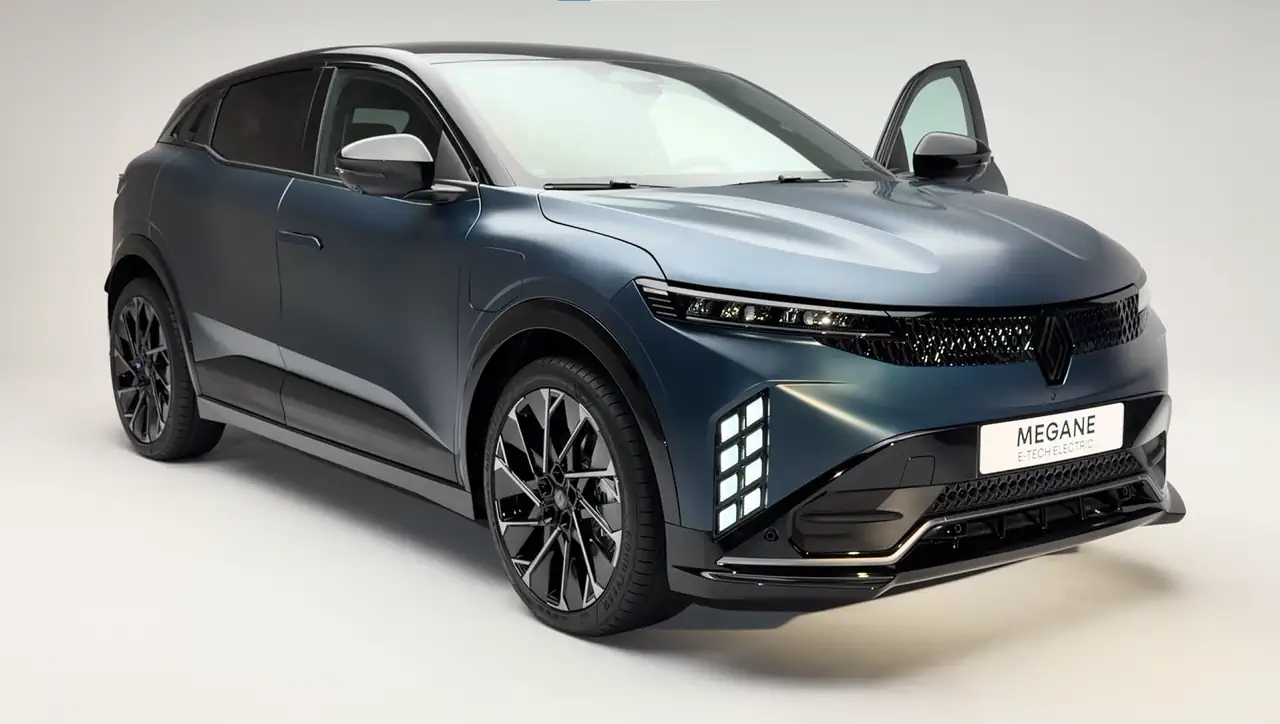
The biggest story on the Megane E-Tech 2027 isn’t the redesigned front end — it’s the switch to a 67 kWh LFP battery promising up to 311 miles of WLTP range and DC fast charging at up to 165 kW.
This is a mid-cycle facelift, not a full generation change. The AmpR Medium platform carries over, but Renault reworked the front fascia, upgraded the software stack and trimmed the global lineup down to two trim levels: Techno and Esprit Alpine.
The Megane E-Tech is not officially sold in the United States as of this writing. In global markets where it is available, the electric hatchback competes directly against the Volkswagen ID.3, Cupra Born and Hyundai Kona Electric — all of which fight for the same buyer looking to step up from a gas-powered compact into a well-equipped EV. Any discussion of US pricing or availability should be treated as not officially confirmed.
Quick Specs
| Spec | Details |
|---|---|
| Body Style | Elevated hatchback / Crossover EV |
| Powertrain | Front-mounted EESM electric motor |
| Horsepower | 217 hp (160 kW) |
| Torque | 221 lb-ft (300 Nm) |
| Transmission | Single-speed automatic reduction gear |
| Drive | Front-wheel drive (FWD) |
| 0–60 mph | ~7.2–7.4 sec (official 0–100 km/h: 7.4 sec) |
| Top Speed | 99 mph (160 km/h, electronically limited) |
| Efficiency | ~16 kWh/100 km (60 kWh); detailed figures for 67 kWh not officially confirmed |
| Range | Up to 280–285 mi WLTP (60 kWh) · up to 311 mi WLTP (67 kWh, 2027 international) |
| On Sale | Facelift revealed globally June 2026; US availability not officially confirmed |
The numbers set a solid baseline — but specs only tell part of the story. How the Megane E-Tech actually drives, what the interior feels like in real life and whether the ownership costs make sense are the questions worth digging into.
A French Electric That Doesn’t Blend Into Traffic
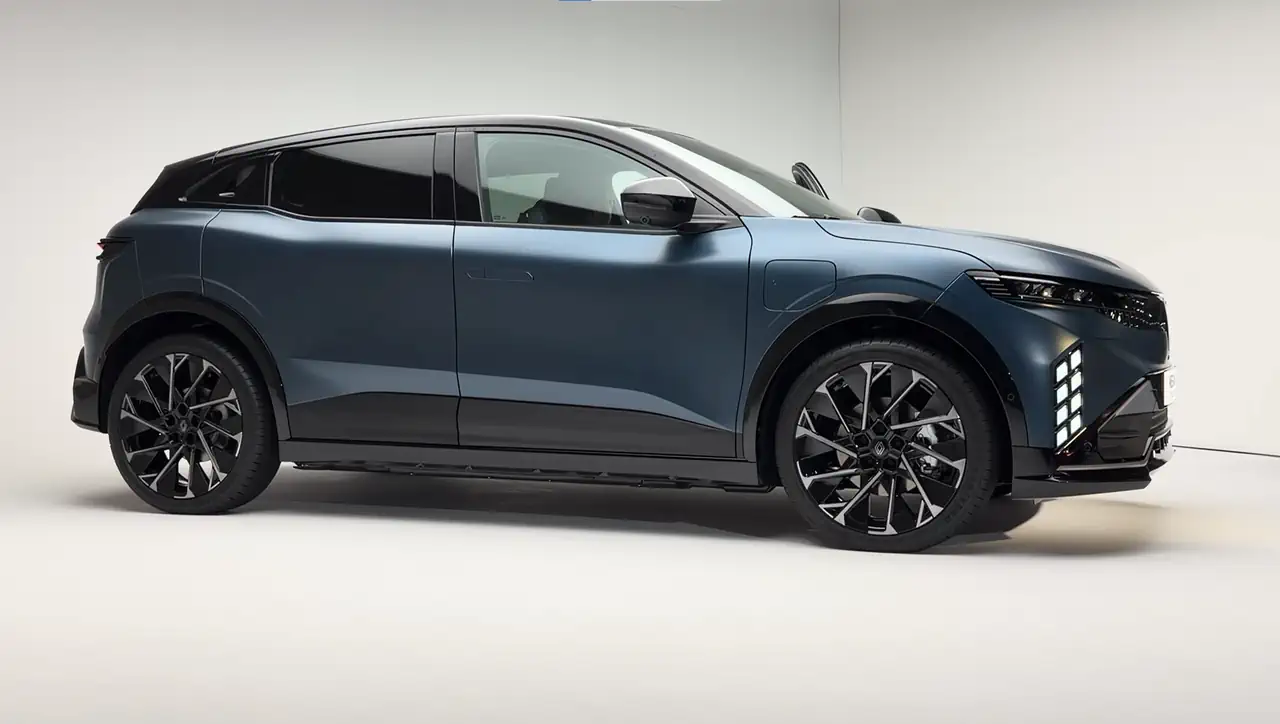
Walking around the Megane E-Tech, it’s clear this is a car designed to be noticed. The 2027 facelift didn’t touch the overall silhouette, but it reworked the front end in ways that read as deliberate and confident rather than just different for the sake of it.
Renault repositioned the brand logo lower on the fascia, added a more substantial front bumper and wrapped the closed grille in gloss black with a diamond-pattern texture that references the brand’s historic design language. The new DRL signature — eight individual “diamond” elements per side — creates a wide, distinctive light bar that makes the car instantly recognizable even in traffic.
From the side, the roofline follows a subtle coupe arc, paired with a high beltline and 19- or 20-inch wheels. The proportions land somewhere between a traditional hatchback and a small crossover — not quite either, which is exactly the point. At roughly 165 inches long, 60 inches tall and a 105.7-inch wheelbase, it’s compact without feeling cramped from the outside.
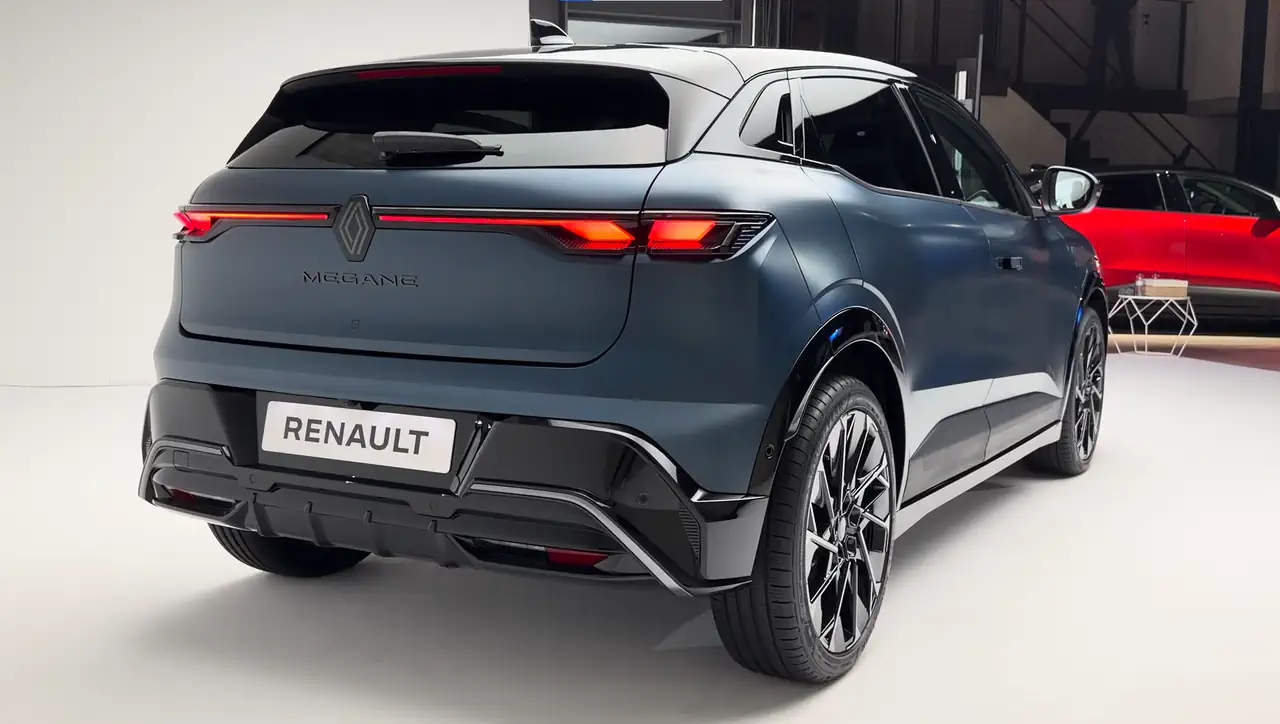
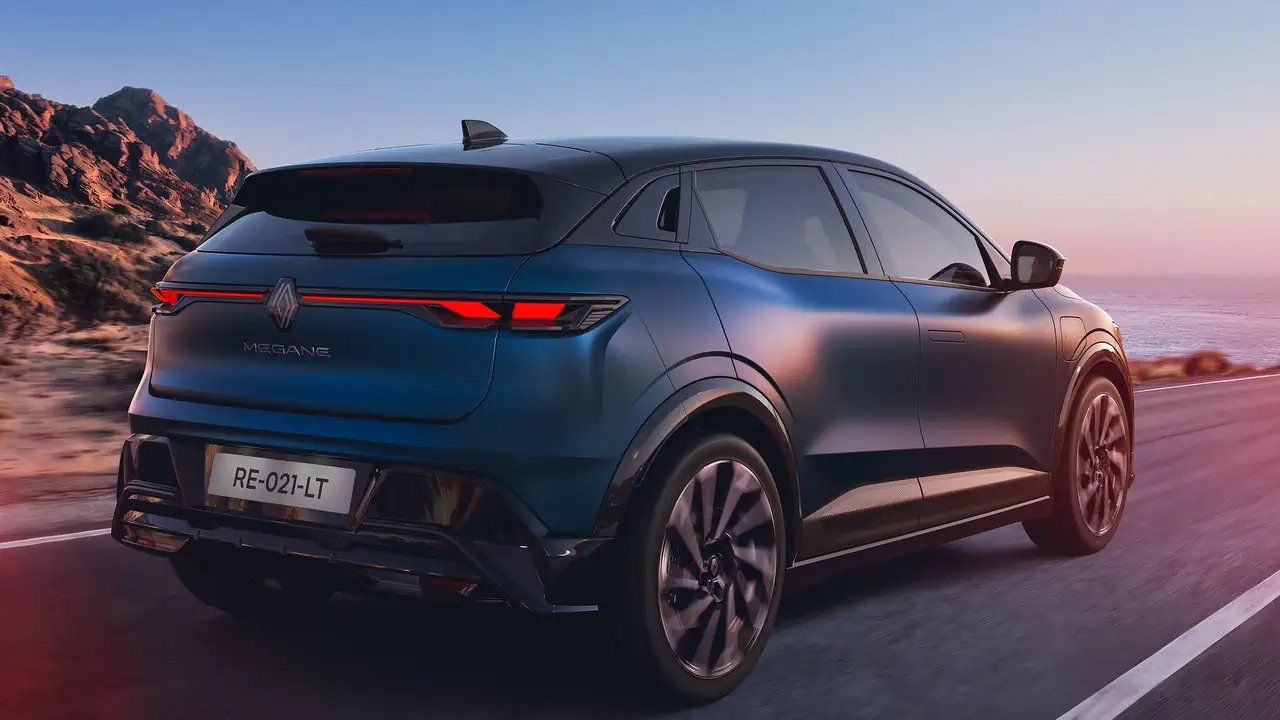
At the rear, the full-width taillamp strip carries over but gains three-dimensional elements without an outer lens — a detail that adds perceived depth and reads as more premium than the price might suggest. A revised rear diffuser-style bumper closes out the look with a bit of extra aggression.
The design language is a clear evolution of what Renault introduced in 2022 — not a reinvention, but a sharper, more resolved version of the same idea.
An Interior That Punches Above the Segment’s Average
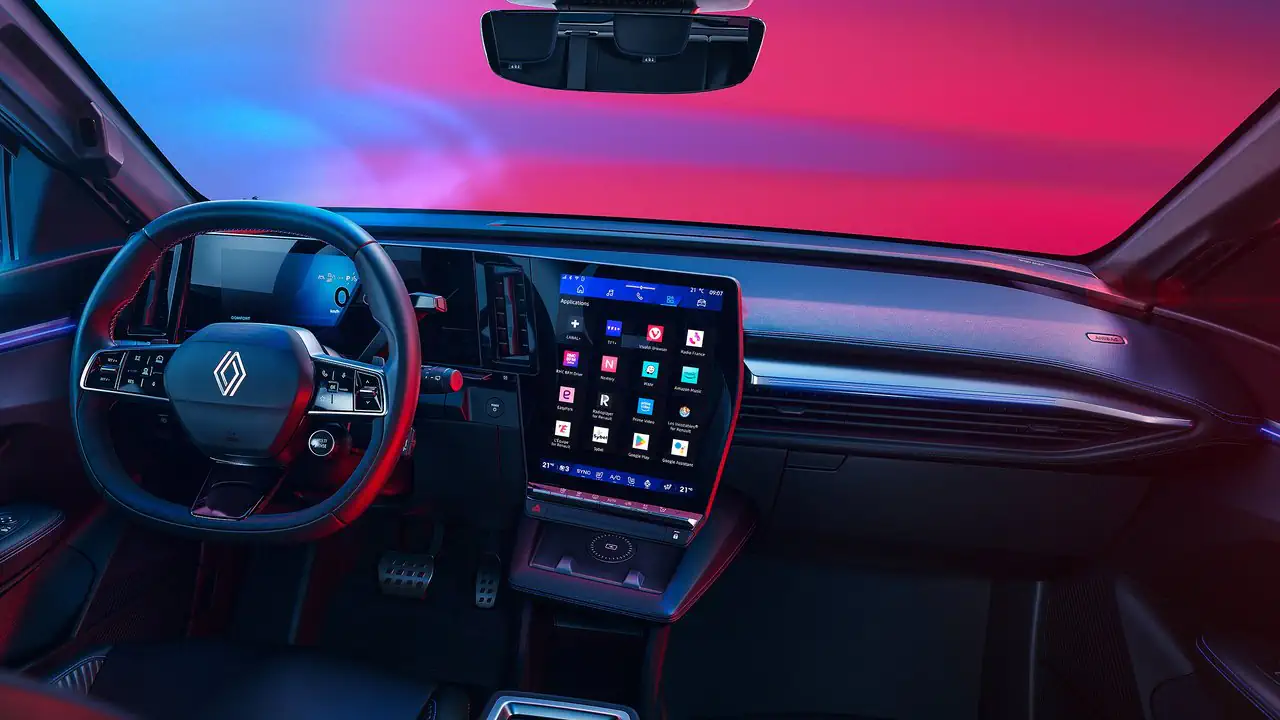
Stepping inside the Megane E-Tech, the layout is immediately intentional. The dashboard is built around an inverted-L arrangement: a vertically oriented center touchscreen (9 to 12 inches depending on trim) paired with a 12.3-inch fully digital instrument cluster. The result is a cockpit that prioritizes navigation and energy management information above everything else.
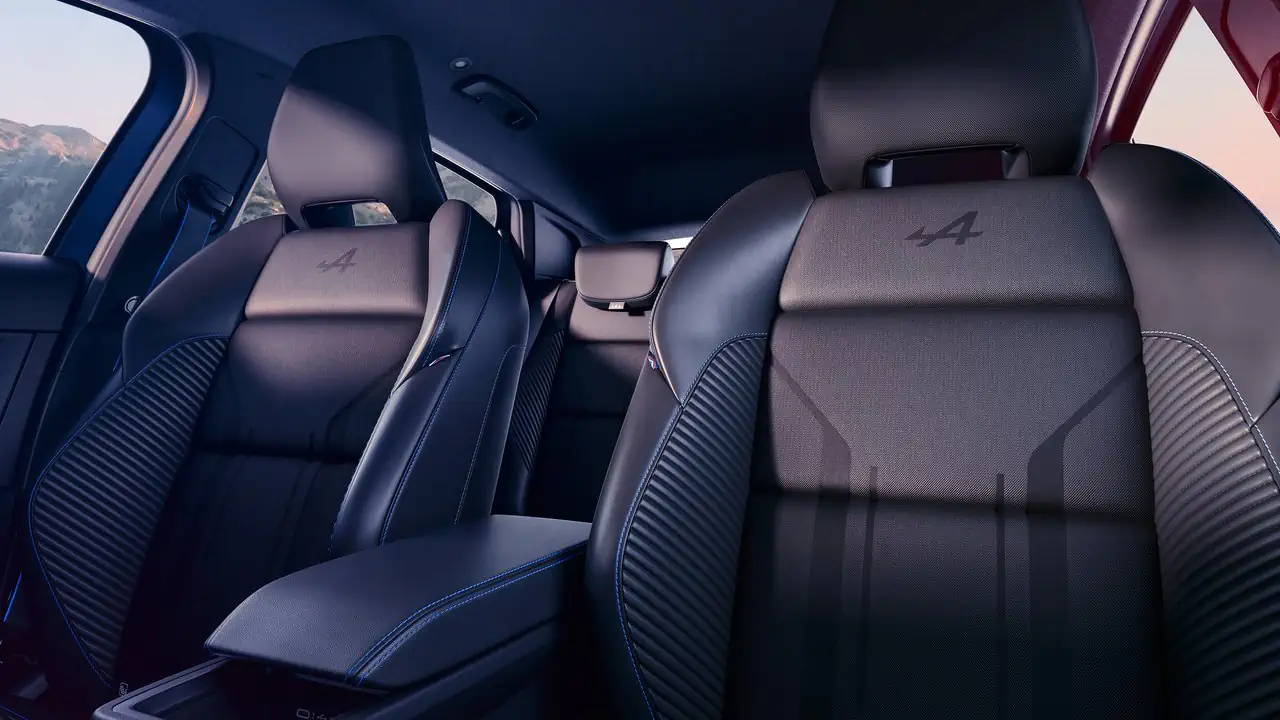
Material quality is a mixed bag, though leaning positive for the price point. High-contact surfaces use textured plastics and soft-touch materials in the right places, but lower door panels and some secondary surfaces use harder plastics that remind you this isn’t an Audi. The Esprit Alpine trim pushes things further with sport-influenced front seats, blue contrast stitching and a door panel finish that transitions from spectral grey to blue — an unusual level of interior drama for a compact EV.
Front seat comfort is a genuine strength. The bolstering provides real lateral support without feeling restrictive on longer drives, and the standard-spec EV60 arrives with heated front seats and a heated steering wheel — features that add daily-use value well beyond what some competitors include at this price.
Screens, Connectivity and the One Real Compromise
The infotainment system runs Android Automotive OS in European and Australian markets, with native Google Maps, Google Assistant and Google Play built in — no phone required for full navigation functionality. The 2027 update brings deeper Google integration and references to Gemini for more conversational voice interaction, though whether that specific feature reaches all markets is not officially confirmed.
The 12.3-inch digital cluster is crisp, fluid and connects directly to the center screen’s navigation data, creating a genuinely modern cockpit experience. The learning curve for the full menu structure is real — users unfamiliar with Google-based interfaces will need a few days to feel comfortable — but the system’s responsiveness is among the best in the segment once you’re past that initial adjustment.
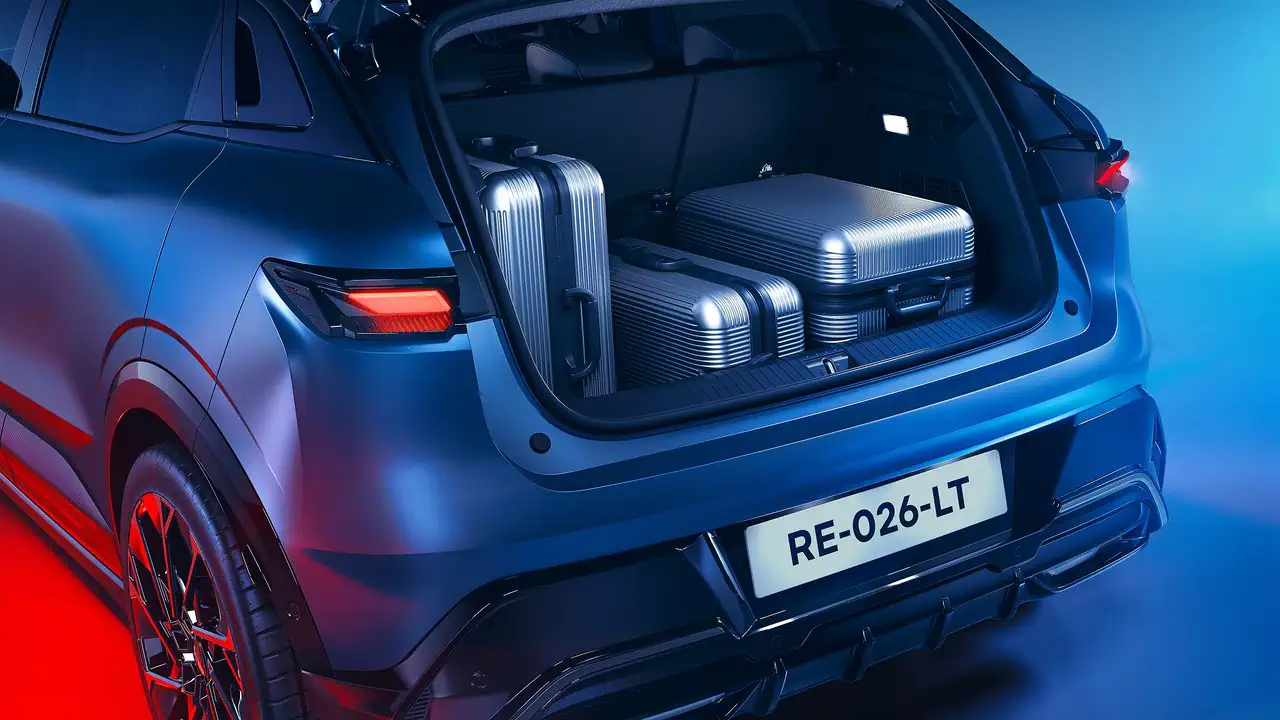
The rear seat is where honesty matters most. Cargo space is solid at 15.5 cubic feet — competitive against rivals like the Hyundai Kona Electric and VW ID.3. Legroom and headroom, however, are adequate rather than generous. Taller adults above 6 feet will notice the limitation, and the coupe roofline is the direct cause. It’s a trade-off the design makes deliberately, and buyers should weigh it accordingly.
Clear strength: The technology package — digital screens, ADAS suite, OTA updates and connectivity — is genuinely among the most complete in the compact EV segment.
Real limitation: Rear passenger space is average at best. This is a two-plus-two car in practice, not a true four-adult hauler.

Under the Hood: What 217 Horsepower Feels Like in an Electric Hatch
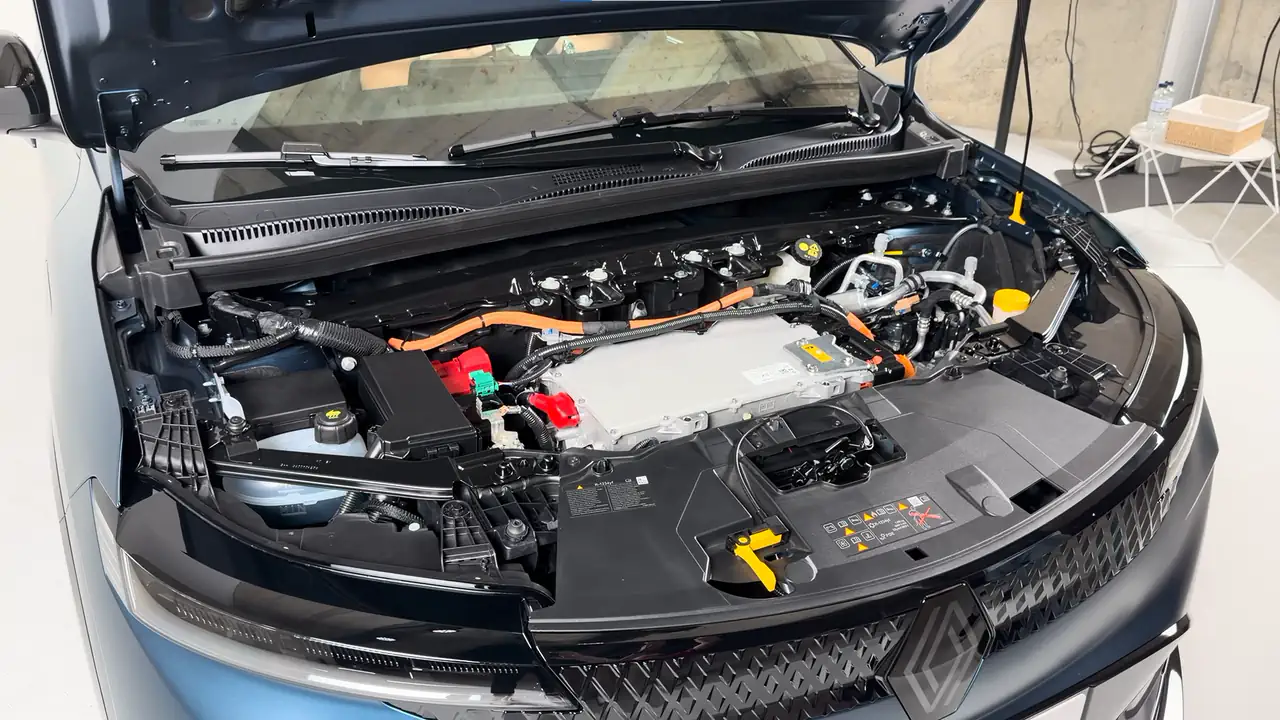
The Megane E-Tech uses an electrically-excited synchronous motor (EESM) mounted at the front axle, driving the front wheels through a single-speed reduction gear. There are no gear changes, no clutch and no delay between throttle input and response — just linear, immediate acceleration from a standing start.
Output is rated at 217 hp and 221 lb-ft of torque. In the real world, that torque figure — available from essentially zero rpm — means the car feels noticeably quicker than the official 0–60 mph time of approximately 7.2–7.4 seconds suggests. Several independent tests recorded runs closer to 6.9 seconds, a gap that’s consistent with how EVs often outperform their own spec sheets in short-distance sprints. Top speed is capped at 99 mph electronically, which is a deliberate efficiency compromise shared by most European EVs in this segment.
Chassis behavior is one of the car’s stronger suits. The flat battery pack lowers the center of gravity significantly compared to a conventional hatchback, and the rear multilink suspension adds composure that the front McPherson struts alone couldn’t provide. The steering is quick and direct without being nervous. This is not a hot hatch, but it handles like a car that was engineered to be driven, not just commuted in.
On FWD traction: applying full power on a wet surface will produce some wheelspin, which is a known limitation of high-output front-drive EVs. It’s manageable, but worth knowing before pushing hard in adverse conditions.
Range in real-world use with the 60 kWh battery lands between 200 and 235 miles in mixed driving based on European test data — below the WLTP figure of 280–285 miles, as expected. Highway driving at sustained speeds brings that figure down further, into the 155–185 mile range. The 2027 model’s 67 kWh LFP battery targets 311 miles WLTP, though real-world numbers at highway speeds will tell a more complete story once independent tests publish full results.
MSRP, Insurance and the Real Cost of Ownership
The Megane E-Tech is not currently sold through US dealerships. In markets where it is available, UK pricing starts at approximately £35,995 to £39,995 for the EV60 range, with European pricing in the €40,000–€50,000 range depending on trim and market. Specific pricing for the 2027 facelift is still being confirmed market by market and should be treated as not officially confirmed beyond those general ranges.
For context on what a US MSRP might look like if the model were ever to arrive stateside: factoring in import duties, compliance costs and competitive positioning against rivals like the Hyundai Kona Electric (starting around $33,550) and the Volkswagen ID.4 (from $38,995), a hypothetical US price would likely fall in the $40,000–$48,000 range. That figure is a market estimate based on competitive context, not an official number.
On insurance premiums: no manufacturer publishes insurance rate data, and actual costs depend on driver profile, location and carrier. For a compact EV with a replacement value in this range, premiums are generally comparable to similarly-priced EVs — but above equivalent gas-powered compacts due to repair cost exposure on battery and electronic systems.
Maintenance costs are a genuine advantage. Without engine oil changes, spark plugs, timing belts or an exhaust system to service, the routine maintenance schedule is significantly lighter than any gas-powered alternative. Renault’s general positioning on EVs requiring less maintenance holds true here, though specific service pricing by interval is not published openly. The warranty structure — five years on the vehicle and eight years or 100,000 miles on the battery in multiple markets — adds a meaningful layer of confidence for early adopters.
Depreciation data is limited given the model’s relative youth. Fast-moving EV technology and growing competition from Chinese brands with comparable range at lower price points are the primary risks to long-term resale value, but no consolidated data on annual loss percentages is available — that figure remains not officially confirmed.
The buyer who makes sense for this car in any market is someone with access to home charging, predominantly urban or suburban driving patterns and a preference for design and technology differentiation over raw interior volume. Corporate fleet programs and subscription channels have also been identified as significant sales avenues. For a household that needs a single vehicle to cover frequent long highway trips, the math becomes harder to justify.
What to Know Before Buying the Megane E-Tech
What is the real-world range of the Megane E-Tech?
In mixed urban driving, results track reasonably close to official figures. At sustained highway speeds, expect closer to 155–185 miles on the 60 kWh battery — a meaningful drop from the WLTP rating. The 2027 model’s 67 kWh LFP pack targets 311 miles WLTP, with real-world highway data still pending from independent tests.
Is the Megane E-Tech expensive to maintain?
Compared to a gas-powered equivalent, maintenance costs are lower — no oil changes, no spark plugs, reduced brake wear thanks to regenerative braking. Renault does not publish specific service pricing by interval, so consult a dealer for exact figures.
Who are the Megane E-Tech’s main competitors?
In global markets: Volkswagen ID.3, Cupra Born, Hyundai Kona Electric and Kia Niro EV. In markets like Brazil where import-priced EVs compete: BYD Yuan Plus/ATTO 3 and similarly-priced Chinese EVs offer more interior space at comparable or lower price points.
Is the 2027 Megane E-Tech coming to the United States?
As of this writing, Renault does not sell passenger vehicles through a US dealer network. There is no official confirmation of US availability for the 2027 model or any version of the Megane E-Tech. Any reports suggesting otherwise should be treated with caution.
A Strong EV That Knows Exactly What It Is
The Megane E-Tech is a rational choice for a specific buyer, wrapped in emotional appeal. The technology package, interior refinement and exterior design are genuine differentiators — not marketing language.
The challenge is the competitive landscape. At its price point in global markets, Chinese EVs are delivering comparable or greater range, more interior space and aggressive pricing. Renault’s answer to that pressure is differentiation on design, software integration and build quality — and for the right buyer, that argument holds up.
This car is not the right fit for drivers who need a single vehicle for regular long-distance highway travel, families requiring generous rear-seat dimensions for adult passengers or buyers prioritizing short-term resale value above all else.
The Megane E-Tech doesn’t try to be everything to everyone — and that focus is precisely what makes it work for the people it’s actually built for.
So — if the Renault Megane E-Tech were to arrive in the US market, would the price be justified against what Hyundai, Kia and VW are already offering? Or does Renault need to sharpen the pencil first? Drop your take in the comments below.
Share this article

Por: Danniel Bittencourt
22/06/2026
Related posts