The Topless GT3 Porsche Held Off Building for Decades
Porsche’s first series-production convertible GT3 pairs a naturally aspirated 4.0-liter engine with a six-speed manual — and a starting price near $275,000 in the U.S.
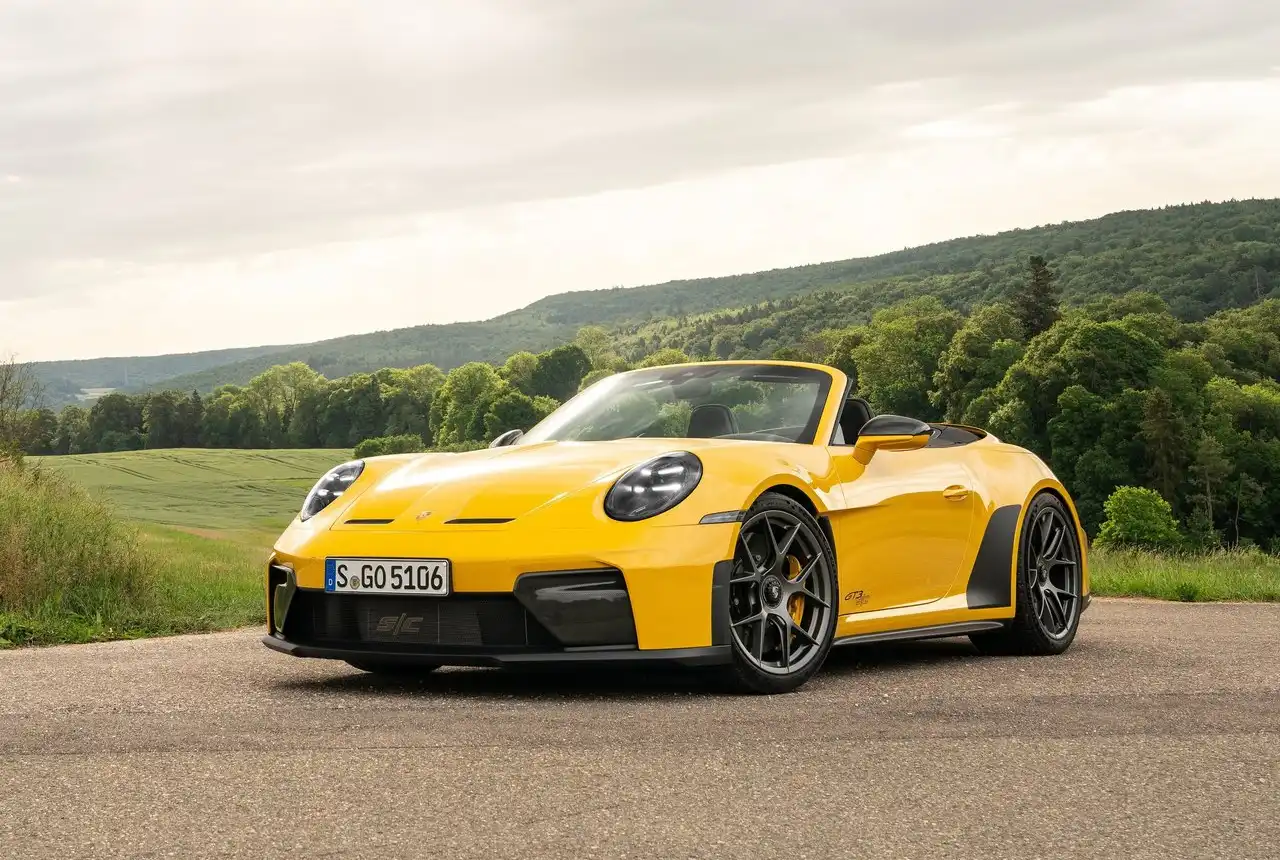
Porsche 911 GT3 S/C: A GT3 Loses Its Roof, Keeps the 9,000-RPM Engine
Porsche has introduced the 911 GT3 S/C, the first convertible GT3 offered as a regular production model rather than a limited run. Unlike the old 911 Speedster, which came and went as a special edition, the S/C becomes a permanent part of the lineup, though factory capacity will still keep numbers tight.
Built on the 992.2 platform, the S/C keeps the naturally aspirated 4.0-liter flat-six with zero hybrid assistance, paired exclusively with a six-speed manual. It’s a direct counterpoint to an industry moving toward turbocharging and electrified powertrains.
The car is aimed at collectors and enthusiasts who value mechanical feel over lap times. Direct rivals include the naturally aspirated Chevrolet Corvette Z06 Convertible and the hybrid-powered McLaren Artura Spider. Porsche has not confirmed a U.S. on-sale date beyond global deliveries beginning in late 2026.
Quick Facts
| Specification | Detail |
|---|---|
| Category | Convertible sports car |
| Engine | 4.0-liter flat-six, 24-valve, naturally aspirated |
| Horsepower | 502 hp at 8,500 rpm |
| Torque | 331 lb-ft at 6,250 rpm |
| Transmission | 6-speed GT manual |
| Drivetrain | Rear-wheel drive |
| 0-60 mph | 3.7 seconds |
| Top speed | 194 mph |
| Fuel economy | Not yet EPA-rated; 17.2 mpg combined under WLTP |
| Range | Up to 380 miles with the extended 22.2-gallon tank |
| Launch date | Unveiled April 2026; deliveries begin late 2026 |
The spec sheet tells part of the story, but the more interesting details are in how Porsche got here. Start with what you actually see on the outside.
The Engineering Behind a Top That Still Looks Like a Coupe
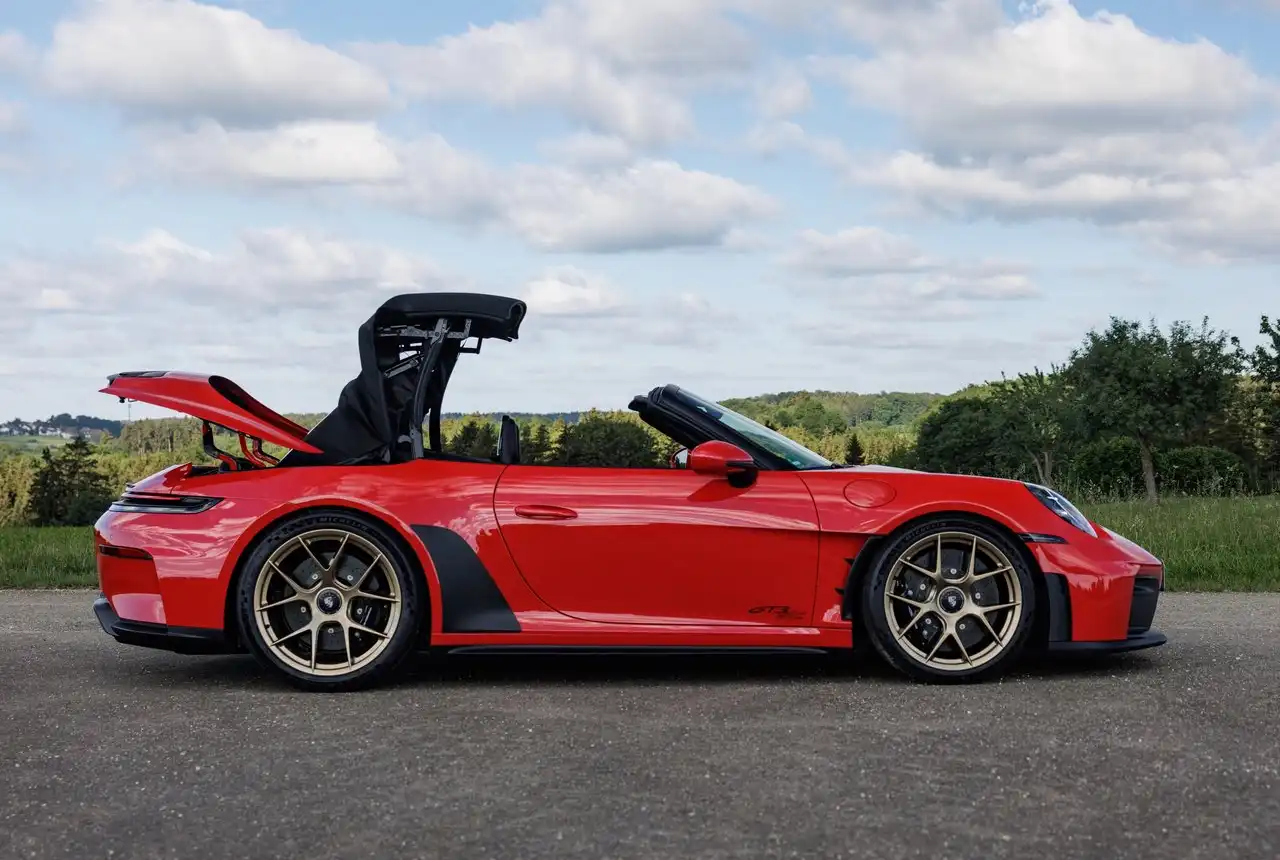
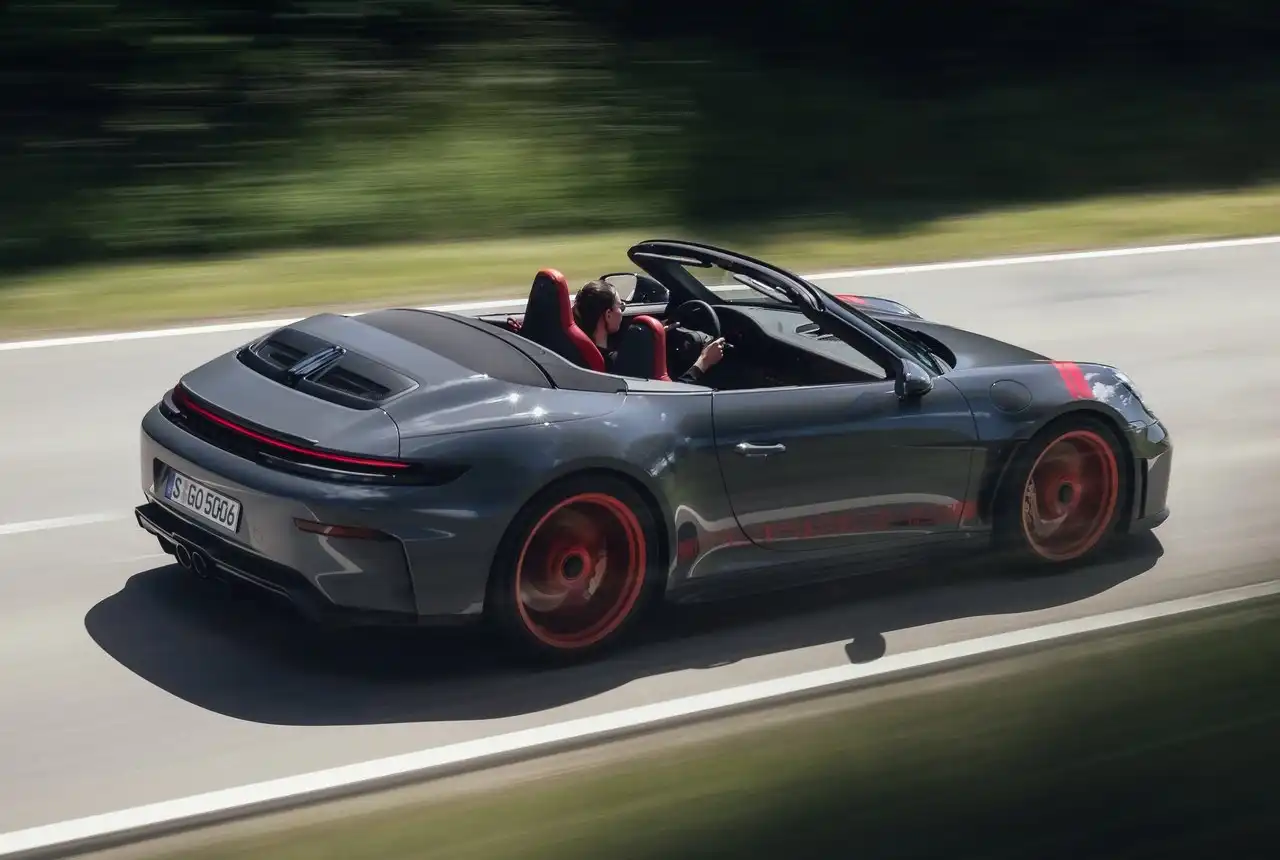
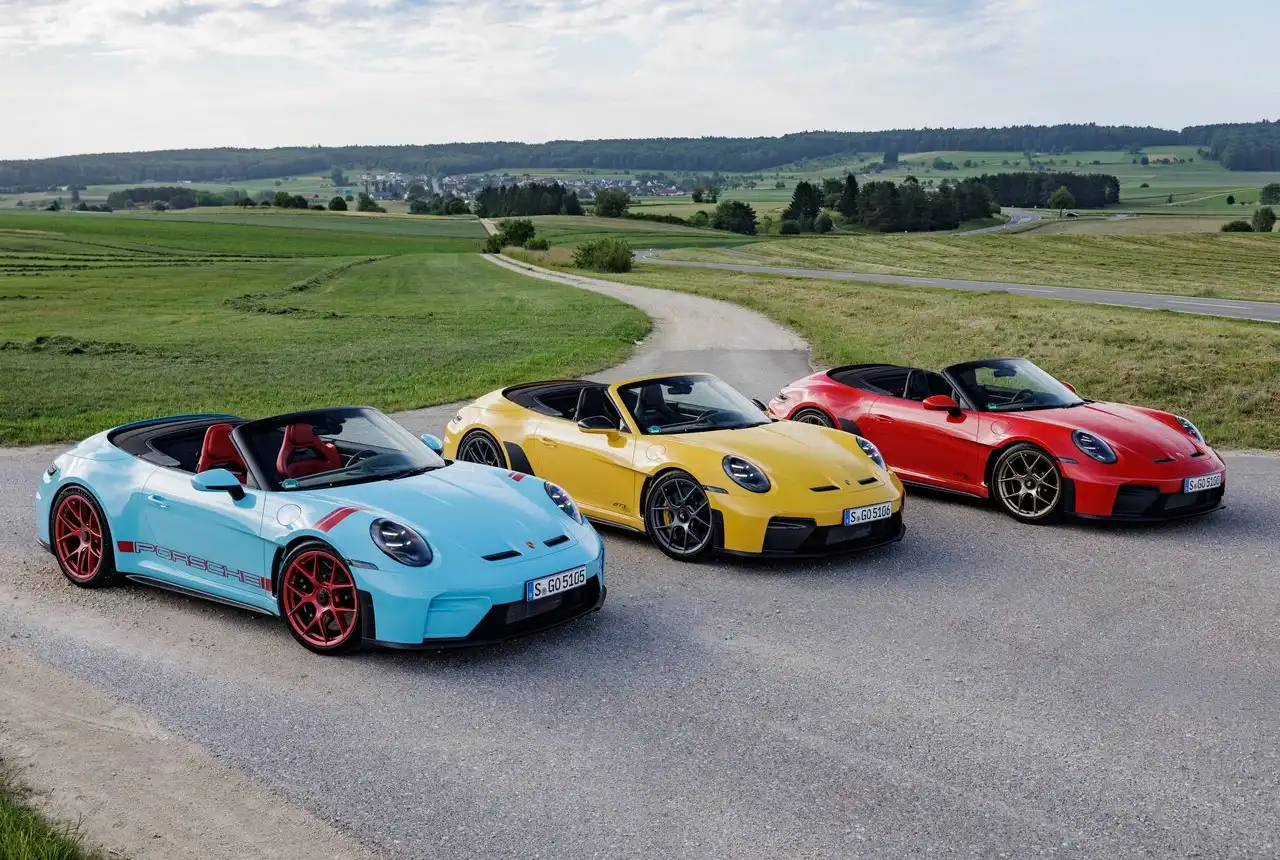
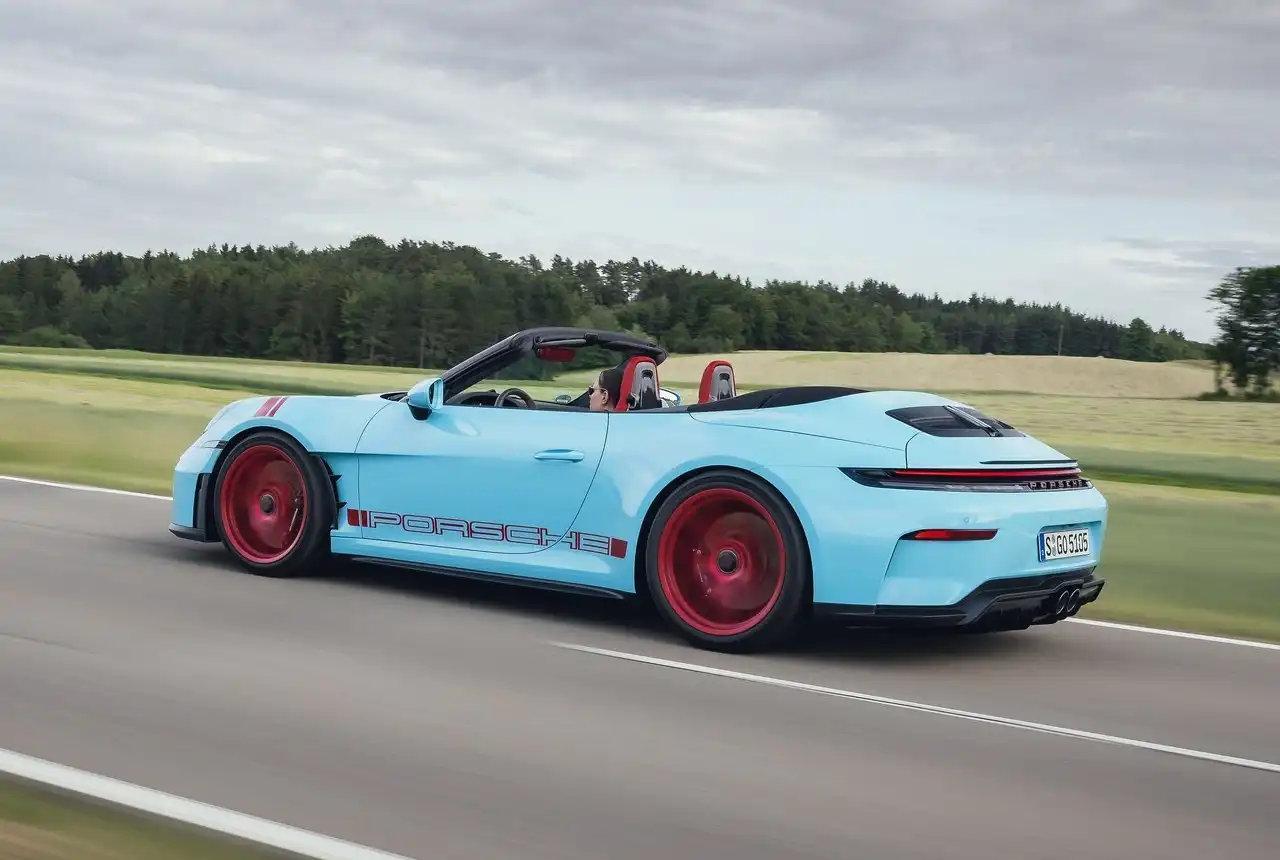
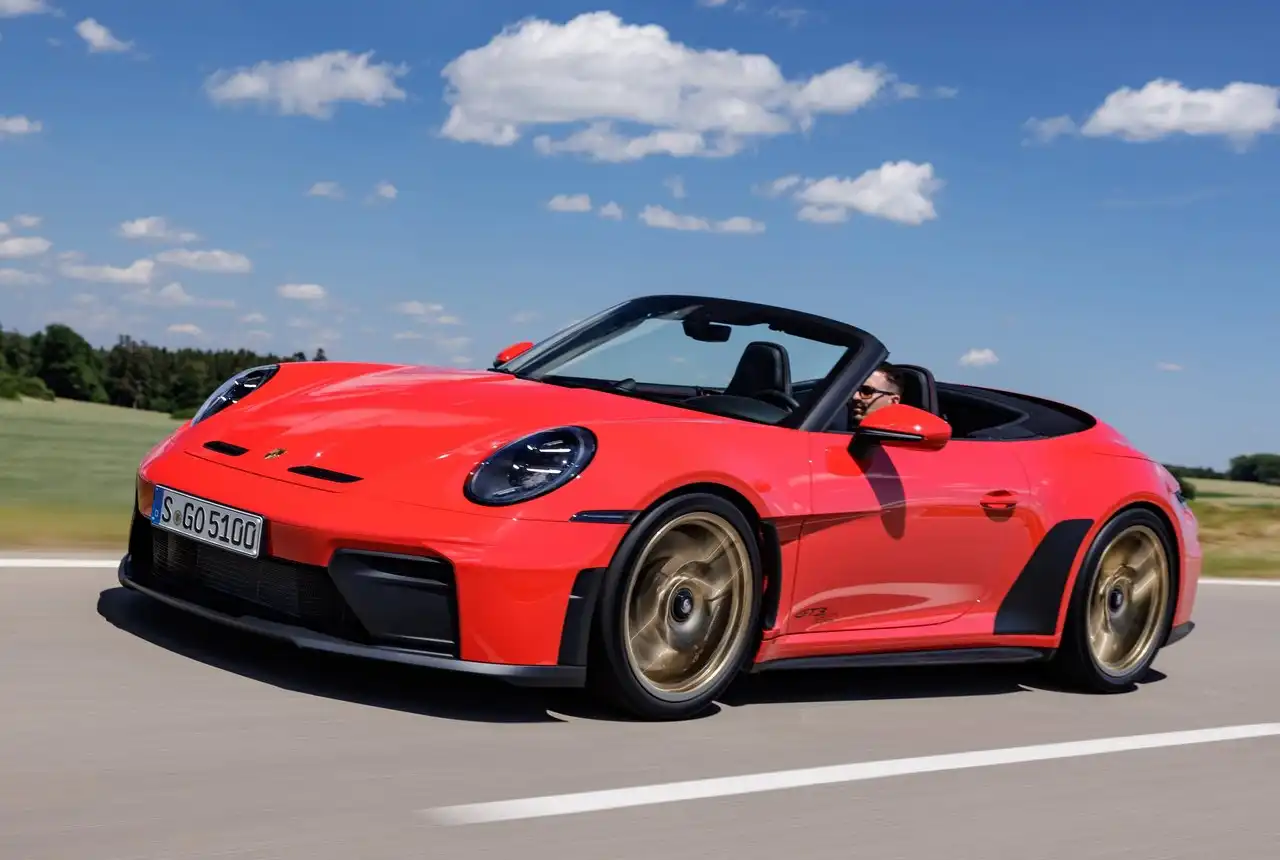
The GT3 S/C keeps a coupe-like silhouette despite the folding fabric roof, thanks to magnesium panels built into the top itself. The idea was to replicate the continuous roofline of the hardtop GT3, even with the top up.
Up front, the Matrix Design LED headlights carry over from the rest of the GT3 family, framed by a matte-black windshield surround. The front fenders, hood, and doors are all carbon-fiber-reinforced polymer, a material usually reserved for track-focused variants.
Along the sides, there are no power-retracting door handles. Instead, fabric pull straps mounted to carbon-fiber bases shave weight at the cost of convenience. The forged magnesium center-lock wheels follow the same logic, cutting unsprung mass.
Out back, the adaptive rear wing adds a Gurney flap — a small lip that generates air vortices to boost rear downforce without the need for a large fixed wing. It’s a compromise between street presence and track aerodynamics, since the S/C skips the swan-neck wing found on the fixed-roof GT3.
Compared with the old 911 Speedster, the S/C moves past limited-run exclusivity and borrows structural components from the 911 S/T, including carbon-fiber doors and magnesium wheels, which help offset the added weight of the roof mechanism.
A Cabin Built for Two, With Little Room for Anything Else
A Track-Focused Cockpit in a Convertible Body
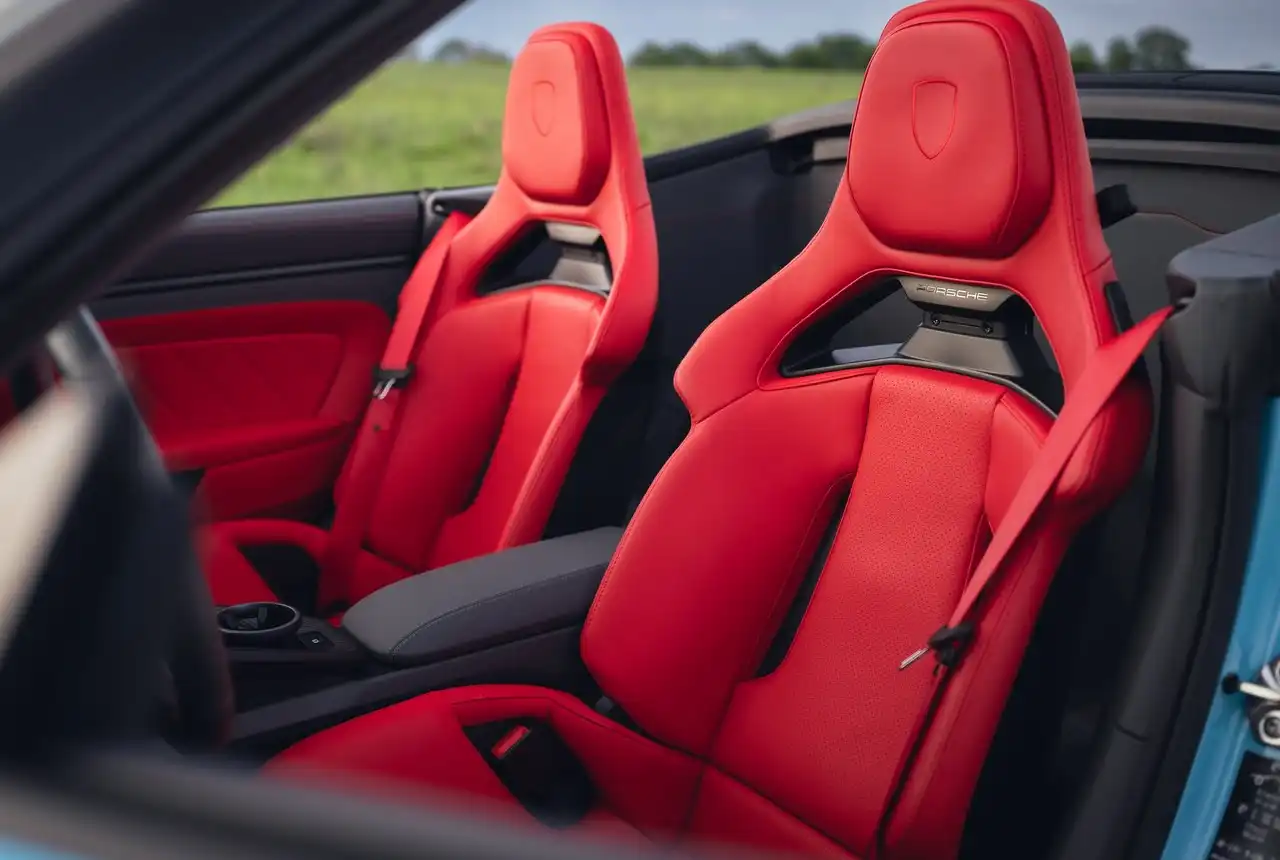
The GT3 S/C is strictly a two-seater — there’s no 2+2 rear bench like other 911 variants offer. That frees up space behind the seats for an optional leather-trimmed storage box instead.
Standard seats are the Sport Seats Plus, with four-way power adjustment and three-stage heating. Buyers can step up to the Lightweight Bucket Seats, carbon-fiber shells with a folding backrest for rear-storage access — a first for this kind of seat in the GT lineup.
Standard upholstery is black leather with GT Silver stitching. The optional Street Style Package brings two-tone color combinations and hand-woven leather accents, a noticeably higher level of personalization than the base car offers.
Compared with comfort-oriented convertible rivals like the Aston Martin Vantage Roadster, the GT3 S/C clearly prioritizes weight savings and rigidity over sound insulation and cargo room — a trade-off that tells you exactly who this car is built for.
Tech Without the Overload of Driver Aids
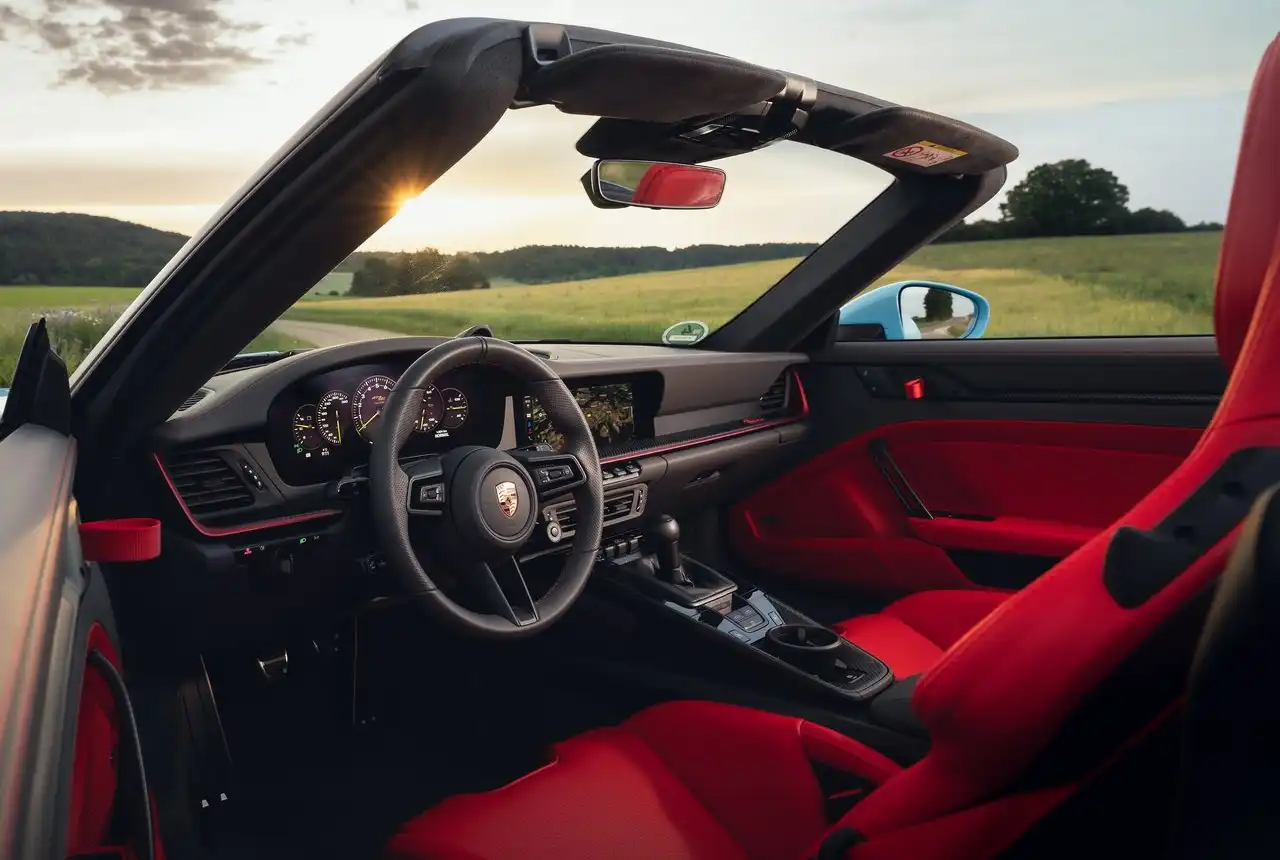
The gauge cluster is a curved 12.6-inch display with a Track Screen mode that strips the readout down to temperature, pressure, and shift lights for track use. The 10.9-inch infotainment screen runs Porsche’s latest PCM software with wireless Apple CarPlay and Android Auto.
Driver-assistance tech is deliberately minimal: blind-spot warning, rear-view camera-based park assist, and basic automatic braking. A physical “Assist” button lets the driver switch off these systems quickly, clearly aimed at track-day use.
There’s no rear seat, just the optional 21.1-gallon storage box behind the front seats. The front trunk holds 4.8 cubic feet, modest even by rear-engine sports car standards.
The cabin’s strength is exactly that refusal to pile on layers of electronic assistance that dilute the connection between driver and car. The real weak point is everyday storage — the door pockets and cupholders are tight, barely fitting a standard-size water bottle.
An Engine That Still Spins to 9,000 RPM Without Electric Help
At the core of the GT3 S/C is the 4.0-liter flat-six, naturally aspirated, with a 13.3:1 compression ratio. It shares its foundation with the GT3 RS engine, with revised camshafts and individual throttle bodies for sharper throttle response.
That setup produces 502 hp at 8,500 rpm and 331 lb-ft of torque at 6,250 rpm — numbers that only tell half the story without factoring in how the engine builds power. With no turbo and no electric motor to fill in low-end torque, the car depends entirely on revs, which means driving it actively just to access its full output.
The only gearbox offered is the six-speed manual, now with a final drive ratio shortened by 8% compared to the outgoing car. In practice, that means shorter shifts and a livelier feel on winding roads, rather than needing long straights to make the engine sing.
Owners of the previous generation point to this ratio change as the biggest real-world improvement, since the old car needed more than 75 mph in second gear alone to hit redline — a speed with little relevance on public roads.
With rear-wheel drive, the GT3 S/C hits 60 mph in 3.7 seconds and tops out at 194 mph, even with the extra drag from the fabric top. Fuel economy comes in at 17.2 mpg combined under the European WLTP cycle, translating to a range of roughly 380 miles with the extended 22.2-gallon tank. EPA figures have not been published as of this writing.
Is It Worth the Money? Who the GT3 S/C Actually Makes Sense For
In the U.S., Porsche lists an MSRP of $273,000, rising to $275,350 after delivery and processing fees — before state taxes. In Germany, pricing starts at €269,000, but can climb past €350,000 depending on local taxation and options.
Porsche has not confirmed U.S. availability details beyond the base MSRP, and no regional variations have been published for American buyers at this time. For context, direct rival the Corvette Z06 Convertible starts well under half that price, though it doesn’t match the GT3 S/C’s exclusivity or motorsport pedigree.
No official figures exist yet for insurance premiums or maintenance costs. As a market estimate, expect both to run high: the exposed carbon-fiber panels can’t be repaired with conventional bodywork and require full part replacement even after minor collisions, and the PCCB ceramic brakes can cost tens of thousands of dollars to replace after heavy track use.
Historically, manual, naturally aspirated GT3 models hold their value unusually well, and some appreciate on the resale market — a byproduct of demand for what buyers see as one of the last cars of its kind as the industry electrifies.
Buying at launch makes sense for someone already connected to the brand who wants the driving experience itself, not a short-term investment play. Buyers looking for cargo space, ride comfort, or more comprehensive driver-assist tech should look elsewhere — hybrid rivals like the McLaren Artura Spider serve that use case far better.
Frequently Asked Questions About the Porsche 911 GT3 S/C
Does the Porsche 911 GT3 S/C come with an automatic transmission?
No. The only gearbox offered is a six-speed manual — there’s no PDK dual-clutch option.
What’s the difference between the GT3 S/C and the old 911 Speedster?
The Speedster was a limited-run model with a manual top; the S/C has a power-folding roof and is a permanent part of the lineup.
How much does the Porsche 911 GT3 S/C cost in the U.S.?
Porsche lists an MSRP of $273,000, or $275,350 with delivery and processing fees, before taxes.
Is the GT3 S/C’s engine turbocharged or hybrid?
No. It’s a naturally aspirated 4.0-liter flat-six with no turbocharging or electric assistance of any kind.
The Verdict
The GT3 S/C is an emotional purchase, not a rational one. It’s expensive, stiff-riding for daily use, and offers almost no cargo room or space for extra passengers.
But for drivers chasing the feeling of a naturally aspirated engine spinning to 9,000 rpm with a manual gearbox and nothing electronic standing between pedal and response, it’s one of the last cars still built this way.
It’s not for anyone who wants a comfortable road-trip car or the latest driver-assist tech. It’s for anyone who still believes driving should require actual work.
A GT3 without a roof — but still every bit a GT3.
So — is it worth paying north of $275,000 for a two-seat convertible with almost no trunk space, just for the sake of a manual gearbox and a naturally aspirated engine?
Share this article

Por: Danniel Bittencourt
04/08/2026
Related posts