BMW Alpina Dropped the Track Setup and Built Something Far More Dangerous
A 640-horsepower V8, crystal glasses built into the rear console, and a price tag expected to clear $200,000 before options. The BMW Vision Alpina Concept just redefined what the brand considers ultra-luxury.

Por: Danniel Bittencourt
18/05/2026
BMW Vision Alpina Concept: The German Grand Tourer That’s Coming for Bentley
Alpina stopped being an independent tuner at the start of 2026. The BMW Vision Alpina Concept is the clearest statement yet of what that shift actually means.
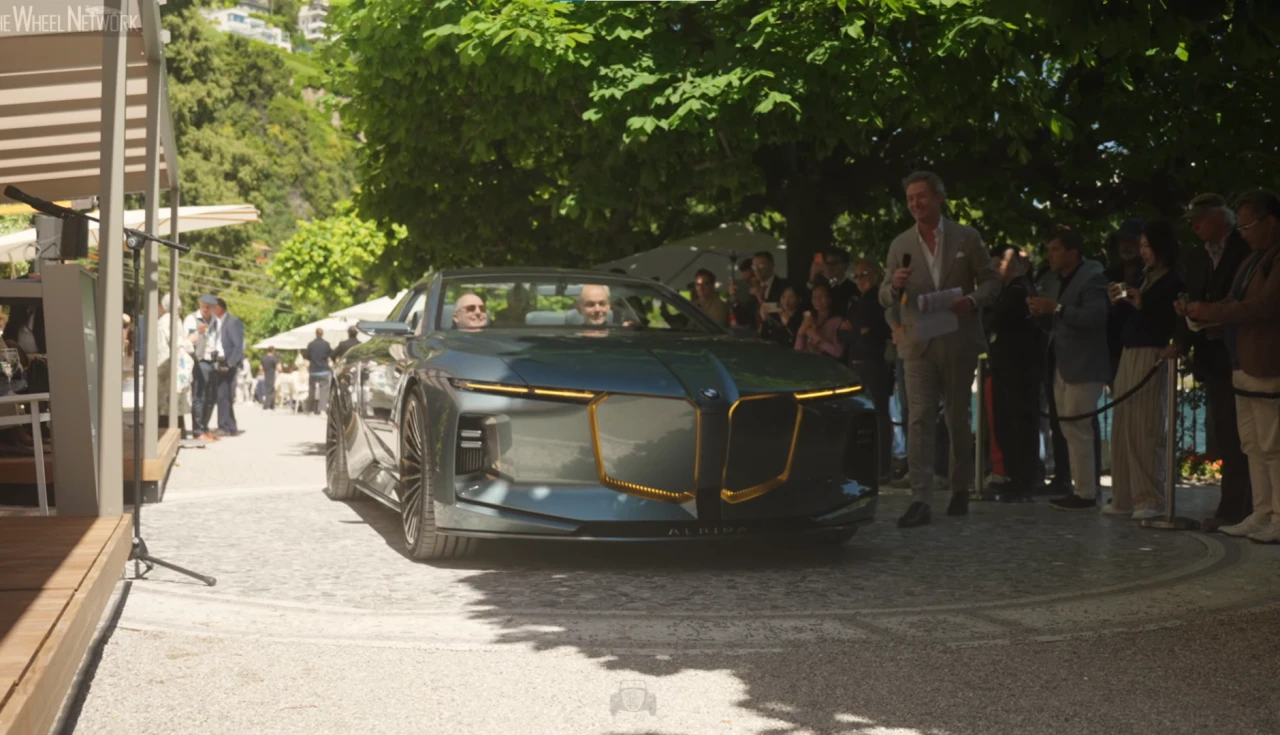
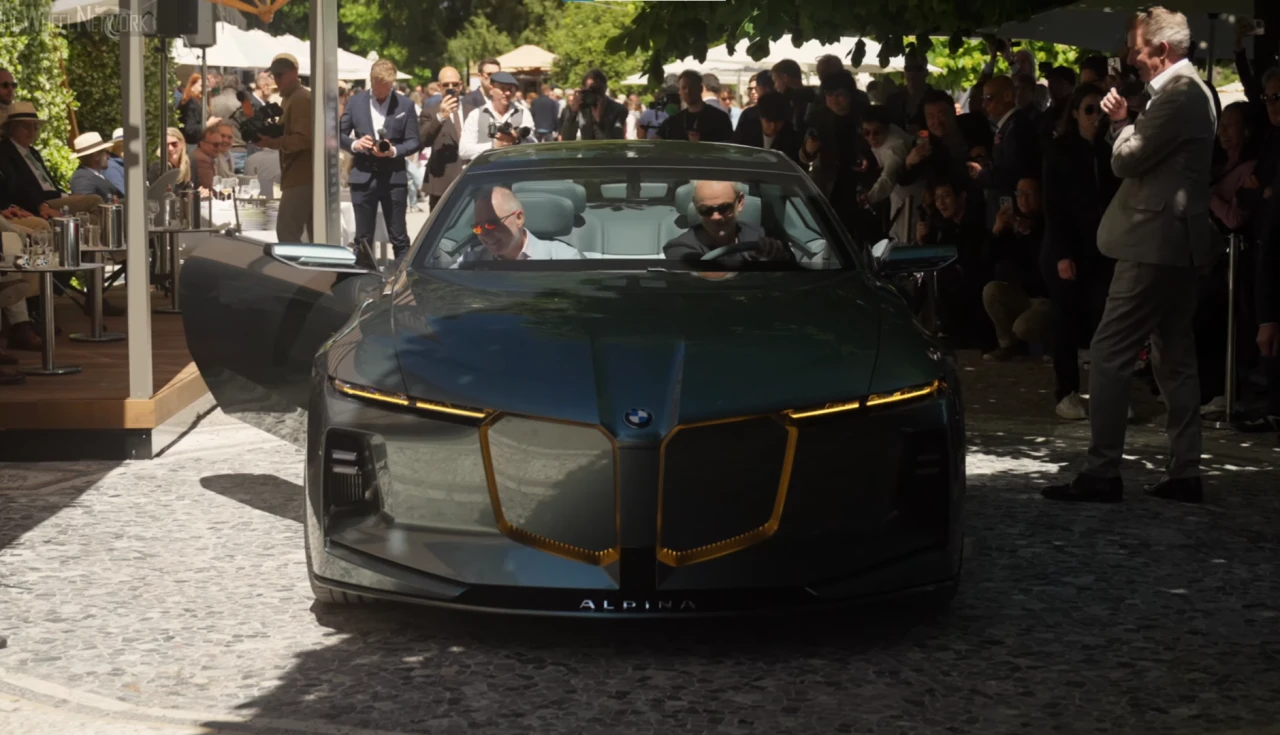
Unveiled in May 2026 at the Concorso d’Eleganza Villa d’Este, on the shores of Lake Como in northern Italy, this concept isn’t a track-focused machine wearing a tuxedo. It’s a full grand tourer — V8 twin-turbo, hand-stitched Alpine leather cabin, and an absolute commitment to long-distance comfort over lap times.
The pitch from BMW Alpina comes down to two words: speed, not sport. No stiff suspension, no aggressive aero pieces fighting for attention. The target buyer is the executive or collector who finds Rolls-Royce too aristocratic for daily use and the BMW M8 Competition too abrasive for the school run.
The direct competition is the Bentley Continental GT and, further out, top-spec Mercedes-Maybach configurations. The production model is scheduled for 2027, riding on the BMW 7 Series platform. No official US launch has been confirmed yet, but the specs and positioning tell the story clearly enough.
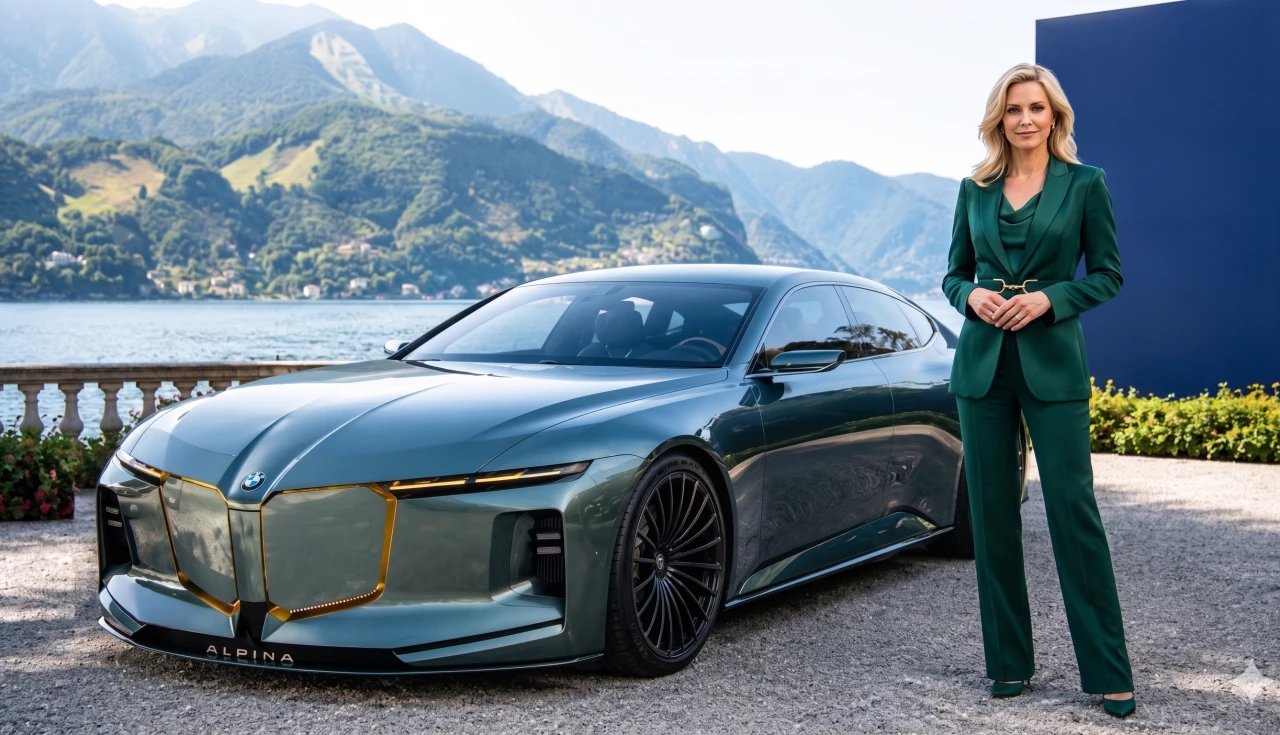
Shark Nose, Hand-Painted Pinstripes and 23-Inch Wheels: The Vision Alpina’s Visual Statement
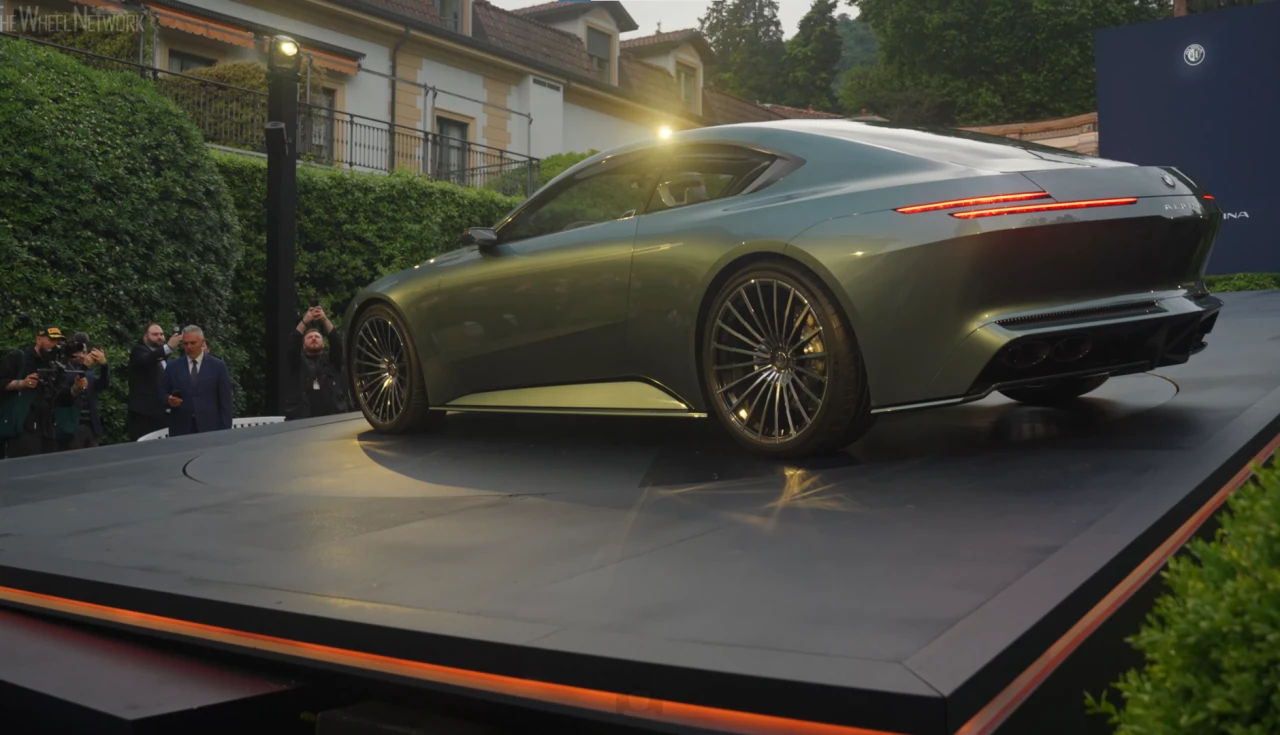
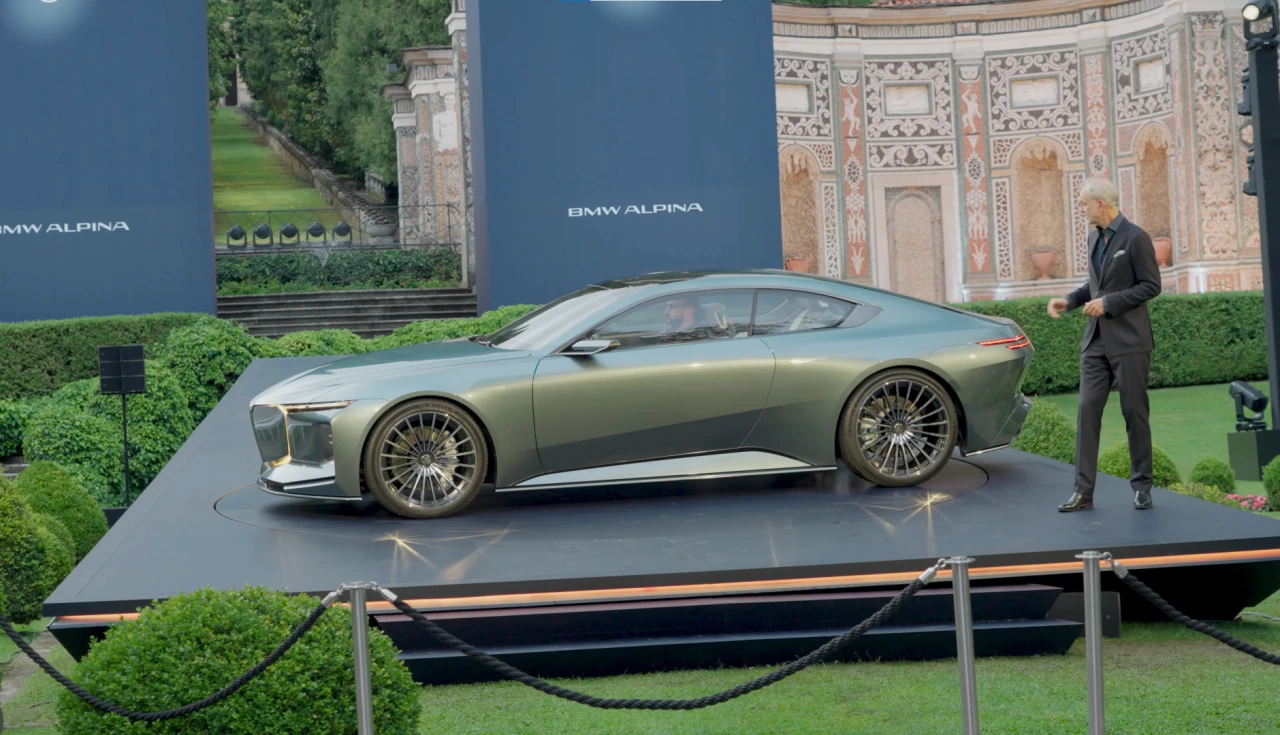
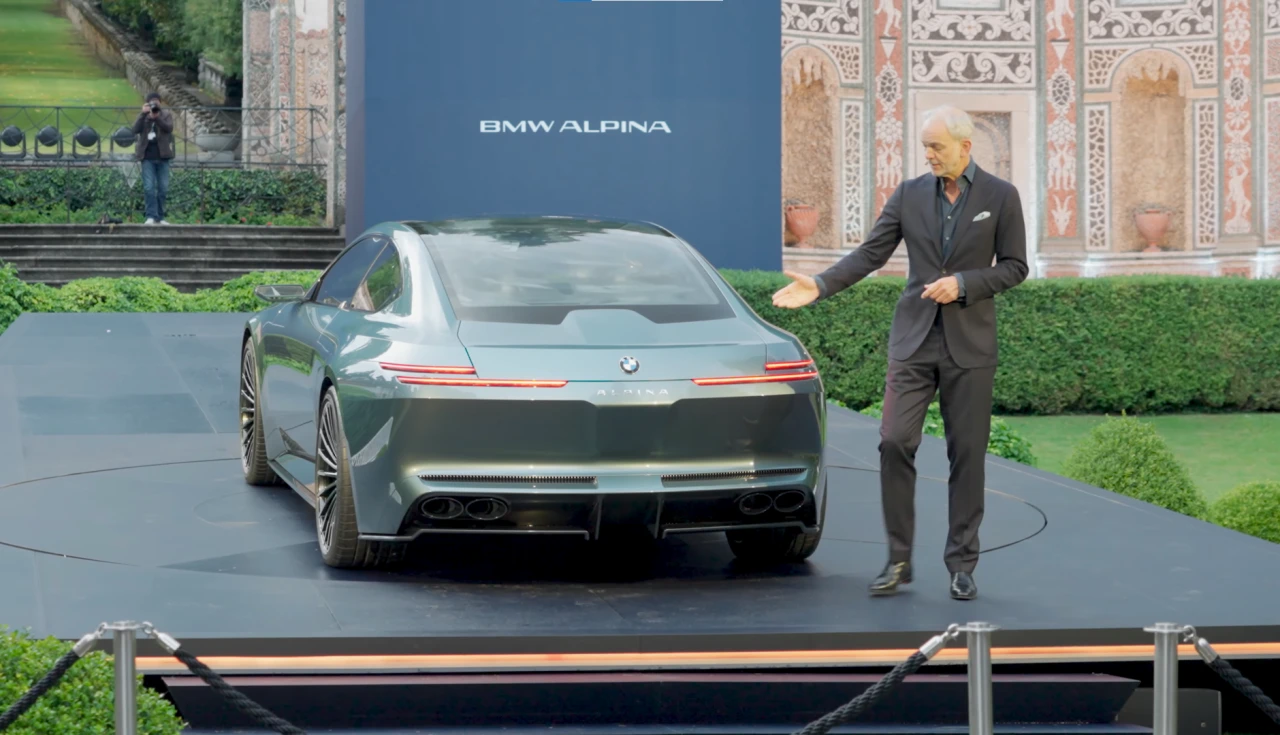
The Vision Alpina stretches 5,200 mm — just over 204 inches — but the long, sloping fastback roofline makes it read leaner than the numbers suggest. It looks like it’s already moving when it’s standing still.
The front end is where the designers made their boldest call. They brought back the shark nose — a forward-leaning, sculpted front fascia that draws directly from the 1956 BMW 507. The twin-kidney grille was reimagined as a three-dimensional illuminated sculpture, with the openings fully sealed at rest. Active shutters open only when the engine needs serious cooling, keeping aerodynamic drag exceptionally low during highway cruising.
The headlights incorporate faceted crystal elements that catch light like cut gemstones. It’s a subtle flex that sits closer to fine jewelry than to typical automotive lighting design.
Along the side, the most defining feature is what Alpina calls the speed feature line — a sharp crease that starts at the lower corners of the front bumper, rises at a precise six-degree angle across the doors, and wraps cleanly around the rear. It’s the kind of detail that takes a flat slab of metal and makes it feel engineered.
The iconic Alpina pinstripes, a brand signature since 1974, were painted by hand and then sealed under the body’s clear coat. The result is a three-dimensional depth that protects the stripes from wear and gives the finish a quality you don’t see on most production cars.
The wheels keep the traditional 20-spoke Alpina geometry, now scaled up to 22 inches up front and 23 inches in the rear. Out back, the body tapers to an arrowhead shape with razor-thin LED taillights and four elliptical exhaust tips sitting inside a subtle diffuser.
The overall effect is controlled and precise. This car doesn’t shout. It doesn’t need to.
Alpine Leather, Cut Crystal and Two-Tone Trim: The Vision Alpina Cabin Is in a Class of Its Own
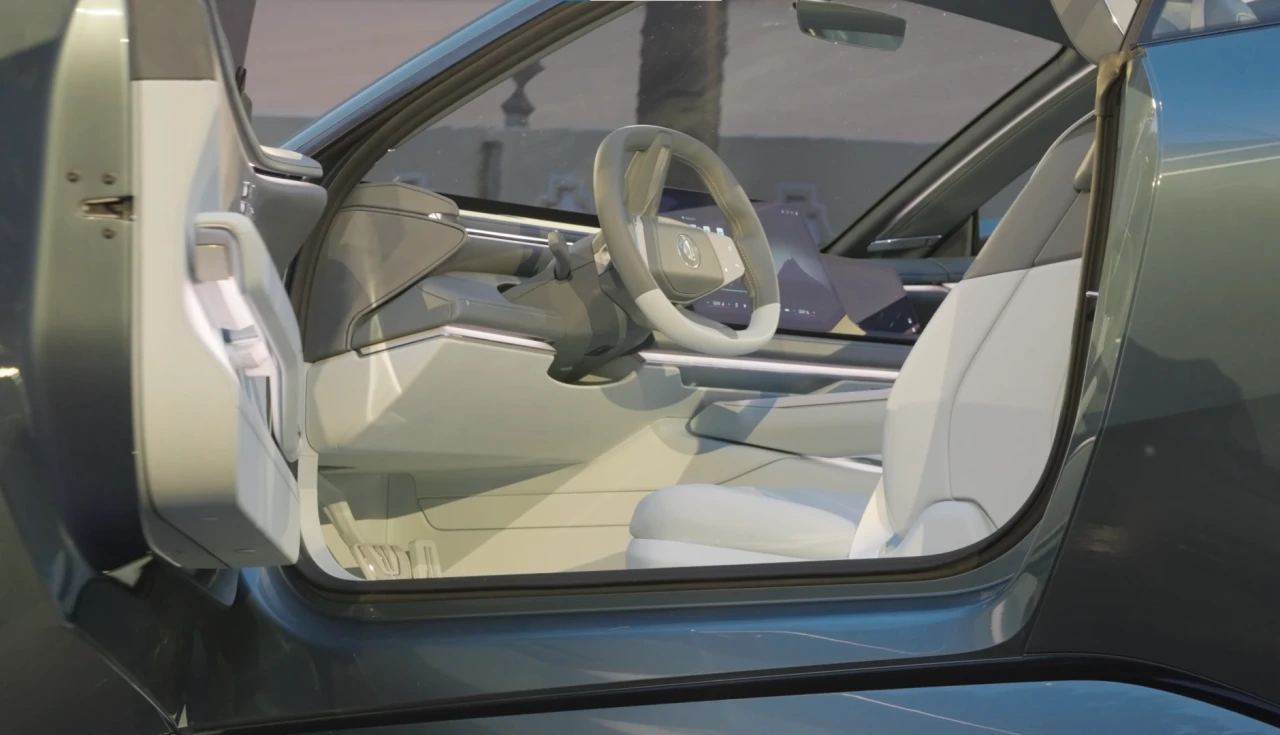
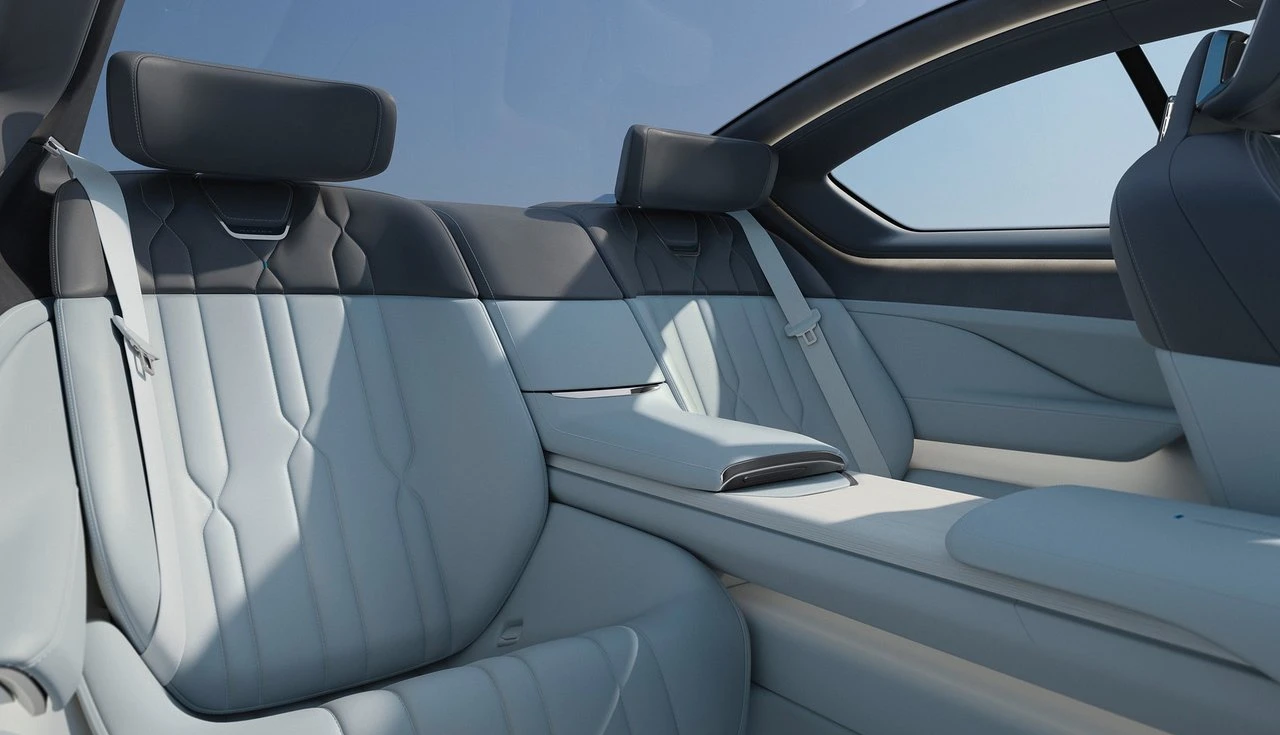
Stepping inside the Vision Alpina feels like walking into a high-end private office that happens to top 300 mph. The 2+2 cabin is built around a sharp two-tone split: a darker upper section to cut windshield glare and sharpen focus, and a lighter lower section in white and gray inspired by the snow-covered Alps, which opens the space up and adds a sense of calm.
Every surface is wrapped in full-grain leather sourced from Alpine tanneries that use low-chemical dyeing processes. The texture is buttery and the smell is part of the experience — the kind of thing that separates a hand-built interior from a factory press. The stitching uses a technique called bridge stitching, applied in the brand’s heritage colors of blue and green, providing a quiet contrast against the lighter leather.
The steering wheel ditches the thick-rimmed M-car design entirely. In its place, a four-spoke design with paired vertical spokes and the new Alpina logo centered at the hub — built for a relaxed grip on long drives. Gear selectors and drive mode controls are carved from faceted translucent crystal, paired with metals machined to watch-grade precision.
Displays, Driver Assistance and the Crystal Detail Nobody Expected
The instrument cluster has no analog gauges. The entire dash is anchored by the BMW Panoramic iDrive system, made up of three distinct screens: a large rhombus-shaped central touchscreen angled toward the driver, a full-width panoramic display at the base of the windshield projecting key data into the driver’s sightline, and a third screen dedicated entirely to front-passenger entertainment and controls.
The UI was redesigned from scratch for Alpina. Switching from Comfort+ to Speed mode doesn’t trigger red aggressive graphics like in an M car. Instead, the signature blue and green palette deepens in saturation, and the background renders a digital representation of the Alps as seen from the brand’s original home in Buchloe, Germany.
The cabin’s standout feature — and the one that has no direct rival in this class — is the motorized rear center console. At the touch of a button, it quietly lifts a thick glass bottle alongside two crystal glasses, each etched with 20 vertical grooves referencing the wheels’ 20-spoke design. The glasses are magnetically secured to the base so they won’t rattle or tip through corners.
The real limitation is one purists will notice immediately: the all-digital setup, however polished, makes the interior feel closer to a modern BMW SUV than to the analog blue-dialed Alpina instruments that longtime fans associate with the brand.
The front seats balance lateral support with the kind of cushioning that handles a six-hour drive without complaint. Rear passengers benefit from the 5,200 mm footprint with proper legroom for adults.
640 HP That Never Breaks a Sweat: The Engineering Behind the Vision Alpina
In a market that’s been sprinting toward full electrification, the confirmed presence of a V8 combustion engine under the Vision Alpina’s hood landed as a deliberate statement, not an oversight.
The powertrain projected for the production model is based on the S68 — a 4.4-liter twin-turbo V8 with two Twin-Scroll turbochargers mounted inside the “V” formed by the cylinder banks, in what’s known as a Hot-V configuration. That placement shortens the exhaust gas path to the turbines, which cuts turbo lag significantly. The engine pairs that with double variable valve timing (Double VANOS) and continuous variable lift (Valvetronic) to optimize breathing across every rev range.
To meet emissions standards and smooth out urban low-speed transitions, the powertrain integrates a 48-volt mild-hybrid system with an integrated starter-generator that fills torque gaps before the turbos reach full boost.
Projected output sits at roughly 640 horsepower at around 5,600 rpm. Estimated torque comes in at ~800 lb-ft, arriving at just 1,800 rpm and holding flat across a wide rev range. That means massive acceleration in any gear, at any speed, without asking the driver for anything.
The 0–60 mph run is estimated between 3.0 and 3.2 seconds — serious numbers for a car weighing approximately 5,300 pounds. But the number that really captures the Alpina philosophy is the top speed: an estimated 208 mph with no electronic limiter. On the Autobahn, the car reaches that mark without sending a single vibration through the crystal glasses in the rear console.
Power routes through an 8-speed ZF automatic transmission recalibrated with Alpina’s proprietary Switch-Tronic software — tuned for seamless, imperceptible shifts rather than the sharp jolts you’d get from an M car. Drive goes to all four wheels via xDrive all-wheel drive, with a rear-biased torque distribution to preserve the feel of a classic rear-wheel-drive grand tourer.
Estimated Specs — BMW Vision Alpina Concept
| Item | Specification |
|---|---|
| Engine | 4.4L V8 Twin-Turbo + 48V Mild-Hybrid |
| Horsepower | ~640 hp (~5,600 rpm) |
| Torque | ~590 lb-ft (from 1,800 rpm) |
| Transmission | 8-speed automatic (ZF + Switch-Tronic) |
| Drivetrain | xDrive AWD, rear-biased |
| 0–60 mph | ~3.0–3.2 seconds |
| Top Speed | ~208 mph (est.) |
| Fuel Economy | ~16–20 mpg combined (est.) |
| Length | 204.7 in (5,200 mm — official) |
| Curb Weight | ~5,300 lbs (est.) |
What the BMW Alpina Would Actually Cost in the US — and Why That Number Makes Sense
BMW has confirmed that the production model will start well above $200,000 before options. In the European market, it goes head-to-head with the Bentley Continental GT, which opens around €230,000. In the US, the final transaction price for a fully configured Alpina could realistically push $250,000 to $300,000, placing it firmly in a segment currently owned by Bentley and the upper reaches of Mercedes-Maybach.
That’s not accidental. The brand is targeting buyers who want the performance numbers of a supercar and the interior refinement of a private jet, without the visual loudness of an Italian exotic.
Ownership costs beyond the purchase price deserve a serious look. Maintenance falls squarely in the high category. The core mechanical and electronic architecture — V8 engine, iDrive system, CAN-BUS network — shares protocols with the authorized BMW dealer network, which helps with diagnostics and routine service. The challenge is with Alpina-exclusive components: the crystal-integrated headlights, the forged 23-inch 20-spoke wheels, and the active roll stabilization hardware aren’t stocked at typical dealerships. Any damage to those parts means waiting on specialty-order imports.
Insurance premiums will reflect both the replacement cost and the scarcity of qualified repair technicians. Annual premiums for comparable ultra-luxury vehicles in the US commonly run $8,000 to $15,000 or more depending on the owner’s profile and location — a realistic baseline for what the Alpina would command.
The buyer this car is built for already knows all of this. They’re not cross-shopping a fully loaded BMW M8 at $140K. They’re comparing the Alpina to a Continental GT or a Rolls-Royce Ghost entry point — and choosing it specifically because it offers a sharper driving connection than either, wrapped in comparable material quality.
If you’re buying for investment logic, wait. If you’re buying because nothing else on the market delivers this exact combination of engineering and restraint, the wait for the 2027 production model is already justified.
Frequently Asked Questions About the BMW Vision Alpina Concept
What engine does the BMW Vision Alpina Concept use? A 4.4-liter twin-turbo V8 paired with a 48-volt mild-hybrid system, with projected output around 640 hp and ~590 lb-ft of torque. BMW has not released an official spec sheet yet.
When will the BMW Alpina production model arrive in the US? The production version, based on the BMW 7 Series platform, is scheduled to launch in 2027. No official US pricing or availability has been confirmed as of this writing.
What’s the difference between BMW Alpina and BMW M? BMW M is built around track performance — firm suspension, aggressive throttle mapping, sharp dynamics. Alpina is built around effortless high-speed cruising: softer but precise, quieter but faster at the top end. Two completely different philosophies.
Who are the main competitors of the BMW Vision Alpina? The Bentley Continental GT is the primary target. At a broader level, top-spec Mercedes-Maybach sedans and high-end Range Rover configurations occupy similar price territory and buyer profiles.
Is the BMW Vision Alpina Worth $250,000?
Financially, ultra-luxury purchases rarely pencil out on paper. That’s not the point.
The Vision Alpina exists for the buyer who considers a Ferrari too cramped, a Rolls-Royce too conspicuous, and a BMW M8 too aggressive for a Tuesday morning. It’s a concept car that maps the direction of a brand in serious transition — and the 2027 production model will carry the full weight of that vision.
For the technically minded driver who wants to cover 500 miles at 200 mph and step out without a wrinkle, there’s genuinely nothing else available right now that hits all those marks.
The Alpina isn’t built to be noticed. It’s built to be understood.
Share this article
Related posts