1,000 Horsepower in a Pickup: What Happens When You Floor the Hummer EV
Weighing over 9,000 pounds with up to 1,000 horsepower, the GMC Hummer EV 2027 defies every logical rule of automotive engineering. How does Detroit’s wildest supertruck handle real-world American roads?

When the Hummer badge was quietly retired over a decade ago, most industry observers assumed the era of the unapologetic American behemoth had come to a permanent end.
The automotive world was sprinting toward tighter emissions regulations, smaller displacement engines, and aerodynamic shapes designed to squeeze every mile out of a gallon of gas.
Yet, when General Motors decided to resurrect its most polarizing nameplate, it didn’t do so with a compromise.
The GMC Hummer EV returned not as a sensible commuter, but as a rolling statement that the transition to electricity could be just as excessive as the V8 era.
Looking at the 2027 lineup, it becomes clear how Detroit’s engineers transformed a symbol of early-2000s fuel consumption into an electric tour de force.
The mission was never to build a practical family vehicle, but rather an engineering showcase of brute force and extreme off-road capability.
Some view this supertruck as an environmental contradiction, while others see it as the absolute pinnacle of full-size truck design.
Regardless of where you stand, ignoring its physical and mechanical presence on American pavement is simply impossible.
From Baghdad to Suburban Driveways: The Weight of a Legacy
The Hummer story is inextricably linked to military heritage, where battlefield survivability and obstacle clearance outweighed aesthetics.
The civilian version of the Humvee became an instant status symbol in the late 1990s, dominating suburban driveways and rap videos alike.
That cultural baggage was a heavy load to carry into the clean-energy era.
How do you convince traditional truck buyers that a massive steel rig could run on battery cells without losing its rugged identity?
General Motors answered by doubling down on an intimidating stance and blocky, squared-off proportions.
The illuminated seven-slot front grille instantly connects the truck to its combustion-engine ancestors, though with a much cleaner, contemporary execution.
By leaning hard into its massive footprint, the GMC Hummer EV carved out its own niche in the luxury truck segment.
It doesn’t pretend to be modest or compact; it wears its oversized heritage with a sense of pride.
This bold positioning has been crucial in capturing both nostalgic brand loyalists and affluent tech enthusiasts looking for the next big thing.
Ultium Architecture and the Mechanics of Excess
Beneath the squared-off sheet metal lies the Ultium platform, the modular backbone of General Motors’ next-generation electric fleet.
This architecture had to be heavily reinforced to handle the immense curb weight and twisting forces generated by the powertrain.
In its top-tier configurations, the truck is propelled by three electric motors delivering up to 1,000 horsepower and an wheel-torque figure that sounds almost fictional.
That is more than enough muscle to pull heavy trailers up steep grades or crawl over jagged boulders without breaking a sweat.
To feed this massive power plant, GM installed a colossal battery pack with a usable capacity exceeding 200 kWh.
The battery assembly alone weighs more than a typical subcompact sedan sold in Europe or Asia.
An adaptive air suspension system and electronic locking differentials work in harmony to control a vehicle mass that pushes past the 9,000-pound mark.
Engineers spent years calibrating the chassis to balance smooth highway cruising with torsional rigidity on dirt trails.
The result is a mechanically complex machine where every suspension arm, axle, and frame rail is over-engineered by industry standards.
Inside the Cockpit: Ergonomics, Space, and Utility
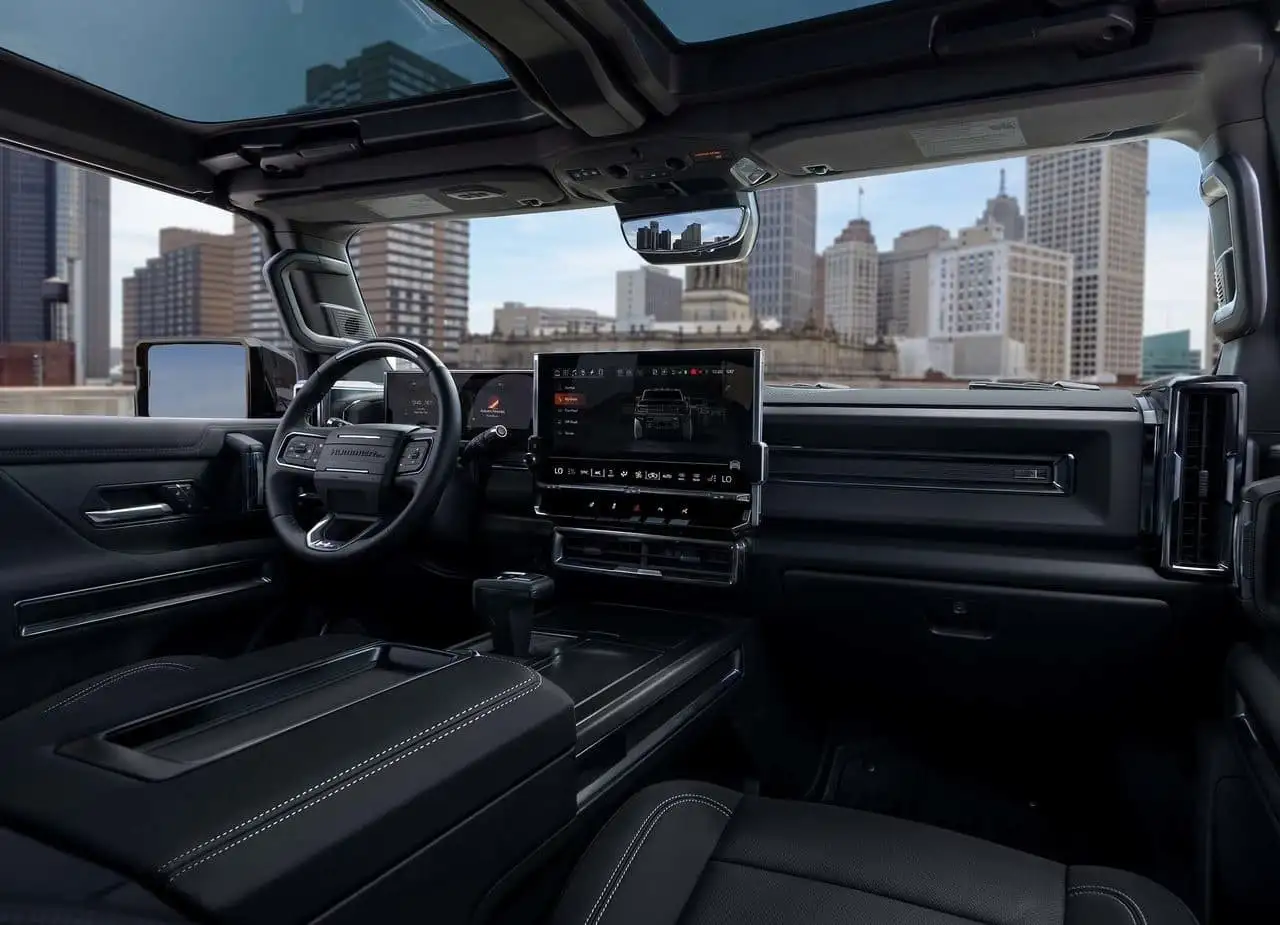
Climbing into the cabin of the GMC Hummer EV requires a solid step up, a visual reminder of its towering ground clearance.
The interior design language mirrors the exterior, featuring straight lines, wide surfaces, and chunky physical controls designed to be operated with work gloves.
Materials consist of high-durability rubberized surfaces, rugged plastics, and premium synthetic leather trims that feel built to withstand abuse.
The goal wasn’t to replicate the delicate luxury of a German sedan, but rather to offer an environment of upscale ruggedness.
Two massive digital displays dominate the dashboard: a 12.3-inch configurable instrument cluster and a 13.4-inch touchscreen for the infotainment system.
The graphical interface was developed in collaboration with digital design studios, featuring sci-fi-inspired animations and real-time telemetry data.
Passenger space is cavernous in both rows, comfortably accommodating five adults of above-average stature without a hint of cramping.
Additionally, the modular Infinity Roof allows owners to remove the glass panels and store them in the front trunk (frunk), turning the supertruck into an open-air convertible.
This versatility transforms the cabin from a quiet highway cruiser into an immersive command center for weekend adventures in the wilderness.
Tearing Up Tarmac and Trails: Defying Physics in the Real World
Stomping the throttle of the GMC Hummer EV from a standstill is an experience that temporarily rearranges your understanding of physics.
Engaging the “Watts to Freedom” launch control system lowers the air suspension, primes the battery inverters, and catapults the truck from zero to 60 mph in roughly three seconds.
Instantaneous all-wheel-drive traction prevents excessive tire spin, throwing the truck’s massive weight down the asphalt with controlled violence.
The physical G-forces pinning you to the seat stand in stark contrast to the lack of V8 roar, replaced instead by a futuristic electric hum.
When the pavement ends, the truck demonstrates why it wears the Hummer badge on its tailgate.
The signature CrabWalk feature steers the rear wheels in the same direction as the front wheels, allowing the vehicle to slide diagonally at low speeds to avoid trail obstacles.
Four-wheel steering also drastically reduces the turning radius, making tight maneuvers in crowded supermarket parking lots surprisingly manageable.
Underbody cameras provide real-time views of the terrain directly beneath the chassis, complete with integrated washers to clear mud and dust from the lenses.
This suite of off-road hardware turns intimidating rock gardens and deeply rutted trails into straightforward obstacles for drivers of any skill level.
The Showdown: Hummer EV vs. Cybertruck and Rivian R1T
The high-end electric truck segment in North America has quickly become a battleground for automotive supremacy and cultural clout.
On one side sits the Rivian R1T, which takes a lifestyle-oriented approach focused on outdoor adventure and clean, Scandinavian-inspired design.
On the opposite end, the Tesla Cybertruck captures headlines with its unpainted stainless-steel exoskeleton and polarising, angular geometry.
Tesla’s entrant leans heavily into aerodynamic efficiency and minimalist interior technology to win over buyers.
The GMC Hummer EV occupies a distinct middle ground between traditional Detroit muscle and futuristic EV engineering.
It offers significantly more interior cabin volume and a more commanding physical presence than the Rivian, appealing directly to buyers used to full-size American trucks.
Compared to the Cybertruck, GM’s flagship offers a more familiar control layout and traditional physical buttons that make daily operation more intuitive.
However, its immense weight penalty translates to less agility in corners and a need for wider parking spaces in dense urban cores.
Choosing between these three American contenders ultimately comes down to personal taste and which design philosophy resonates most with the buyer.
The Daily Grind: Charging, Efficiency, and Infrastructure Reality
All that structural steel, mechanical strength, and sheer horsepower come with a notable trade-off in electrical efficiency.
The GMC Hummer EV is far from the most economical EV on the market, consuming a significant amount of kilowatt-hours to move through stop-and-go city traffic.
The aerodynamics of a brick wall paired with heavy-duty, all-terrain tires create substantial drag, leading to quicker battery drain at interstate speeds.
To compensate for this thirst, the truck utilizes an 800-volt electrical architecture capable of ultra-fast DC charging at high-output stations.
When plugged into a 350-kW charger, the battery can regain nearly 100 miles of range in just roughly ten minutes, provided the charging station functions at peak output.
However, attempting to recharge a battery pack of this magnitude on a standard Level 1 residential outlet is an exercise in futility that would take multiple days.
Another real-world consideration involves navigating older city infrastructure, narrow bridges, and compact residential garages.
Drivers must occasionally plan their routes and parking strategies in advance to accommodate the vehicle’s exceptional width and curb weight.
It is simply the operational cost of driving an uncompromising supertruck built without traditional automotive boundaries.
The 2027 Outlook: What This Means for American Trucks
As the 2027 lineup rolls out, General Motors solidifies the GMC Hummer EV not as a temporary PR stunt, but as the technological flagship of its entire portfolio.
The truck functions as a rolling laboratory, testing software and hardware solutions that eventually filter down to more mainstream models like the Chevrolet Silverado EV.
Continuous updates to driver-assist technologies, including the hands-free Super Cruise system for mapped North American highways, keep the platform feeling state-of-the-art.
GM understands that buyers paying top dollar in this segment expect nothing less than the most advanced technology available.
The electric truck market will continue to evolve, balancing the consumer desire for extended driving range with the necessity of competitive pricing.
Even so, there will always be a dedicated audience for vehicles that prioritize emotional impact, sheer presence, and maximum capability.
The Hummer EV has proven that American buyers are more than willing to embrace electrification if it comes wrapped in a package of extreme performance.
The challenge moving forward will be refining the efficiency of the platform without diluting the larger-than-life personality that made the badge famous in the first place.
The GMC Hummer EV stands as a monumental milestone in modern automotive history.
It represents the unlikely marriage between the rugged, brute-force attitude of military-inspired trucks and the clean, silent power of modern electric propulsion.
Its greatest strengths lie in its overwhelming horsepower, exclusive off-road driving modes, and an unmistakable street presence that no competitor can fully duplicate.
On the flip side, its massive curb weight and substantial physical footprint are undeniable realities that require careful consideration before putting an EV of this size in your driveway.
This is a machine built on excess, engineered specifically for drivers who want to push the absolute boundaries of what an electric pickup can do on the highway and on the trail.
Now we want to hear from you: would you want an electric supertruck with the massive size and aggressive attitude of the Hummer EV, or do you prefer smaller, more efficient electric vehicles for daily driving? Drop your thoughts in the comments below and join the conversation!

Danniel Bittencourt
15/07/2026