Lotus Evija 2025: The World’s Most Powerful Production EV Reviewed
2,011 HP, 130 units worldwide, and an MSRP hovering near $2.7M — but it can’t touch a public road in America. The Lotus Evija is the most extreme production car ever built. Does it actually deliver?
Lotus Evija 2025: The 2,011 HP Electric Hypercar That Rewrote the Rules
2,011 horsepower. All-electric. 130 units for the entire planet. The Lotus Evija is the most powerful production car ever homologated — and it arrived without a combustion engine in sight.
This isn’t a new generation or a facelift. It’s the single sharpest break in Lotus’s 77-year history: the British brand that built its reputation on being featherlight now produces the world’s heaviest technological statement on four wheels.
Its closest rivals are the Rimac Nevera and the Pininfarina Battista. But Hethel’s approach is fundamentally different — this machine was engineered for the circuit, not the highway.
And in the United States, there’s a twist: the Evija cannot legally be driven on public roads. Every unit delivered stateside is a track-only machine, by federal mandate.
Lotus Evija Quick Specs
| Specification | Details |
|---|---|
| Category | Electric Hypercar |
| Powertrain | 4 independent radial axial-flux electric motors |
| Output | 2,011 HP (1,500 kW) |
| Torque | 1,257 lb-ft |
| Transmission | 4 single-speed planetary gearboxes (one per wheel) |
| Drive | Permanent AWD with torque vectoring |
| 0–60 mph | Under 3.0 seconds |
| Top Speed | 217 mph (electronically limited) |
| Efficiency | ~121 MPGe (EPA equivalent) |
| Range | 195–215 miles (WLTP cycle) |
| On Sale | 2025 — deliveries underway |
The numbers above don’t describe a car. They describe a controlled detonation on four wheels. But raw figures and WLTP range estimates don’t tell the full story of what Lotus actually built here — and the real narrative gets far more complicated the moment you leave pit lane. Keep reading.
The Carbon Sculpture That Breathes the Air Around It
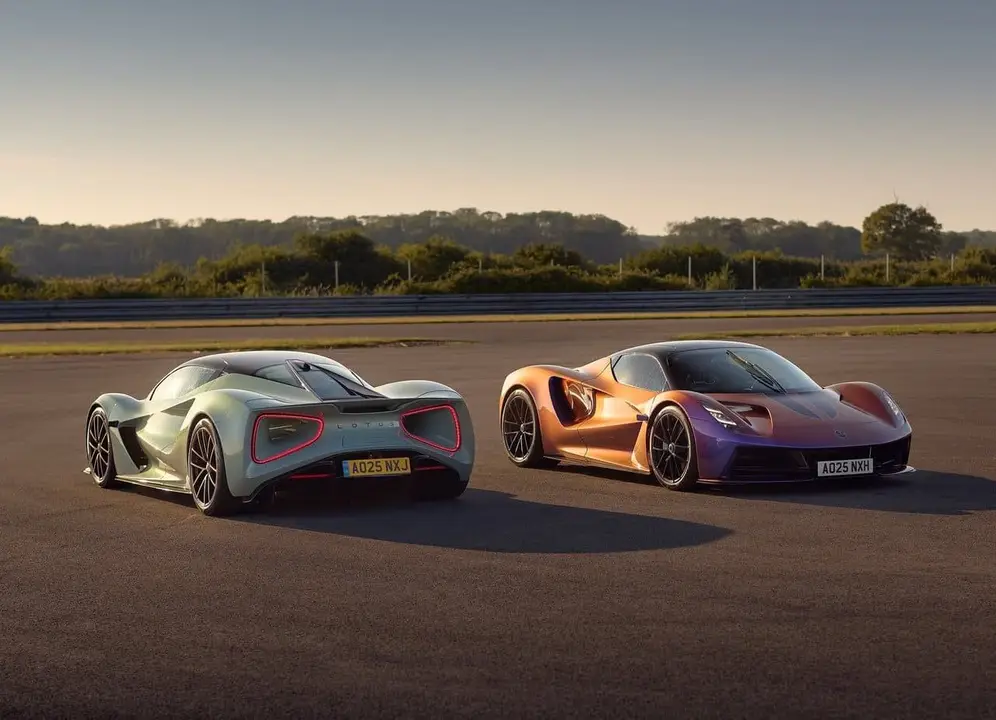
Walking around the Evija for the first time is genuinely disorienting. There’s nothing here that connects visually to any Lotus that came before it — no echoes of the Elise, no trace of the Exige’s aggression.
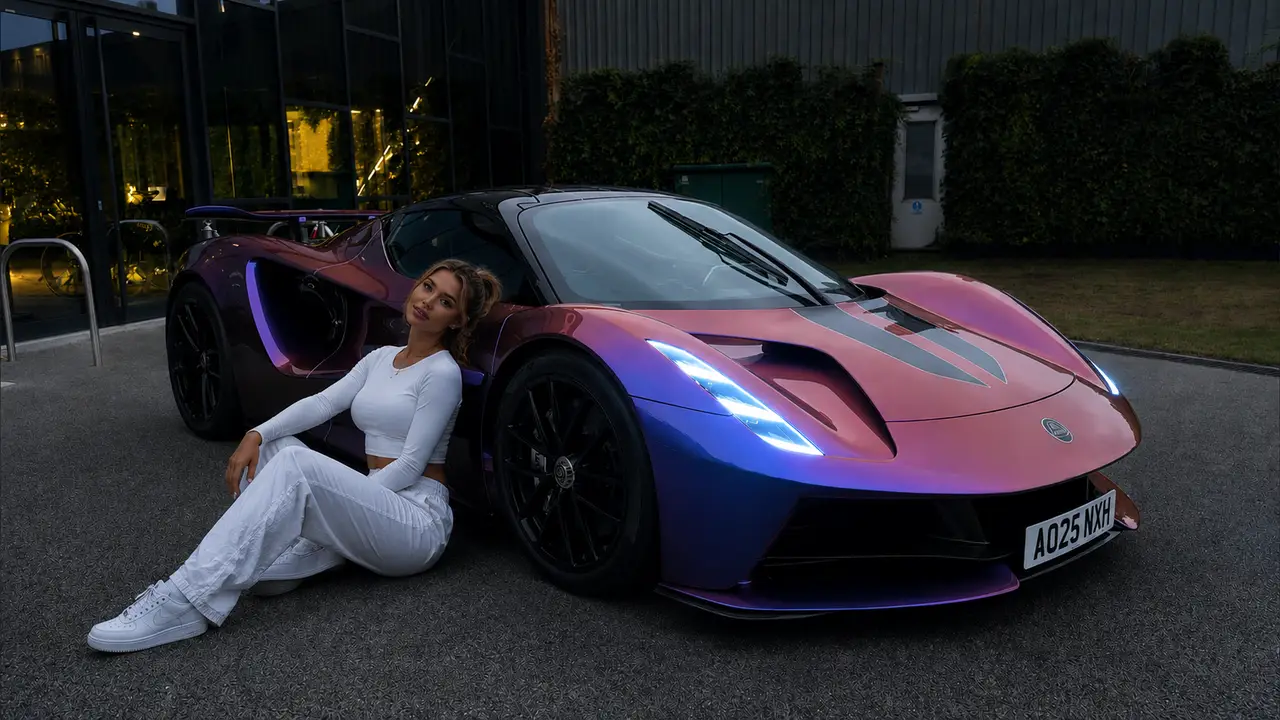
Up front, the nose is compressed almost to a vanishing point. There’s no conventional grille. The headlights are a tight laser matrix co-developed with Osram — solid-state diodes housed in modules narrow enough to preserve the laminar airflow running across the hood.
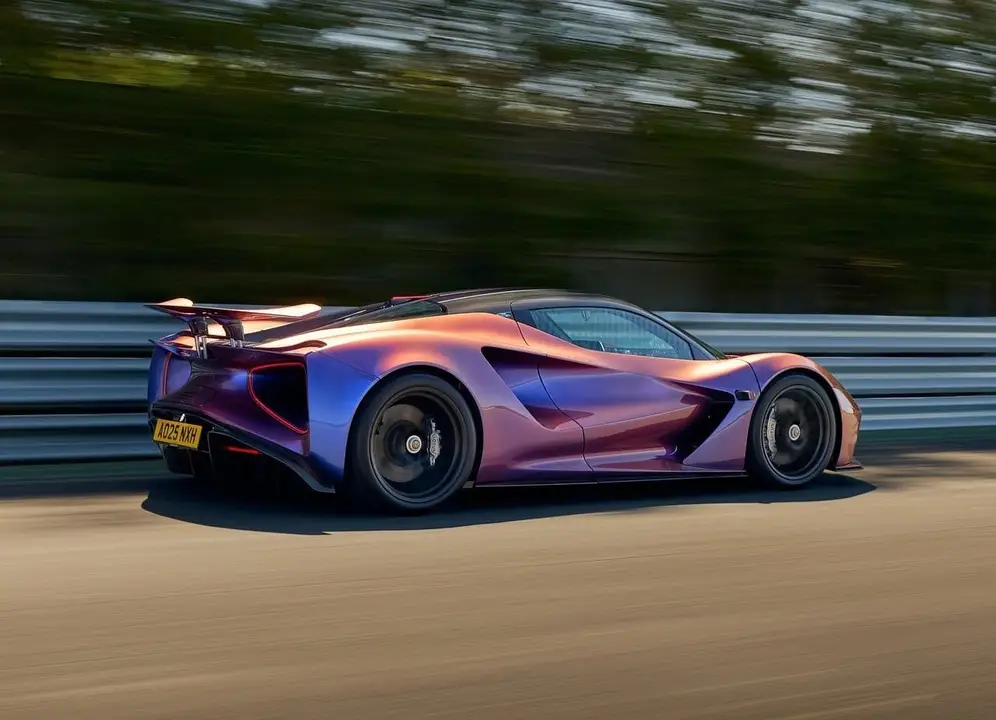
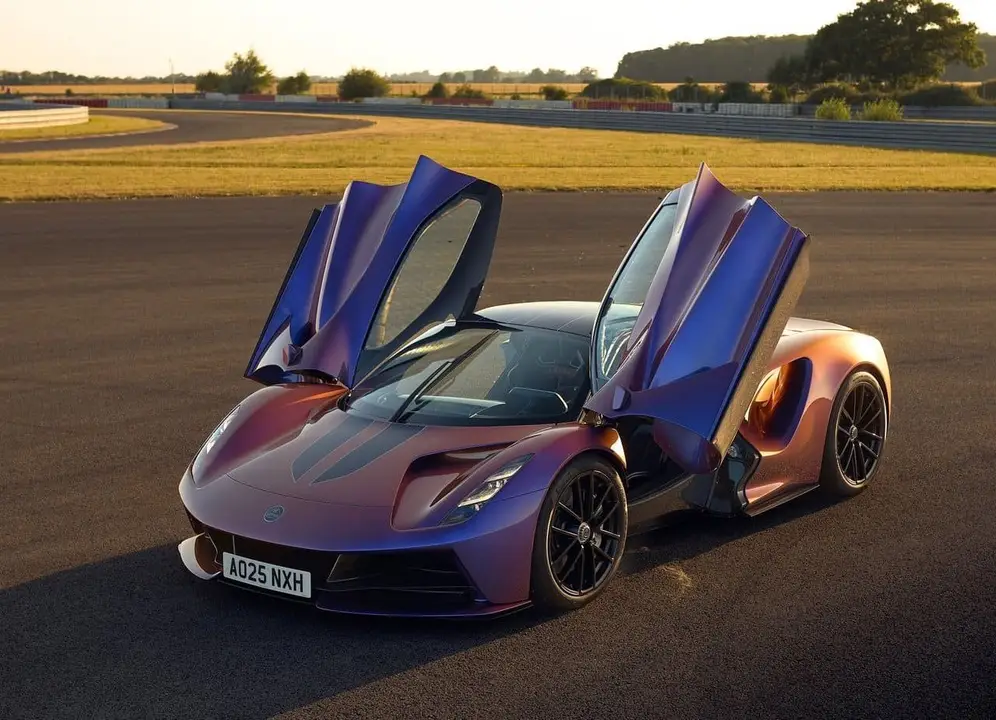
From the side, the roofline drops to just 44.2 inches off the ground. The magnesium-forged wheels fill the arches with surgical precision. The whole silhouette reads like something designed in a wind tunnel rather than a studio.
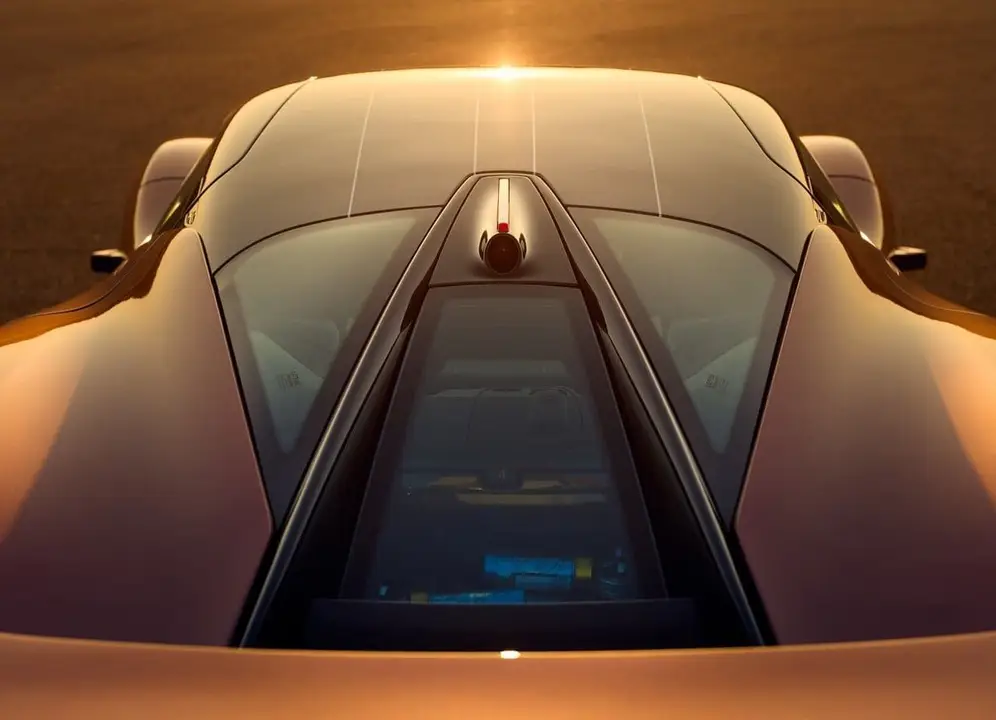
The rear is where the engineering thesis becomes visual. Two massive Venturi tunnels cut horizontally through the taillights. High-pressure air enters the flanks, travels through the body and creates a low-pressure zone that pulls the chassis toward the pavement. At top speed, this system generates 3,704 lbs of downforce — nearly the car’s own curb weight pressing it into the track.
No physical mirrors. Motorized camera arms deploy from the front fenders at unlock. The doors are dihedral, latch-free, actuated entirely by the key fob. The carbon skin is unbroken from any angle.
This design doesn’t reference the current Lotus language — it obliterated it entirely, on purpose.
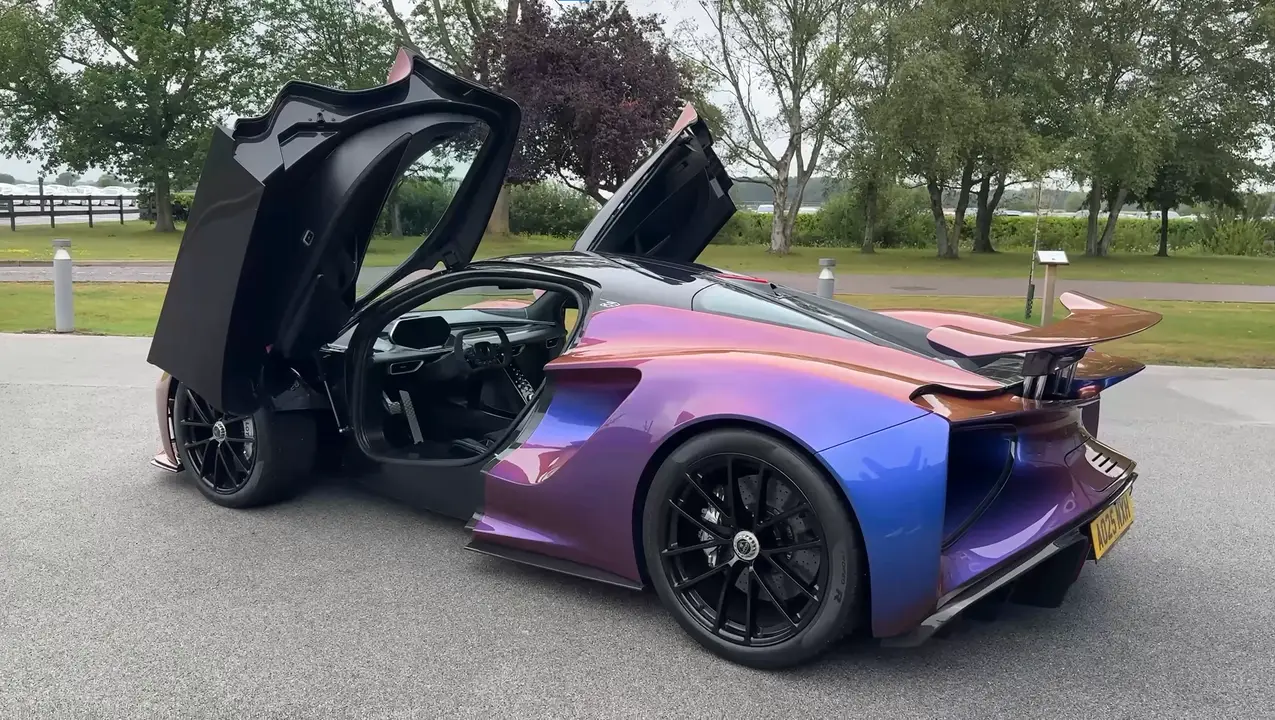
A Cockpit Built Around the Driver, Nothing Else
The doors pivot forward and upward, revealing an interior that makes its priorities clear immediately. No excess. No theater. Every surface exists to eliminate distraction and keep your attention on the track ahead.
The dominant feature is what Lotus calls a “floating wing” center structure — a hollow metallic pillar running floor to ceiling, covered in dozens of hexagonal backlit haptic switches. It looks like a honeycomb built from aircraft-grade aluminum, and every input confirms itself through your fingertips.
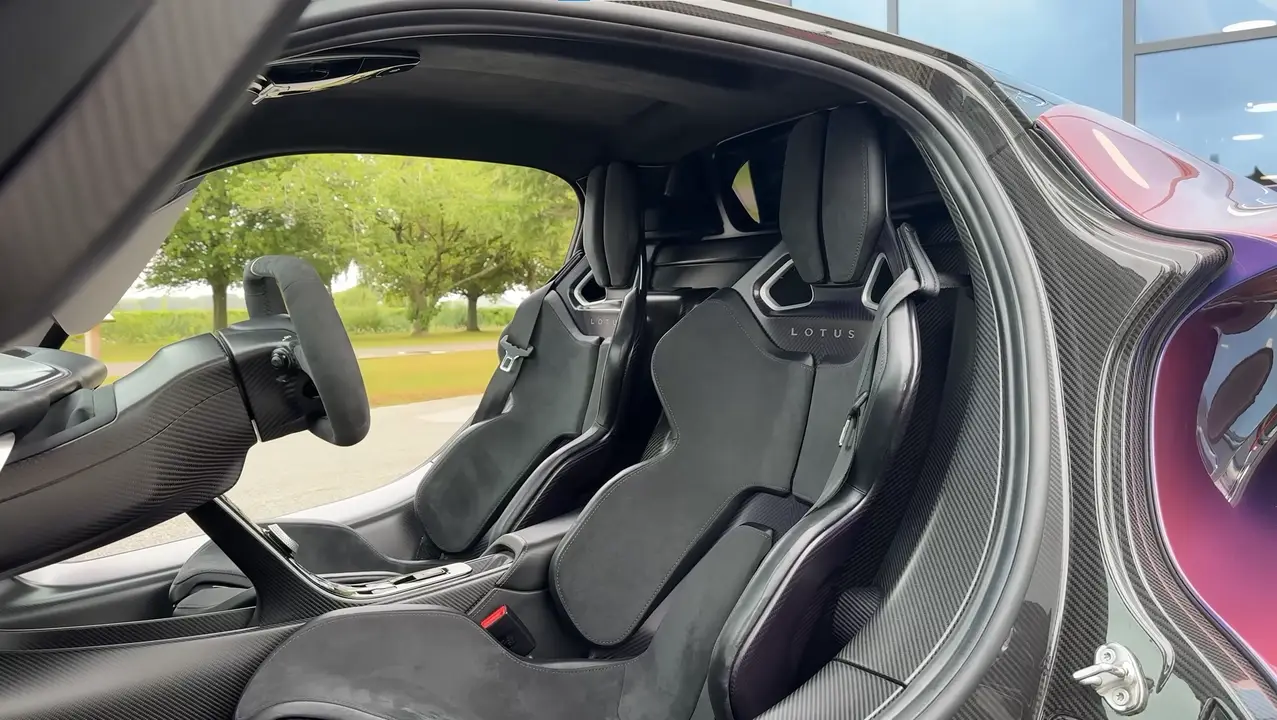
The seats are hand-formed carbon fiber shells with segmented Alcantara padding. Lateral support is absolute. Long-distance comfort is not the point.
Material quality is consistent with the asking price. Carbon, machined metal and Alcantara everywhere. The Fittipaldi Edition escalates further: genuine black leather with gold-thread stitching across the dash and headliner, with Emerson Fittipaldi’s signature permanently engraved into the carbon panels.
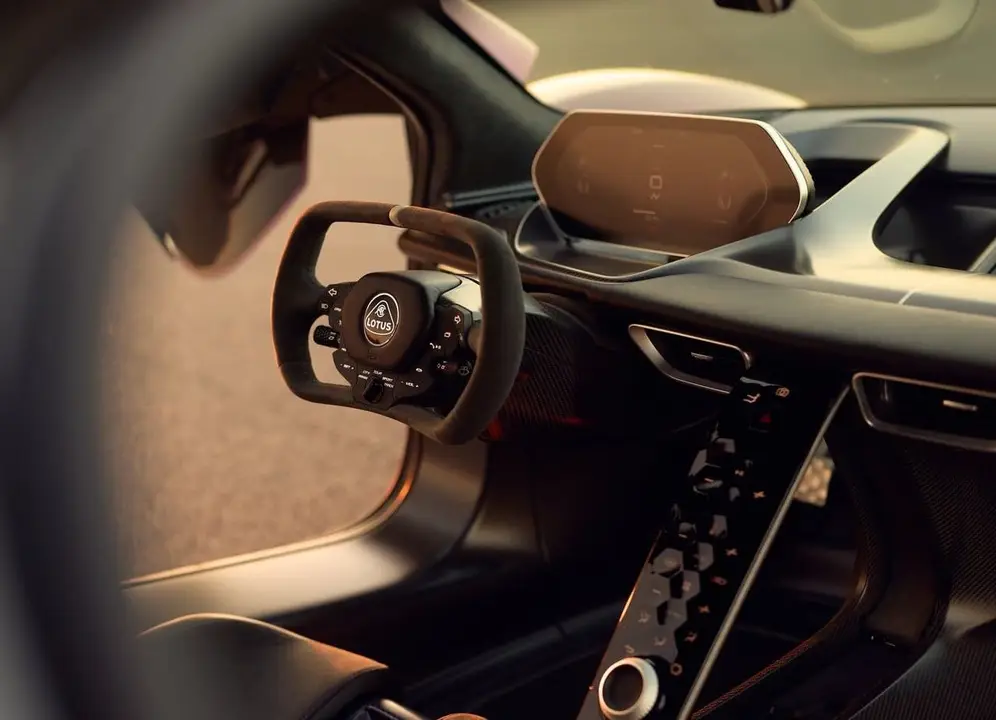
Screens, Data and the Limits of the Space
The infotainment system runs through a single primary display ahead of the driver, with cloud-based telemetry via onboard data modems, dual-zone climate control, Apple CarPlay and Android Auto integration.
The camera system replacing conventional mirrors feeds three interconnected high-definition screens inside the cabin. Refresh rate is instantaneous. The coverage is genuinely superior to physical glass in most conditions.
The steering wheel is a flat-bottomed yoke with rotary selectors for driving modes and chassis settings. Column adjustment is manual and multi-angle.
Trunk space? Technically present. The rear compartment offers 5.3 cubic feet — which testers unanimously describe as fitting two rolled race suits and a pair of carbon helmets. Nothing else.
Undisputed cabin strength: the camera-based mirror replacement system is the best execution of the concept in any production car currently available.
Real limitation: the dihedral door geometry creates genuine ergonomic problems in tight urban environments — the sweep arc threatens ankles and shins for anyone who forgets to step back before the mechanism clears.
2,011 HP on Tarmac: What Those Numbers Actually Feel Like
Four radial axial-flux electric motors, engineered by Integral Powertrain Ltd. Each wheel gets its own motor, its own silicon carbide inverter and its own single-speed planetary gearbox. No conventional driveshaft. No complex transfer case. Each complete Electrical Drive Unit measures just under four inches deep.
Combined system output is 1,500 kW — 2,011 HP. Torque sits at 1,257 lb-ft, managed individually at each corner by torque vectoring algorithms operating in millisecond intervals.
The 0–60 mph sprint happens in under 3.0 seconds flat. That number is impressive, but it’s not the headline. The sprint from 124 mph to 186 mph happens in roughly half the time it takes the best quad-turbo combustion rivals to cover the same interval. Top speed is electronically capped at 217 mph to protect the Pirelli Trofeo R tire sidewalls from centrifugal disintegration.
The NMC 91 kWh battery pack runs on an 800V architecture, developed by Williams Advanced Engineering. It’s mounted vertically behind the seats — replicating the polar moment behavior of a mid-rear combustion engine — centralizing rotational inertia in a way that makes the car pivot around its own center with unsettling precision.
DC fast charging accepts up to 350 kW. From 10% to 80% in 12 minutes. Full charge in 18 minutes via CCS connector.
Braking is handled by 15.4-inch carbon-ceramic rotors at both axles, clamped by AP Racing six-piston calipers. There is no regenerative intrusion through the brake pedal — pure hydraulic mechanical feedback, exactly as Lotus intended.
Rated efficiency is 121 MPGe under EPA-equivalent metrics, with a WLTP range of 195 to 215 miles.
$2.7 Million MSRP — And That’s Before It Gets Complicated
The Evija carries a base MSRP of approximately $2.7 million in the US market — and arrives exclusively as a track-only vehicle.
Federal safety regulations require two-stage intelligent airbags that the Evija’s aerodynamic and weight-focused architecture cannot accommodate. The result is a car that is fully street-legal across Europe but categorically cannot be registered for public road use in any American state. Every US delivery goes directly to a private garage or racing facility.
That context shapes the entire ownership calculus differently here than anywhere else on earth.
Insurance premiums for a vehicle with no MSRP equivalent on any actuarial table are negotiated as bespoke contracts — closer to fine art coverage than automotive policies. Market Estimate: annual premiums comfortably exceeding $150,000, with standard exclusion clauses during timed track sessions — precisely the use case for which the car exists in this market.
Maintenance costs for routine service are, in theory, lower than a comparable V12 combustion hypercar. No heavy fluids, no complex gearbox rebuilds, no exhaust systems. Market Estimate: routine servicing substantially below thermal equivalents in the same price bracket. However, 800V battery degradation issues or torque vectoring software failures require Lotus’s “Flying Doctors” — factory-trained engineers flown in from England with proprietary diagnostic hardware. Dealer network support for this vehicle in the US remains extremely limited.
Financing at this level operates entirely outside conventional retail lending — private banking lines and structured asset finance are the standard instruments.
The investment debate is legitimate. Post-production combustion hypercars from Ferrari and Gordon Murray have historically appreciated sharply. BEV hypercars face the opposite pressure: solid-state battery technology is advancing fast enough that the performance figures commanding $2.7 million today will be replicated by mainstream performance EVs within a decade. Secondary market resistance to software-dependent ultra-luxury vehicles is already being reported by dealers globally.
Who does this make sense for? The serious collector pursuing the rarest object in the current EV landscape — particularly the Fittipaldi Edition with its verifiable connection to Formula 1 history. The track-day enthusiast seeking the most extreme driving instrument available on earth right now. Not for anyone prioritizing long-term financial returns or daily usability.
Frequently Asked Questions About the Lotus Evija
What is the real-world range of the Lotus Evija?
195 to 215 miles under WLTP testing. In full track mode with unrestricted performance, the battery depletes in approximately 15 minutes or around 30 miles of aggressive running.
Can the Lotus Evija be driven on public roads in the United States?
No. Due to the absence of federally mandated two-stage intelligent airbags, every US-market Evija is delivered as a track-only vehicle, ineligible for street registration in any state.
Who are the Lotus Evija’s main competitors?
The Rimac Nevera and Pininfarina Battista are the most direct rivals in the all-electric ultra-performance hypercar segment.
Are maintenance costs high on the Evija?
Market Estimate: routine servicing is expected to run below comparable V12 hypercars. Complex battery or software failures, however, may require factory-dispatched specialists — a significant cost variable for US owners without local authorized service infrastructure.
Does the Lotus Evija Justify $2.7 Million?
The Evija is an emotional purchase — full stop. The electro-hydraulic steering is the most communicative in its class. The acceleration above 124 mph is in a category no combustion rival can reach. The pure mechanical braking system delivers confidence that no regenerative setup currently matches.
The software instability is documented and real. Track endurance is 15 minutes before recharge. The cargo hold fits two helmets.
This car is not for the daily driver, the value-focused buyer or anyone expecting grand touring capability.
It is the most extreme statement 130 people in the world can make about what an electric hypercar is capable of becoming.
And you — does a $2.7 million track-only car that needs a recharge after 15 minutes of hard running make any sense to you, or is this the most elaborate way ever invented to spend a fortune standing in the pit lane? Drop your take in the comments below.
Share this article

Por: Danniel Bittencourt
05/06/2026
Related posts