Mercedes-AMG G63 Azura: Full Review of Mansory’s Convertible SUV
Mansory took a Mercedes-AMG G63, cut the roof off, shortened the chassis, flipped the doors backward and pushed output to 820 horsepower. The Azura Cabrio debuted in Monaco and it doesn’t look like anything else on the road.

Por: Danniel Bittencourt
08/05/2026
Mansory Azura 2026: The G63 That Lost Its Roof and Gained 820 Horsepower
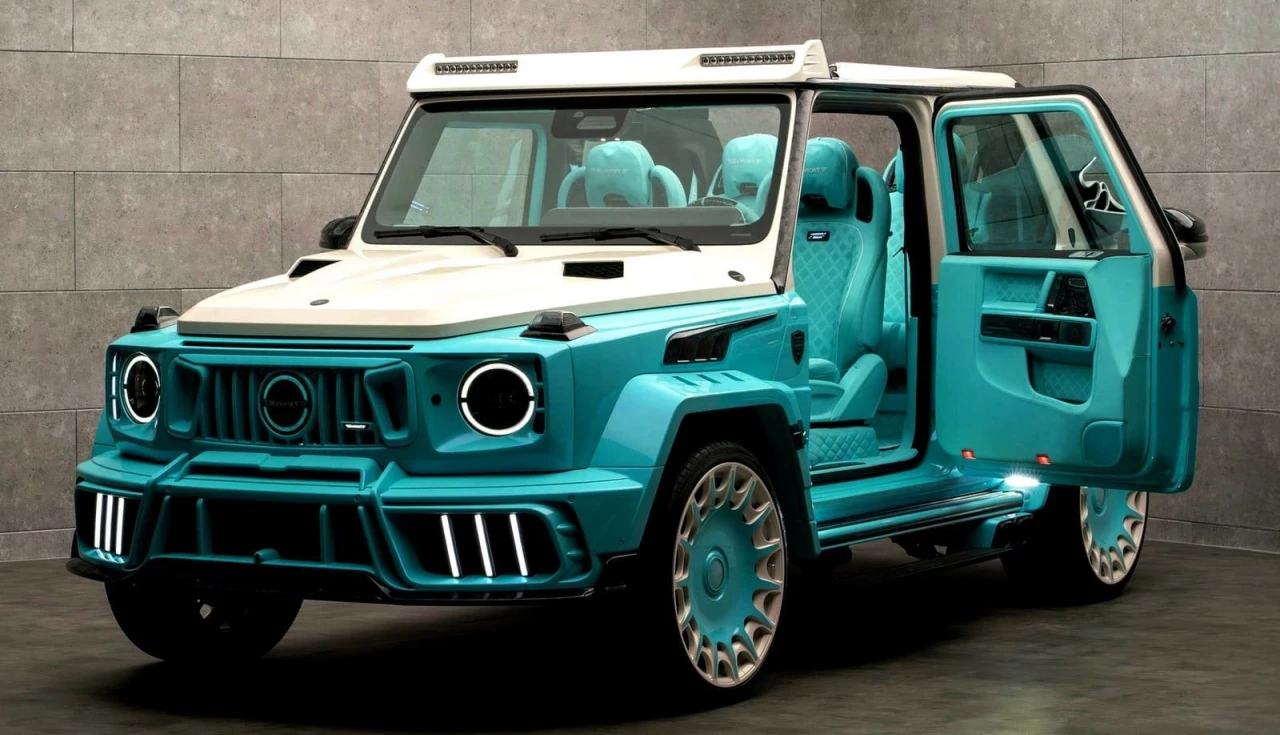
Mansory took a Mercedes-AMG G63, removed the roof, shortened the chassis, reversed the door hinges and tuned the engine to 820 horsepower. They called it the Azura Cabrio — and it’s one of the most structurally ambitious builds any tuner has attempted on a production SUV.
The car made its global debut at the 2026 Top Marques Monaco, a show that brought together more than 235 exceptional vehicles and launched a dedicated pavilion for ultra-luxury tuners. This isn’t a body kit — it’s a full structural rebuild on top of the updated 2025/2026 Mercedes-AMG G63 platform.
In the world of radically modified luxury SUVs, the closest rivals are the Brabus 900 and builds like the Mansory Venatus Coupé EVO C, which is based on the Lamborghini Urus. Neither one combines a convertible layout, coach doors and a shortened wheelbase in the same package.
The Azura wasn’t built for the mass market. It was built for a specific type of buyer — someone who already owns everything and wants what nobody else can have.
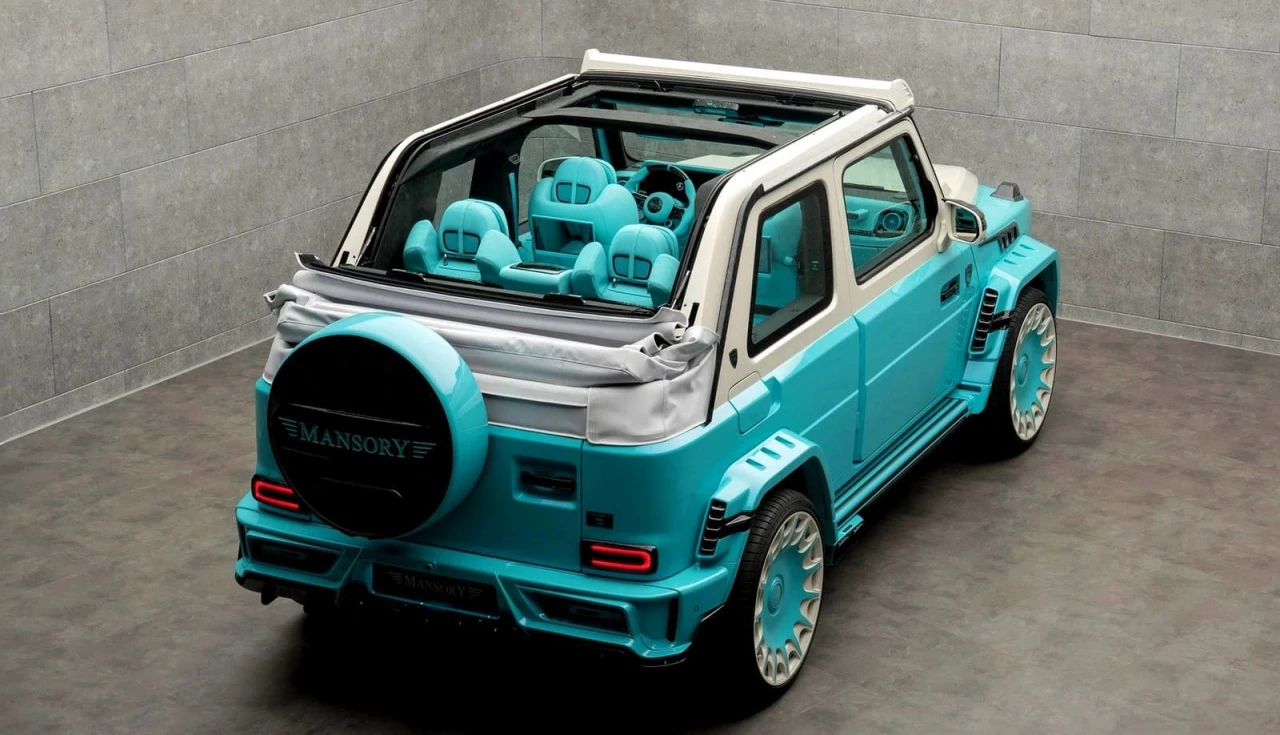
Wide Body, Backwards Doors and a Two-Tone Paint Job That Demands Attention
The Azura starts with a silhouette most people recognize instantly — the boxy, upright stance of the G-Class — and transforms it in ways that leave no room for subtlety.
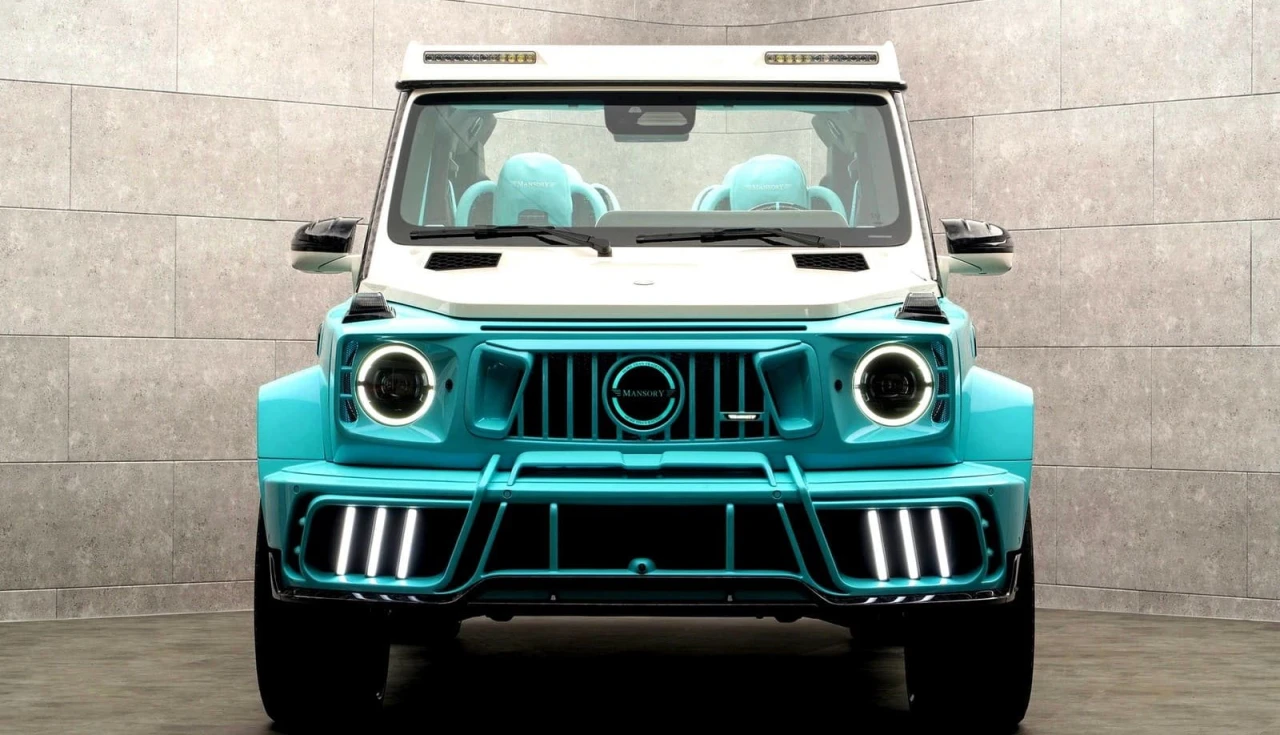
Up front, the hood is an entirely new piece sculpted in forged carbon fiber, featuring a raised center spine and multiple functional heat extraction vents. The factory Panamericana grille was discarded entirely. In its place sits a custom mesh surround with the Mansory emblem at center. The front bumper was redesigned with a chin spoiler, sharp angular LED daytime running lights and enlarged openings for intercooler cooling.
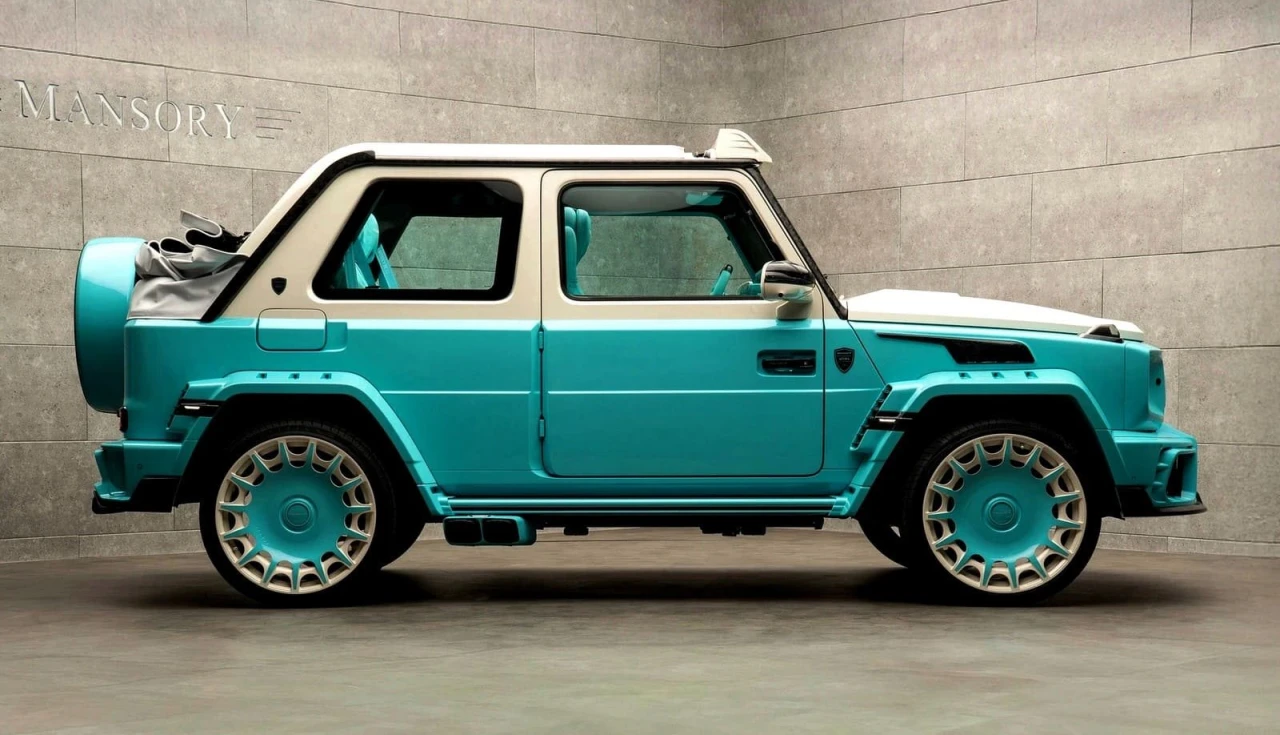
From the side, the transformation is impossible to miss: two doors where there used to be four, and both of them open backward — coach-style, like a Rolls-Royce. The opening gap is massive. Electric retractable side steps are a practical necessity here, not a styling choice — without them, climbing into this vehicle would be a workout.
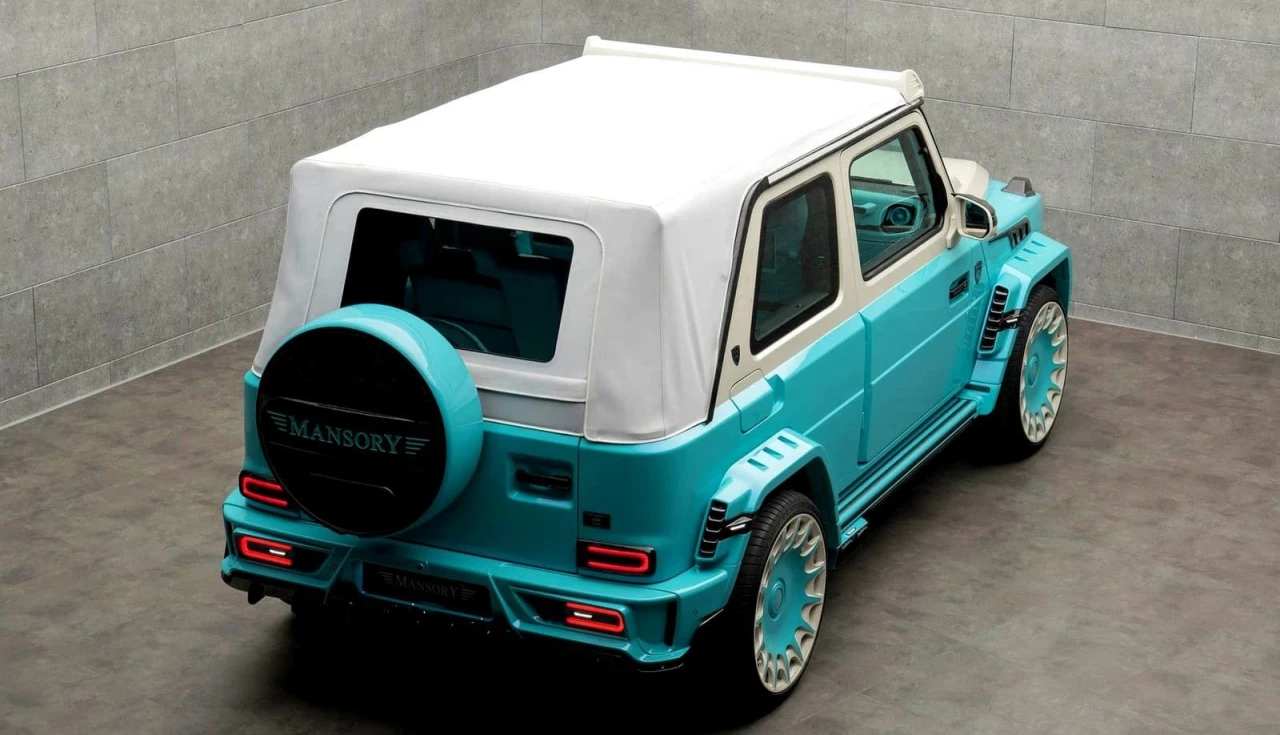
The fender arches were extended with wide-body flares that house forged 24-inch wheels finished in matching white and teal, wrapped in ultra-low-profile tires.
Out back, Mansory doubled up on the taillights — one set in the factory position, another mounted lower on the redesigned bumper — flanking a rear diffuser with directional fins. The spare tire stays mounted on the tailgate, now in a custom carrier.
The dual-tone paint ties the whole look together: pearl white across the upper body, vibrant teal below the beltline, with gloss black accents throughout. It’s deliberately conspicuous — every design choice here was made to be noticed.
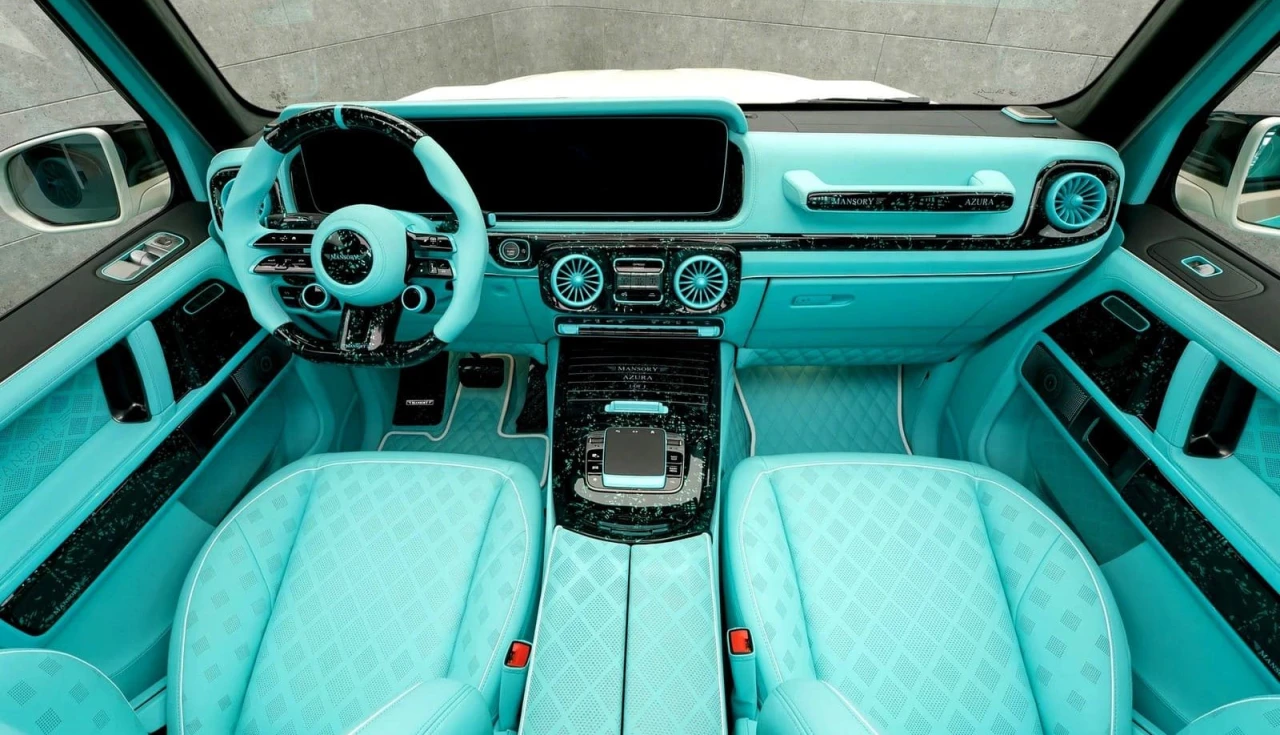
Aquarium on Wheels: The Azura’s Interior Throws Subtlety Out the Window
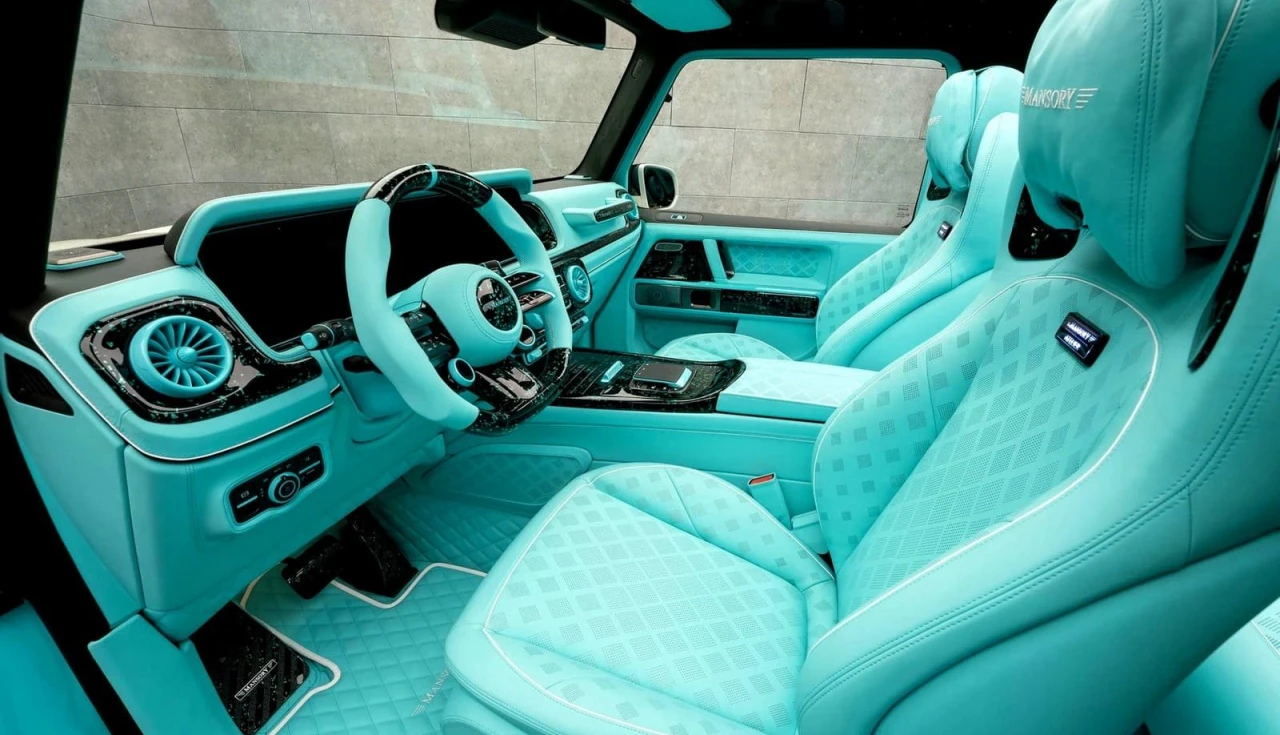
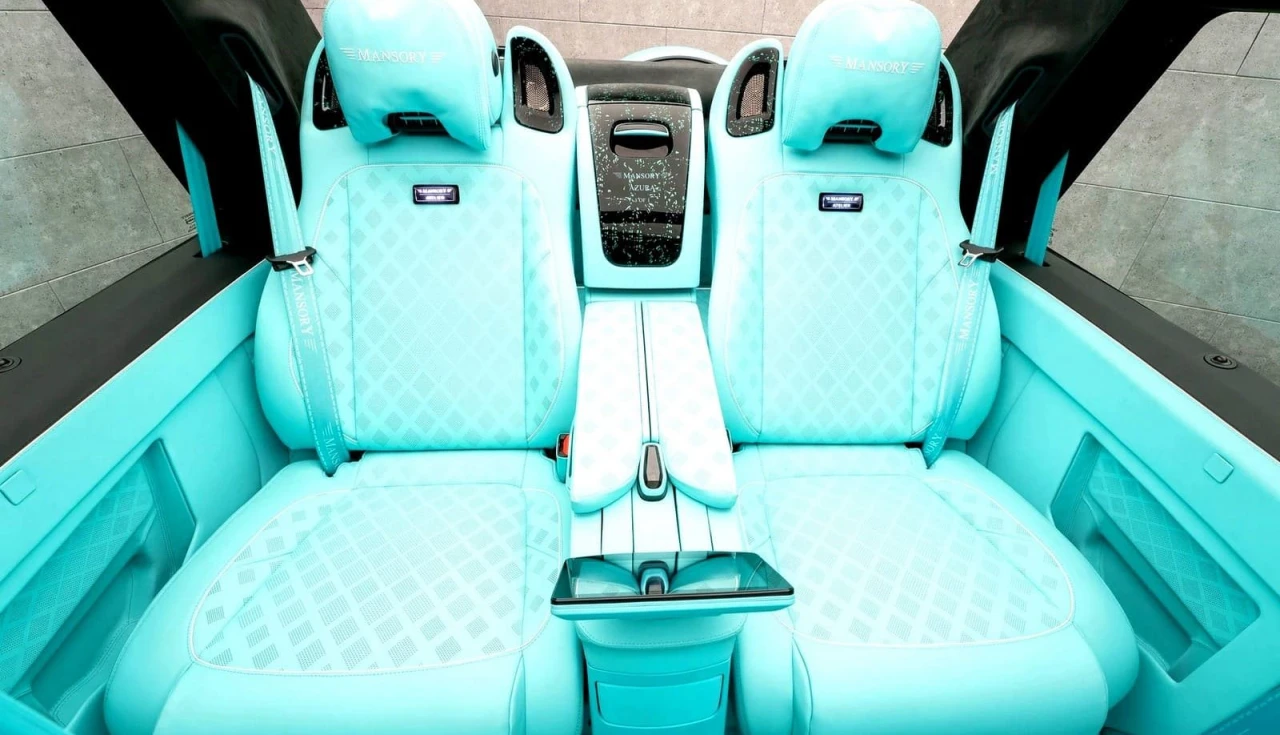
Drop the top and the cabin is fully exposed to the world — and what’s inside is a sea of turquoise Nappa leather stitched in a white quilted pattern. Seats, dashboard, center console, door panels, steering wheel — all wrapped in the same palette.
The seating layout was reworked from the standard five-passenger bench configuration to four individual captain’s chairs, each more sculpted and supportive than what the factory G63 offers. Surfaces that didn’t get leather were treated to exposed carbon fiber panels infused with blue metallic flake in the resin — an eccentric material detail that reads as deliberately one-of-a-kind.
Floor mats are thick wool or leather. The Mansory logo appears on the headrests, door sills and seatbelts. The “Azura” name is engraved on the grab handle on the passenger side of the dashboard. Rear passengers get a floating center console with climate controls built in.
MBUX, 360-Degree Cameras and a Trunk That Paid the Price
The technology foundation carries over untouched from the 2025/2026 Mercedes-AMG G63 — and that’s a genuine strength. The MBUX infotainment system runs augmented reality navigation, wireless smartphone mirroring and the “Hey Mercedes” AI voice assistant.
The dual digital display panel under a single curved glass pane stays in place. ADAS features were retained in full, including Active Steering Assist and Active Emergency Stop Assist — both new to this generation of the G-Class. The 360-degree camera system with bird’s-eye view and the transparent hood function for off-road visibility kept working, though engineers had to recalibrate the sensors to account for the wider track width from the body kit.
Rear passengers get wireless charging pads and multi-zone climate control. The strong point of the cabin is undeniably its level of material customization — there’s nothing in production that comes close.
The clear limitation is cargo space. The retractable soft top mechanism takes up the majority of the rear storage area, cutting the available trunk volume to somewhere between 200 and 250 liters — less than half of what the standard closed G63 offers.

820 HP and 848 lb-ft: What Mansory Did to the AMG V8 Is Not Subtle
The starting point is the AMG M177 4.0-liter twin-turbo V8 — the same hand-built engine that powers the factory G63, assembled in Affalterbach under the “one man, one engine” philosophy. From the factory, it produces 585 hp and 627 lb-ft of torque. Mansory treated those numbers as a baseline.
The stock turbos were pulled and replaced with larger-diameter units carrying optimized compressor wheels capable of moving significantly more air. The entire exhaust system was stripped and rebuilt — new high-flow downpipes, stainless steel mufflers and dual side exits ahead of the rear wheels produce a sound that matches the visual aggression of the bodywork. The ECU was completely reprogrammed with a more aggressive fueling and boost map.
The result: 820 hp and 848 lb-ft of torque (1,150 Nm), with an electronic torque limiter active at peak to protect the drivetrain from catastrophic stress during hard shifts in first and second gear. The AMG Speedshift 9G-Tronic was kept for its proven tolerance to extreme loads, operating with a reinforced torque converter.
Power goes to all four wheels through a permanent AWD system with locking differentials front, center and rear — a core G-Class feature that stays fully intact. Zero to 60 mph happens in 4.0 seconds. Top speed is electronically capped at 155 mph — not because the engine runs out of pull, but because running faster than that in a soft-top SUV on 24-inch wheels with a naturally high center of gravity is a structural and safety risk the engineers weren’t willing to take.
Fuel economy lands around 35 mpg combined under official test conditions. In real-world driving — the kind of driving this engine invites — that number drops fast.
Specs at a Glance
| Specification | Detail |
|---|---|
| Engine | 4.0L Twin-Turbo V8 (AMG M177, modified) |
| Output | 820 hp |
| Torque | 848 lb-ft (1,150 Nm) |
| Transmission | 9-speed automatic (AMG Speedshift 9G-Tronic) |
| Drivetrain | Permanent AWD with locking differentials |
| 0–60 mph | 4.0 seconds |
| Top Speed | 155 mph (electronically limited) |
| Fuel Economy | ~15 mpg combined (est.) |
| CO₂ Emissions | ~360 g/km |
| Estimated Weight | ~5,730 lbs (2,600 kg) |
| Estimated Wheelbase | ~105.5 in (2,680 mm) |

What Does a Mansory Azura Actually Cost — And Does the Math Make Any Sense?
Mansory doesn’t publish a fixed price list. The final cost of each Azura depends on exactly what the buyer chooses — leather grade, carbon fiber resin tint, additional trim elements. Every car is built under the “one of one” philosophy, meaning no two Azuras are identical.
Based on comparable builds recently sold through private sales and specialty auctions, the market estimate places the Azura between $700,000 and $900,000. That’s the turnkey figure — base vehicle plus the full conversion carried out by Mansory’s facility in Brand, Germany.
For context, a factory Mercedes-AMG G63 starts around $180,000 in the US. The premium on top of that reflects hundreds of hours of hand labor: chassis cutting and reinforcement, bespoke forged carbon body panels, individually assembled cabin upholstery and one-off paint work.
Maintenance costs will be substantial. Independent actuarial data from the US market shows that even a standard G-Class can accumulate over $16,000 in maintenance and unplanned repair costs within the first ten years of ownership — with a roughly 44% probability of a major repair event in that window. Add larger turbos running at elevated heat, a recalibrated ECU operating outside factory parameters and body panels that have to be sourced directly from Mansory’s autoclave in Germany, and the ongoing cost picture gets considerably more expensive.
Standard auto insurance won’t cover this vehicle. Carriers that handle everyday policies have no pricing framework for a structurally modified, hand-built SUV with no crash repair data and replacement parts that require international shipping. Only specialty high-net-worth insurers — Private Client Group policies — will write coverage, and the annual premium reflects the logistical reality of a total-loss scenario.
Is it worth buying? For the buyer it was designed for, the data actually supports a yes. Rare Mansory G-Class builds have shown resistance to conventional depreciation curves, and in some cases have sold above original asking price in the secondary market, driven by long production wait times and demand from buyers in the Middle East, Los Angeles and London who want the car immediately rather than waiting years for a custom build slot.
The Questions Buyers Actually Search Before Looking Up the Azura
Will the Mansory Azura be sold in the United States? There’s no official US distribution. Each Azura is ordered directly through Mansory in Germany on a custom basis. Any US buyer would be managing a private import, which means federal compliance review and additional costs on top of the already significant purchase price.
What’s the real-world fuel economy of the Azura? The official combined estimate lands around 15 mpg. Under hard acceleration — which a 820-hp twin-turbo V8 in a near-6,000-pound SUV tends to encourage — that number drops noticeably. This engine wasn’t engineered with economy as a priority.
Who are the Azura’s main competitors? In the segment of radically modified ultra-luxury SUVs, the closest comparisons are the Brabus 900, the Mansory Venatus Coupé EVO C (Urus-based) and heavily modified versions of the Ferrari Purosangue. None of them combine a convertible layout with coach doors and a shortened wheelbase in the same package.
How expensive is insurance on the Mansory Azura? Standard carriers won’t quote it. High-net-worth specialty insurers handle policies for vehicles like this, and annual premiums reflect the cost reality: any panel damage involving the bespoke carbon fiber body means sourcing replacement parts from Germany at international shipping rates with aerospace-level fitting precision required.
Does the Mansory Azura Justify Its Price Tag?
For anyone looking for a practical daily driver, the answer is straightforward — no, and the question probably shouldn’t be asked in the first place. The Azura offers roughly 200 liters of trunk space, a width that makes urban parking genuinely difficult and operating costs that exist in a separate category from any rational ownership calculation.
For the buyer it was actually built for, the calculus is different. Real scarcity, hand-built production, resistance to conventional depreciation and a public presence that no production vehicle can replicate — those are the relevant variables for this transaction.
The Azura isn’t a car you drive every day. It’s a car you own.

Share this article
Related posts