BRABUS BODO 2027 Debuts With Twin-Turbo V12 and Just 77 Units Worldwide
A 1,000-horsepower twin-turbo V12 grand tourer with no hybrid assistance, no electric motors, and production capped at just 77 units worldwide. The BRABUS BODO 2027 isn’t a tuned car — it’s a fully handcrafted hypercar that starts at $1.1 million.

Por: Danniel Bittencourt
17/05/2026
BRABUS BODO 2027: The German Giant That Stopped Tuning Cars and Built Its Own Hypercar
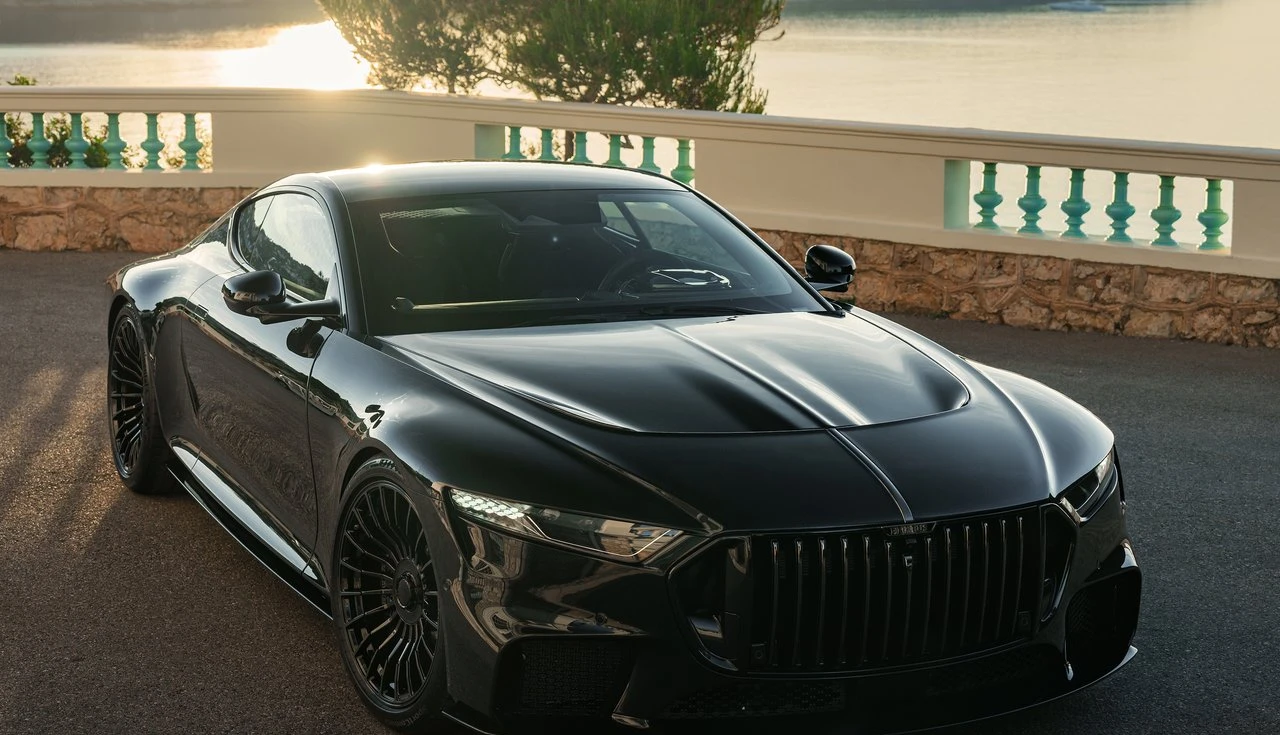
BRABUS officially pulled the wraps off one of the most ambitious projects in its nearly five-decade history at the FuoriConcorso event in May 2026 — held along the shores of Lake Como, Italy. The reveal wasn’t just another modified Mercedes with a bigger engine and a carbon lip spoiler. It was the BODO 2027: a ground-up hypercar with a name that carries real emotional weight inside the company.
The BODO is built around the advanced bonded-aluminum monocoque chassis from the 2025 Aston Martin Vanquish. But the transformation is so complete — in bodywork, powertrain, interior, and technology — that virtually nothing of the donor car remains visible to the eye.
The name is a direct tribute to Bodo Buschmann, who founded the company in Bottrop, Germany in 1977 and passed away in 2018. His son, CEO Constantin Buschmann, brought to life a vision his father had been nurturing for nearly two decades: a standalone grand tourer, wearing no three-pointed star, engineered to be as brutal as it is beautiful.
In terms of competition, the BODO doesn’t fight for space at your local exotic dealership. It goes head-to-head with the Bentley Mulliner Batur, the Ferrari 12Cilindri, and special-project Aston Martins like the Valour. Production is locked at exactly 77 units — a nod to the company’s founding year.
Sharp Enough to Cut Air, Wide Enough to Turn Heads: The BODO’s Carbon-Fiber Body Explained
At 5,062 mm long — nearly 8.5 inches more than the Vanquish it’s based on — the BODO is unmistakably a grand tourer built to dominate every road it drives down. Its width of 2,027 mm and a roofline sitting just 1,305 mm off the ground give it the proportions of a car that looks planted even standing still.
Every body panel is crafted from pre-preg carbon fiber, the same process used in Formula 1 and aerospace manufacturing. The resin-impregnated sheets are cured under pressure in industrial autoclaves, producing panels that are simultaneously lighter, stiffer, and stronger than anything stamped from aluminum or steel.
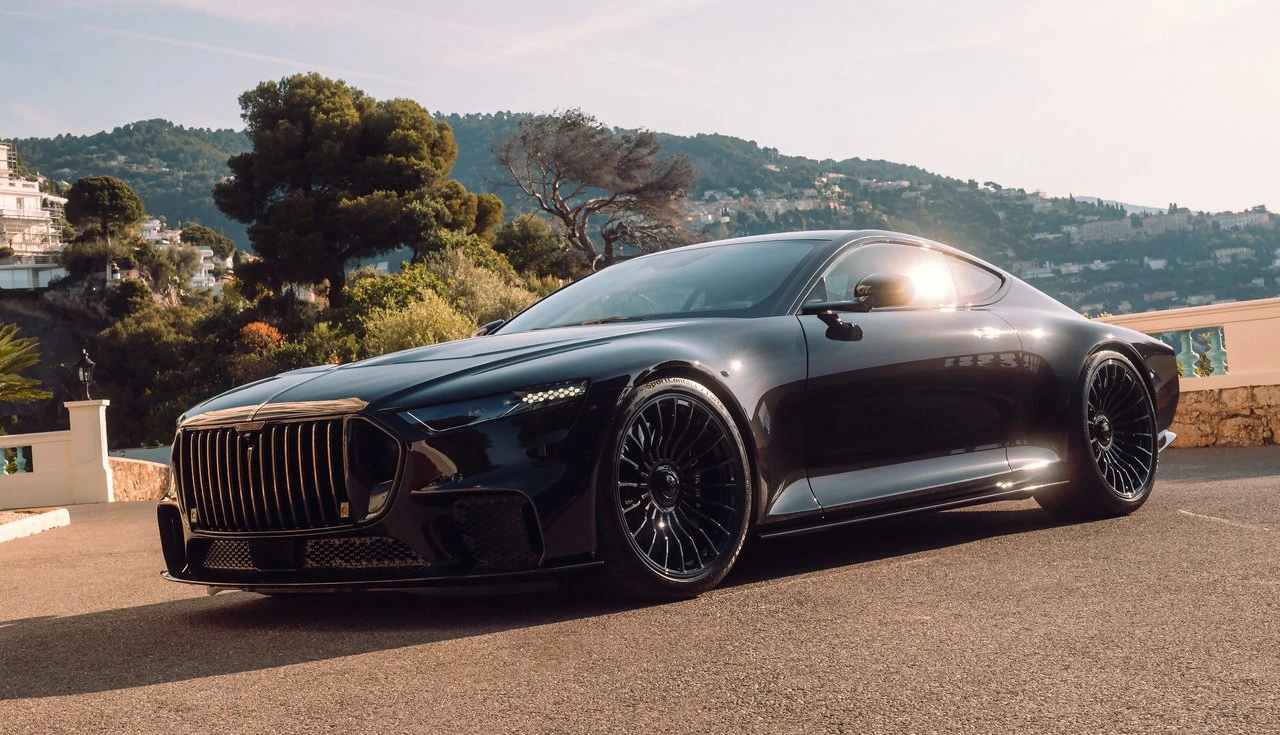
Up front, a sculpted shark-nose fascia dominates the view. Thirteen vertical blades frame the massive BRABUS “B” logo at the center of the grille. Flanking it, two RAM-AIR intake ducts pull in cold, dense air at speed to feed the V12’s intercoolers — these aren’t styling exercises, they’re thermodynamically necessary. A carbon fiber front splitter below generates meaningful downforce at speeds beyond 185 mph.
The side profile runs a long, flat hood with a center crease channeling airflow, a fixed panoramic glass roof that flows seamlessly from the windshield, and massively flared rear fenders required to cover those 13-inch-wide rear tires.
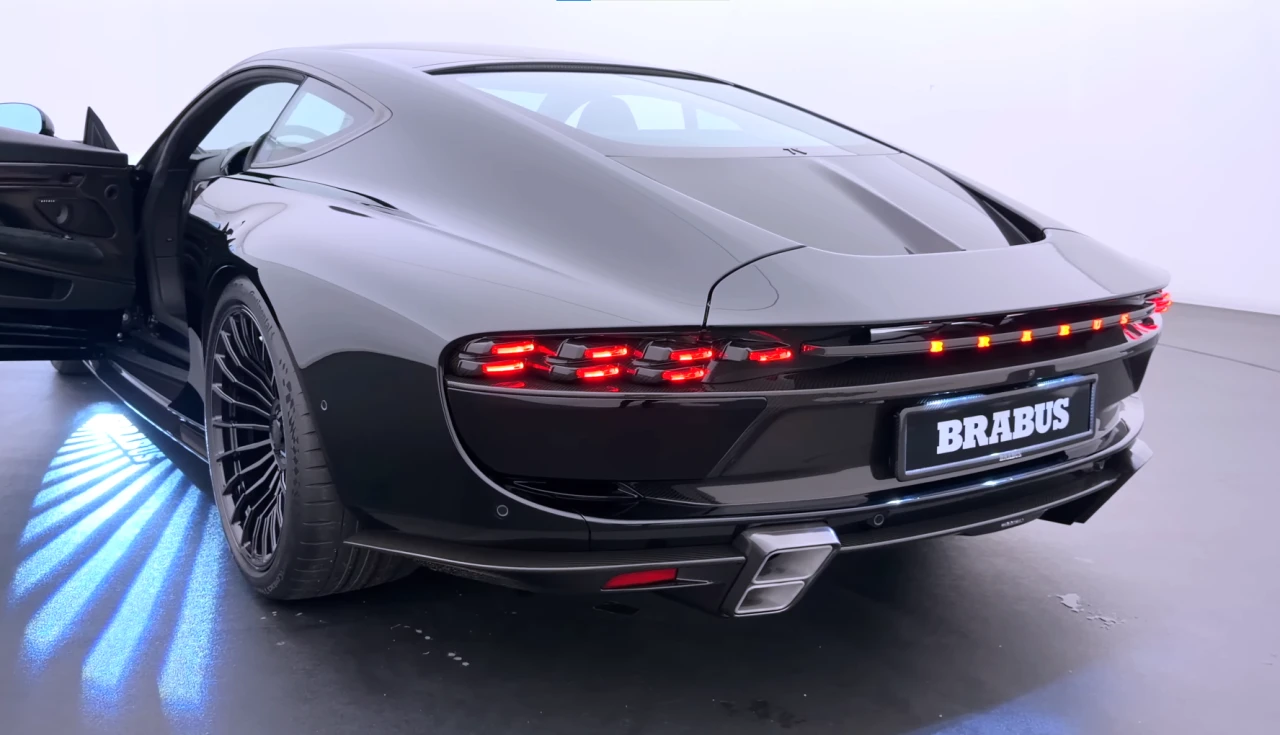
The rear is where the BODO makes its most polarizing statement. The boat-tail silhouette — a shape borrowed directly from pre-war aerodynamic racing cars — sweeps back dramatically. Seven floating LED segments per side form the nighttime signature, with a three-dimensional illuminated “BRABUS” nameplate at the center. Four vertically stacked exhaust outlets feed into an exposed carbon diffuser below.
The active rear spoiler stays hidden in the bodywork below 75 mph. Above that threshold, hydraulic actuators deploy it automatically — and in hard braking situations above 87 mph, it snaps to a near-vertical angle to act as an aerodynamic air brake, shifting the pressure balance rearward and helping shed speed.
Inside the BODO: Hand-Selected Leather, Carbon Everywhere, and an Embroidered Legacy
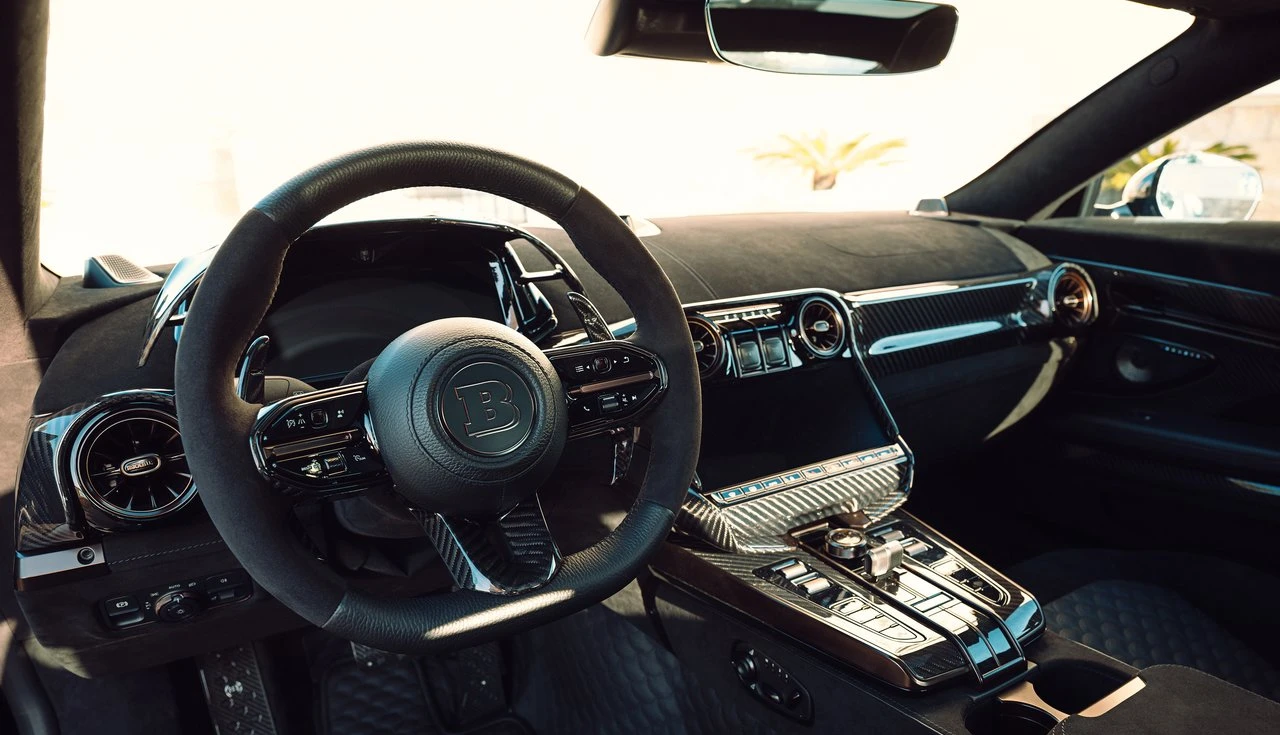
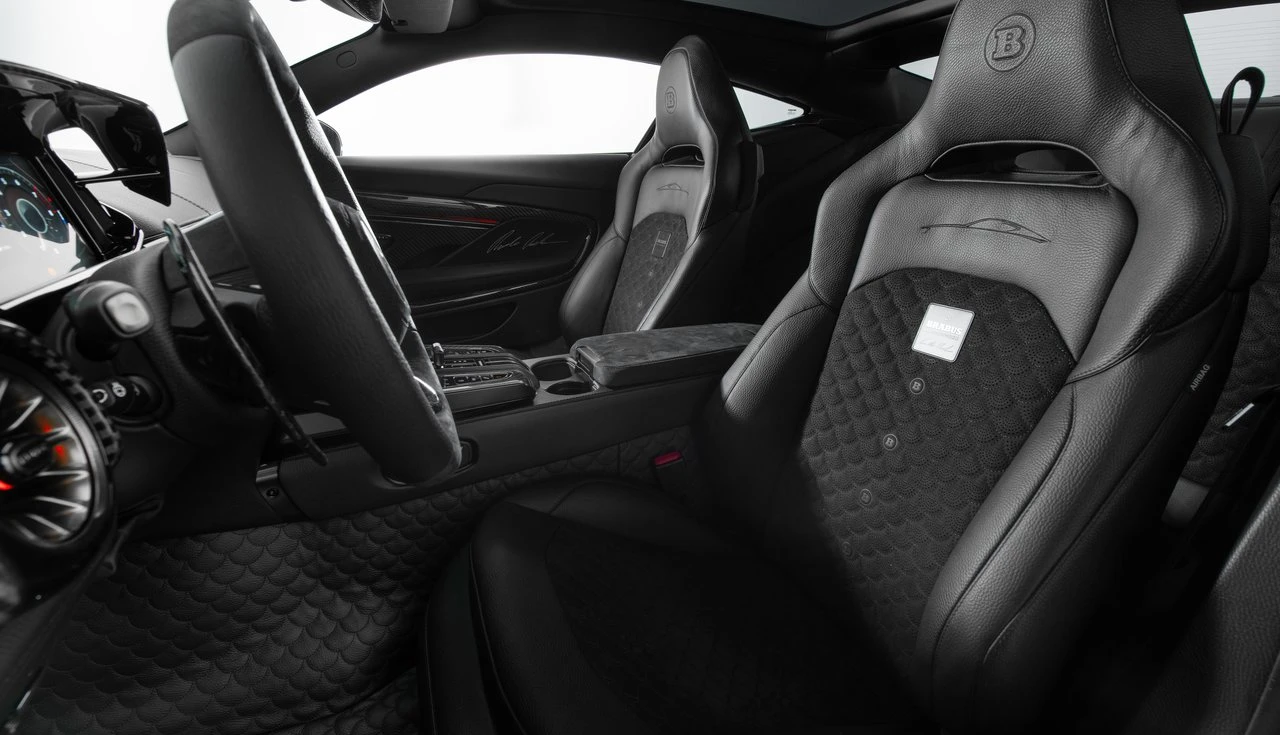
The cabin follows a 2+2 layout inherited from the Vanquish architecture — two full front seats and two minimal rear seats meant more for short trips than long hauls. But everything that was British in the finishing has been replaced by what BRABUS calls the “BRABUS Masterpiece” interior package: hundreds of hours of handcraft work in leather, microfiber, and carbon.
The leather is sourced and individually inspected — only hides with zero surface imperfections make the cut. It’s paired with Nubuck microfiber on contact surfaces, reducing glare and improving grip. Every piece of plastic from the Vanquish has been replaced with high-gloss exposed carbon fiber on the center console, door panels, and seat bases. Subtle “Shadow Gray” metallic accents on switches and handles break up the all-black environment.
The sport seats are ergonomically sculpted for lateral support under hard cornering loads, with the BODO’s own side silhouette stitched directly into the seatbacks. Bodo Buschmann’s personal cursive signature is embroidered into the door panel padding and integrated into the entry sill plates — a detail that turns the interior into a genuine tribute, not a marketing gesture.
Digital Cockpit, Analog Soul — and a Blockchain Chip You’d Never Expect to Find
The infotainment system retains the Aston Martin’s touchscreen platform, with high-resolution navigation, topographic maps, and full smartphone integration. BRABUS, however, redesigned the upper dashboard entirely.
A floating carbon fiber “wing” shades the digital instrument cluster behind the steering wheel, cutting reflections on the windshield. Air vents were machined into turbine-style circular pieces with ambient lighting embedded inside. The accelerator and brake pedals are machined carbon fiber — functional, not decorative.
The most technically unique feature in the cabin doesn’t live on any screen. It’s a NFC chip embedded inside a cast-metal plate bearing Bodo Buschmann’s original physical signature, located in the trunk. Hold a smartphone to it, and it unlocks an encrypted blockchain-based digital passport — an immutable, decentralized record confirming which of the 77 units you’re looking at, its exact factory specifications, and its full ownership history.
The trunk itself is the BODO’s real-world compromise. The boat-tail body structure limits cargo space to an estimated 248 liters — workable for a weekend bag but far less than the exterior size implies.
BRABUS addresses this directly by including a bespoke weekender bag with every car, hand-stitched from the exact same leather batch used in that specific unit’s interior, designed to fit the trunk perfectly.
Pure Internal Combustion in a Hybrid World: The BODO’s Twin-Turbo V12 Doesn’t Apologize
Under that long, vented carbon hood sits a 5.2-liter twin-turbocharged V12 — no hybrid motor, no torque-fill system, no mild-hybrid buffer. It’s a pure internal combustion engine, completely re-engineered by BRABUS technicians in Bottrop from the Aston Martin’s original block.
Peak output is 1,000 horsepower (735 kW) at 6,400 rpm. Peak torque hits 885 lb-ft (1,200 Nm), available as a wide, flat plateau from 2,900 to 5,000 rpm. That torque curve matters: it means the engine doesn’t need to be spinning hard to pull hard. Throttle response is immediate in any gear, at almost any speed.
Two new four-valve-per-cylinder heads were flow-tested and ported on computerized benches to maximize intake and exhaust efficiency at high revs. Larger-geometry turbocharger rotors replace the originals, and a recalibrated direct injection system runs premium-grade fuel. The RAM-AIR induction system feeds cold air forcefully into the intake box as vehicle speed rises.
Thermal management under the hood — always a challenge with a twin-turbo V12 in a low-slung carbon body — is handled through oversized heat exchangers at the front and functional extraction vents in the hood. In a detail borrowed directly from the McLaren F1 and used in spacecraft construction, the airboxes and cam covers feature 24-karat gold-infused carbon fiber to reflect radiant heat.
The ZF 8-speed automatic runs in a transaxle configuration, physically integrated into the rear axle. That positioning — heavy V12 pushed back behind the front axle, gearbox at the rear — produces a near-perfect 50.2% front / 49.8% rear weight distribution. All power goes to the rear wheels only. No all-wheel drive, no torque vectoring between axles.
The numbers tell the rest: 0–60 mph in 3.0 seconds, 0–125 mph in 8.5 seconds, 0–186 mph in 23.9 seconds. Top speed is electronically governed at 224 mph to protect the Continental SportContact 7 Force tires — developed exclusively for this car — from centrifugal delamination at sustained extreme speeds.
Five drive modes — Wet, GT, Sport, Sport+, and Individual — alter throttle mapping, suspension stiffness, exhaust valve behavior, and traction system intervention independently.
Technical Specs — BRABUS BODO 2027
| Specification | Detail |
|---|---|
| Engine | 5.2L Twin-Turbo V12 |
| Horsepower | 1,000 hp (735 kW) @ 6,400 rpm |
| Torque | 885 lb-ft (1,200 Nm) |
| Transmission | ZF 8-Speed Automatic (Transaxle) |
| Drivetrain | Rear-Wheel Drive |
| 0–60 mph | 3.0 seconds |
| Top Speed | 224 mph (electronically limited) |
| Curb Weight | 3,912 lbs (1,774 kg) |
| Length | 199.3 in (5,062 mm) |
| Width | 79.8 in (2,027 mm) |
| Height | 51.4 in (1,305 mm) |
| Wheelbase | 113.6 in (2,885 mm, estimated) |
| Rear Tires | 325/30 ZR 21 |
| Total Production | 77 units worldwide |
Starting at $1.1 Million in Germany — Here’s What It Actually Costs to Own One
The BODO carries a base price of €1,000,000 — roughly $1.1 million USD at current exchange rates — leaving the factory in Germany without any customization options selected. That number already places it in direct competition with the Bentley Mulliner Batur and Ferrari’s most limited special editions.
For American buyers, that figure is the starting point of the conversation, not the end of it. Import duties, federal taxes, shipping, customs brokerage fees, and dealer or broker margins on ultra-low-volume exotics will push the real acquisition cost significantly higher. While BRABUS has not announced official U.S. pricing or a dealer network for the BODO, independent importers handling similar vehicles typically add 20% to 35% above the European base price to cover all-in landing costs. That puts a realistic U.S. estimate somewhere between $1.35 million and $1.5 million — and that’s before any bespoke customization the factory offers to each of the 77 buyers. These are market estimates, not official figures.
Maintenance will run at the highest tier in the exotic car segment. A handbuilt twin-turbo V12 with bespoke components, exclusively manufactured Continental tires, and a bonded-aluminum chassis requires factory-level expertise to service correctly. Independent shops won’t cut it. Expect service intervals and parts costs comparable to a Bugatti or Pagani ownership experience — meaning annual maintenance budgets well into five figures. Insurance will reflect the same profile: very few carriers will underwrite a car this rare, and those that do will price premiums accordingly.
Is it worth buying at launch? For buyers who secured an allocation, the answer leans yes. As one of the last pure-combustion V12 grand tourers to emerge from a serious European manufacturer, the BODO has the rarity and the provenance to hold — and likely grow — its value over time. The blockchain-authenticated ownership record only strengthens that case in future collector auctions.
The buyer profile is narrow: serious collectors, automotive purists who see electrification as a compromise, and investors who understand that 77 units with full documentation will only become harder to find as the years pass.
Everything Buyers Are Searching for Before Writing That Check
How many BRABUS BODO 2027 units will be produced? Exactly 77, worldwide. The number references BRABUS’s founding year of 1977 and the production run is fixed — the company has no plans to expand it.
What is the BRABUS BODO 2027 price in the United States? No official U.S. MSRP has been announced. Based on the European base price of €1,000,000 and typical import cost structures, a realistic all-in estimate for American buyers falls between $1.35 million and $1.5 million before customization. This is a market estimate, not a confirmed figure.
Does the BRABUS BODO have a hybrid or electric motor? No. The 5.2-liter twin-turbo V12 runs without any form of electric assistance — no mild hybrid, no plug-in system, no front electric axle. It’s a pure internal combustion powertrain.
Who are the main competitors of the BRABUS BODO 2027? The Bentley Mulliner Batur, Ferrari 12Cilindri, and Aston Martin Valour are the closest rivals in terms of price positioning, production volume, and grand touring intent.
Is the BRABUS BODO 2027 Worth Over a Million Dollars?
That depends entirely on what you’re buying it for. As a driver’s car, it delivers — the full ADAS suite, adaptive magnetic suspension, and GT-focused chassis tuning make it genuinely usable on real roads, not just garage displays. As a collector’s investment, the logic holds: 77 units, a documented tribute to a founding figure, blockchain-verified provenance, and a pure V12 at a moment when the industry has largely moved on.
For someone chasing status alone, there are easier ways to spend seven figures. But for a buyer who understands what “last of a breed” actually means in automotive history — this is it.
The BRABUS BODO doesn’t ask for your attention. It simply takes it.
Share this article
Related posts