This Ferrari HC25 Costs Over $6 Million and There’s Only One on Earth
One of a kind in every sense, the Ferrari HC25 packs 720 horsepower from a pure twin-turbo V8 with zero electrification, marks the end of Maranello’s analog Spider lineage, and carries an estimated price tag north of $6 million.
Por: Danniel Bittencourt
17/05/2026
Ferrari HC25: The Last Pure V8 Spider Ferrari Will Ever Build Just Arrived
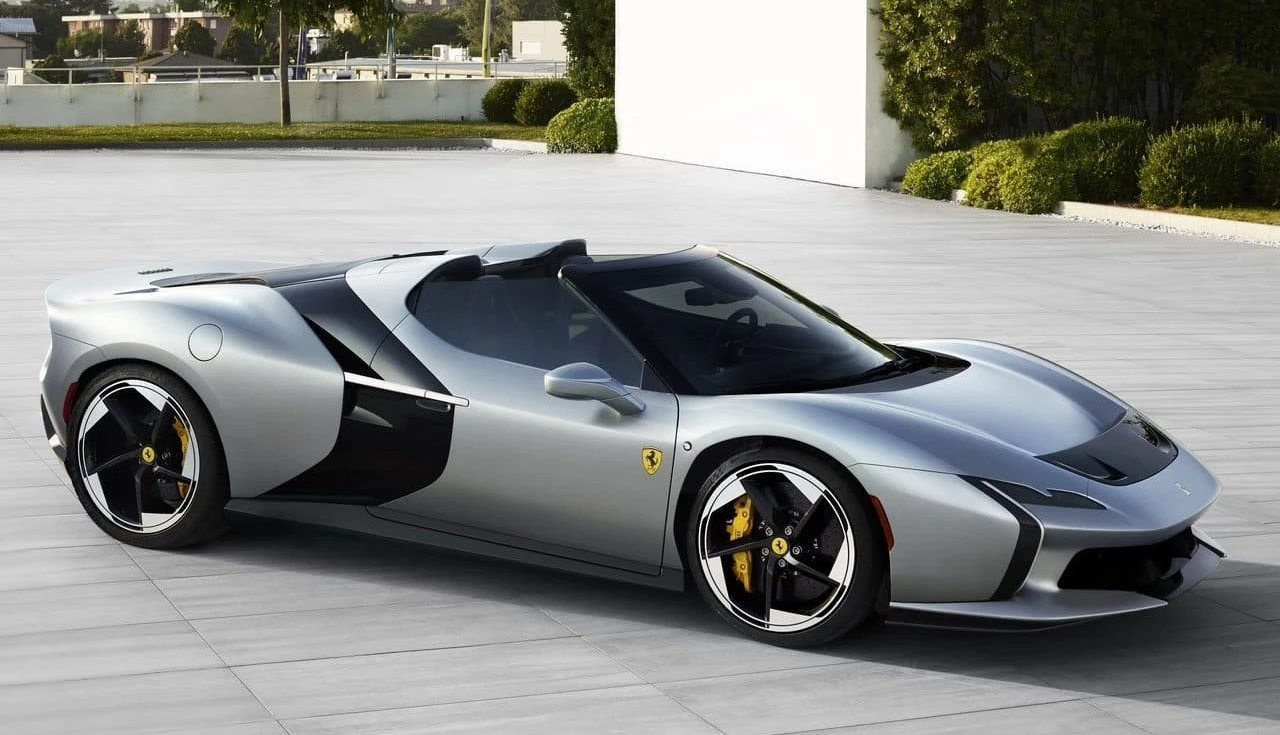
Ferrari just pulled the wraps off the HC25, a singular creation born from the brand’s elite Special Projects program. The reveal took place on May 15, 2026, at the Ferrari Racing Days held at the Circuit of the Americas in Austin, Texas.
This is not a limited edition. It’s not a production variant. The HC25 is a true One-Off, meaning exactly one exists in the entire world. The mechanical foundation comes from the F8 Spider, but the bodywork, design language and onboard systems were completely reimagined by the Ferrari Design Studio.
The mission is twofold: bring a dignified close to the era of pure, non-hybridized twin-turbo V8 convertibles at Ferrari, while previewing the visual direction of next-generation halo cars like the F80. Its real competition isn’t Porsche or McLaren — it’s bespoke commissions from Bugatti and Pagani.
As for availability in the U.S. market? There’s nothing to allocate. One unit exists, and it already has an owner.
A Black Ribbon That Slices the Ferrari HC25 Clean in Half — by Design
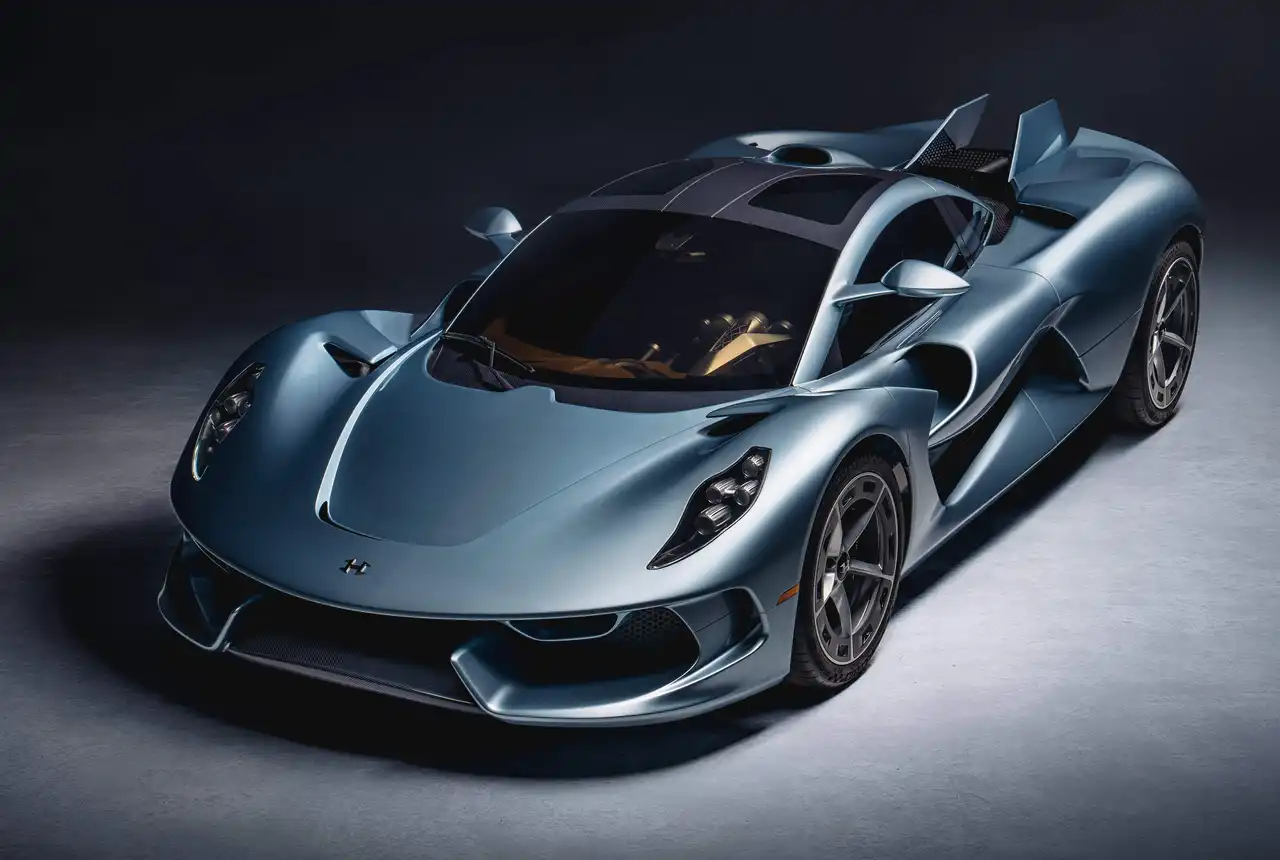
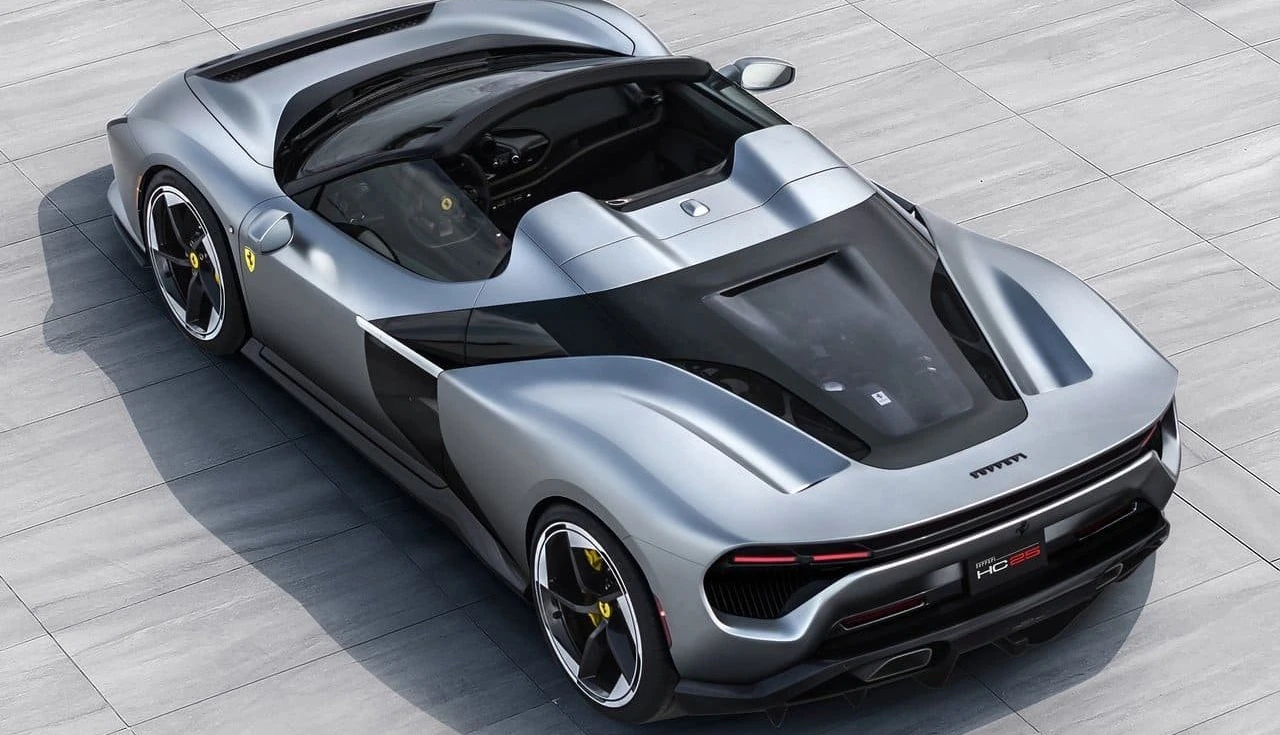
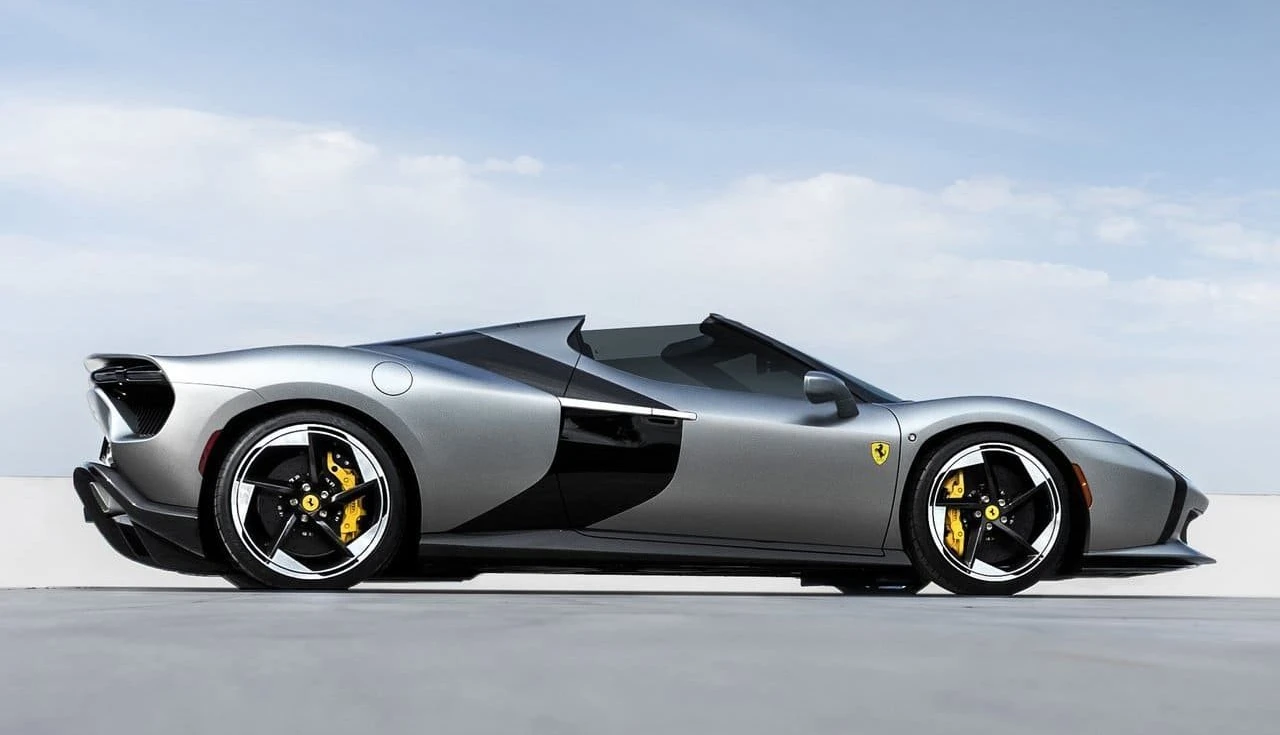
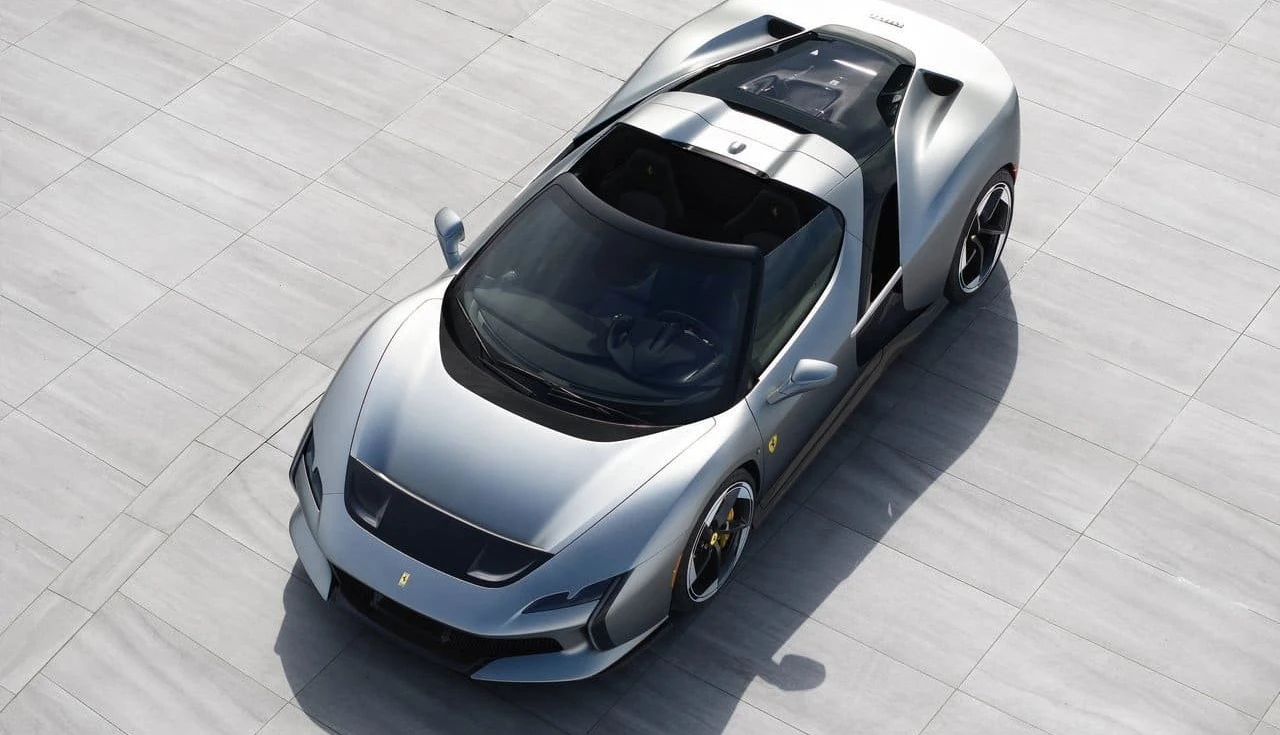
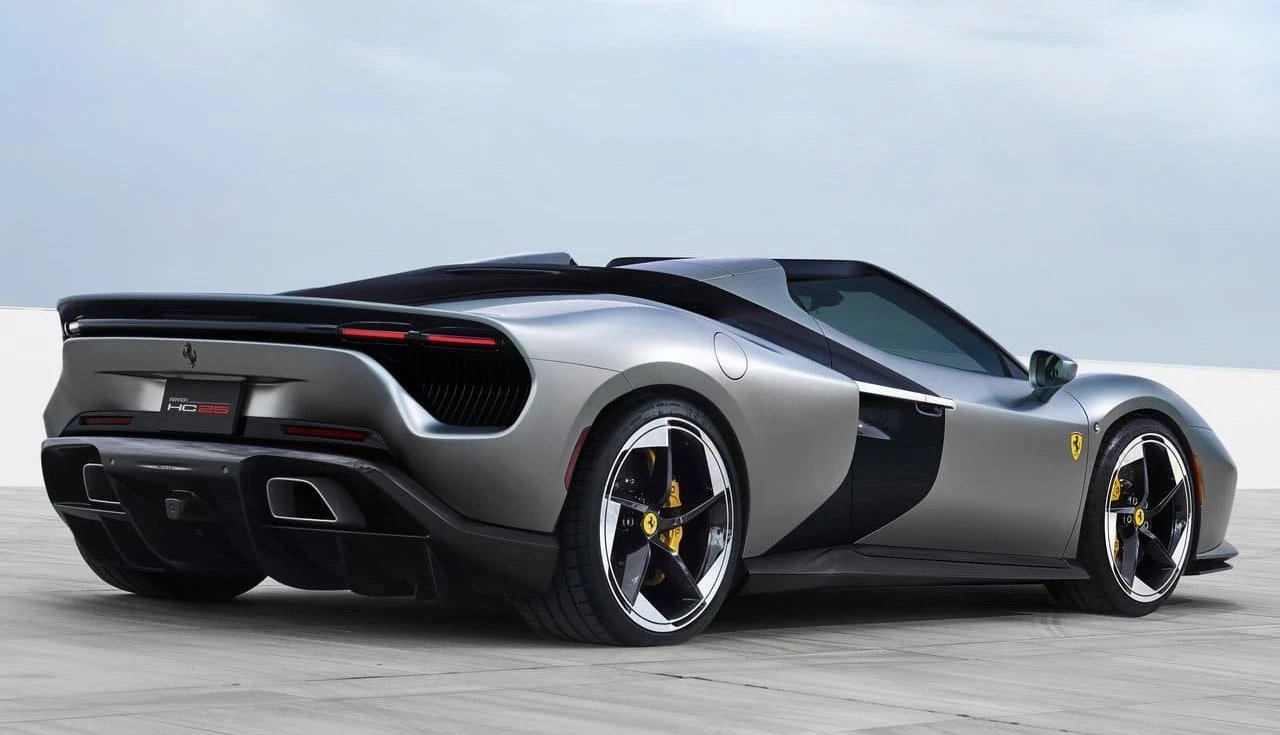
The first thing that grabs your attention on the HC25 is the glossy black band that splits the bodywork from nose to tail. It runs across the hood, drops down the door panels and blends into the engine cover. This isn’t decoration — that “aerodynamic ribbon” conceals massive air intakes feeding the radiators and intercoolers, keeping the side surfaces clean, uninterrupted and aerodynamically efficient.
The body color is a matte finish called Moonlight Grey, playing off the gloss black of the central band and sharp yellow accents scattered across the car. The result is a palette that reads technical, precise and deliberately modern — nothing close to the red most people instinctively associate with Ferrari.
Up front, the LED headlights are razor-thin, using light modules Ferrari has never deployed before. The daytime running lights follow a vertical boomerang shape, tracing the curve of the front fenders with millimeter accuracy. It’s the first time Ferrari has used this DRL signature on any Special Projects commission.
From the side, a machined solid-aluminum blade doubles as a door handle, preserving the unbroken flow of the bodywork. Around back, the signature round taillights are gone, replaced by slim horizontal LED strips in the style of the Ferrari Roma. The diffuser is aggressive, with two trapezoidal exhaust outlets flanking it. The bespoke wheels run five thin spokes with a diamond-cut outer face and darkened dual channels — engineered to create the visual illusion of a larger diameter while pulling heat away from the brakes.
Carbon Fiber and Yellow Stitching: The HC25 Cabin Ditches Traditional Luxury
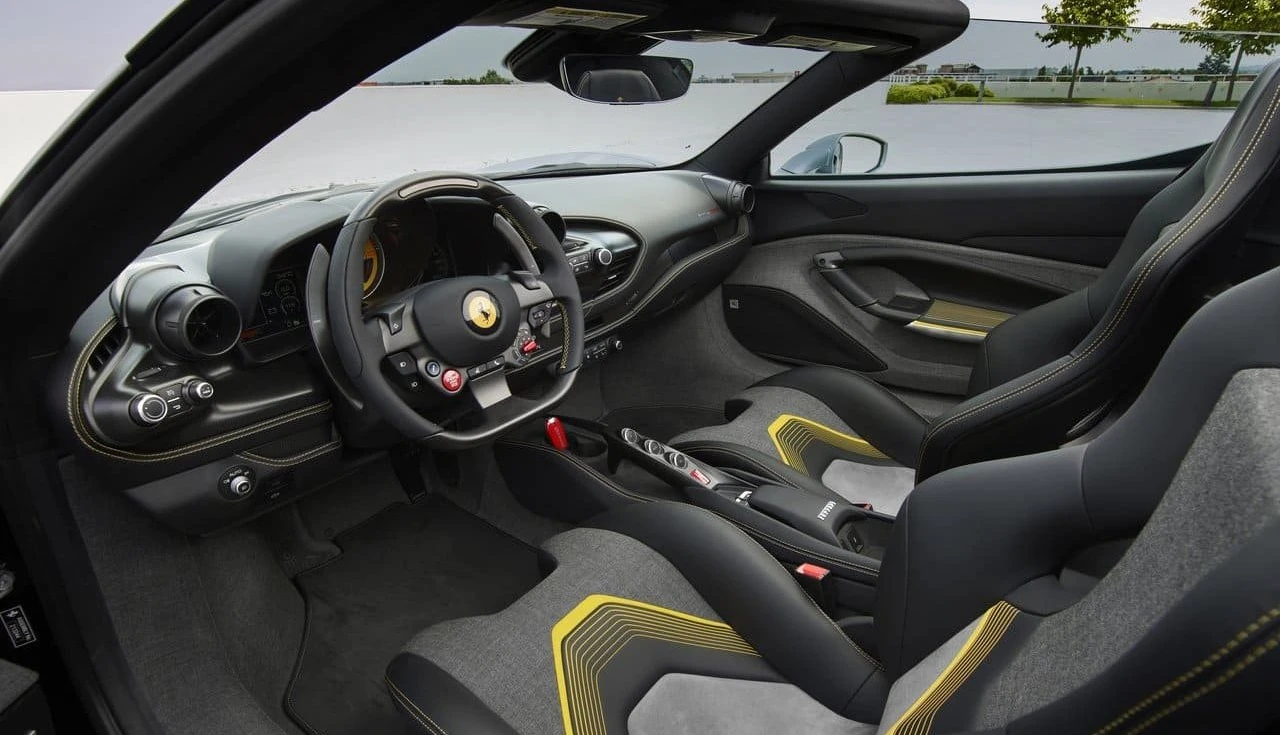
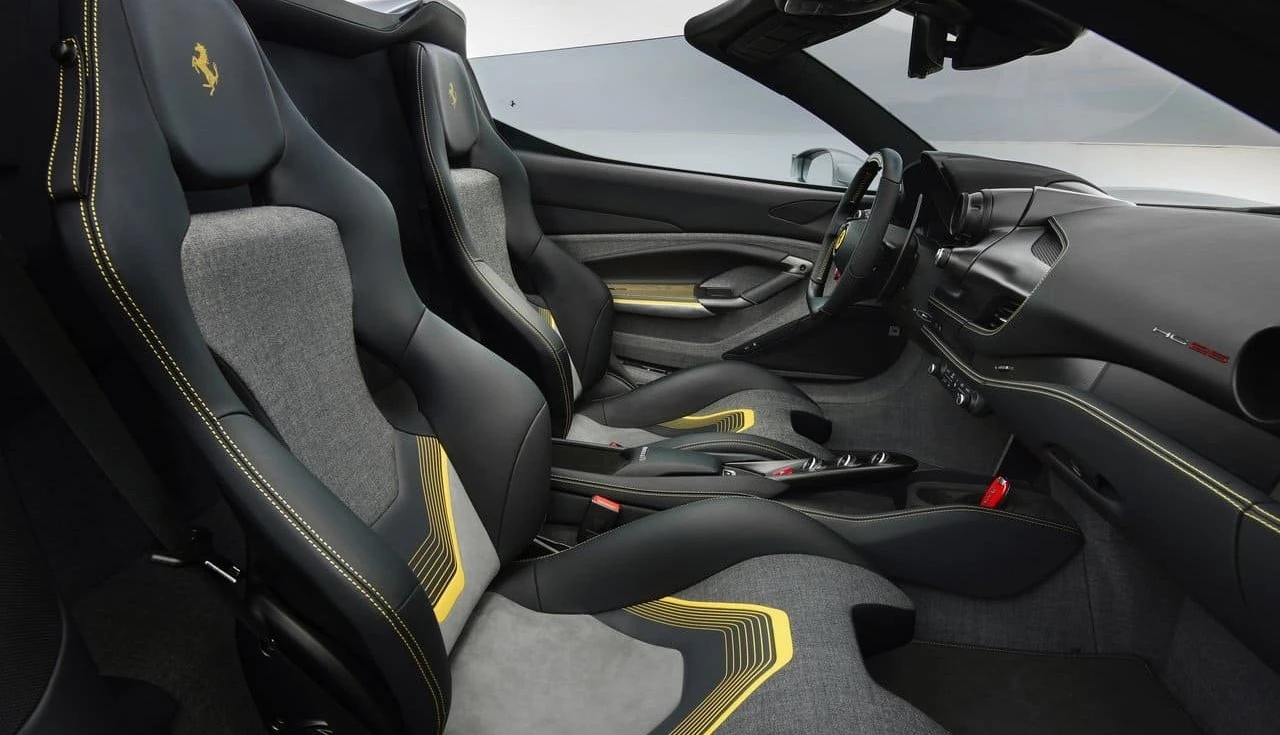
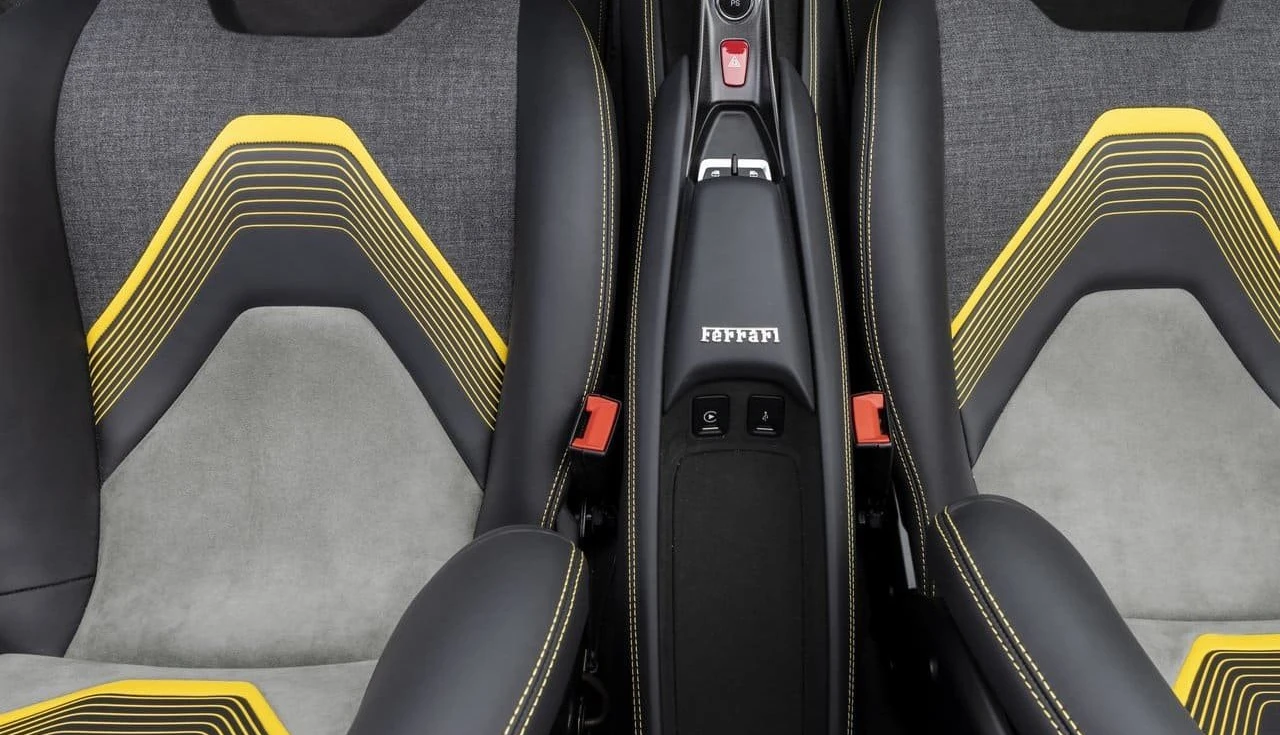
Step inside the HC25 and the first thing you notice is what’s missing: the wall-to-wall leather that defines most Ferrari interiors. Instead, the cabin leans into structural carbon fiber — in both matte and gloss finishes — with the sport seats and door panels wrapped in a technical grey fabric that feels more race-ready than grand tourer.
Yellow details break through the monochrome scheme with precision stitching and graphic inserts on the seats, tracing boomerang shapes that directly mirror the DRL signature at the front of the car. That visual continuity between the exterior and interior is intentional, not coincidental. The instrument cluster keeps the analog tachometer front and center, flanked by high-resolution displays — a layout inherited directly from the F8 Spider platform.
Driver-Focused Tech With No Oversized Touchscreen in Sight
The HC25 doesn’t chase the trend of massive center screens or semi-autonomous driving aids. The entire interaction philosophy is built around the driver staying connected to the road. Everything essential — from the Manettino dial to the key driving controls — lives on the steering wheel, so your hands never have to leave it.
Apple CarPlay integration and advanced track telemetry modules are accessible through the displays flanking the tachometer. The ADAS suite is limited to high-performance active safety protocols only, with no intrusive steering corrections or unwanted electronic interventions. The car puts full dynamic control back in the driver’s hands — where Ferrari believes it belongs.
Standout strength: the visual coherence between interior and exterior is exceptionally well executed, even by One-Off standards. Real limitation: interior space and cargo capacity are bound by the F8 Spider’s physical architecture, with an estimated 7 cubic feet of trunk space in the front compartment — enough for two carry-on bags, nothing more.
The sport seats deliver strong lateral support for track sessions. For everyday urban commuting, that same firmness will remind you of what the car was actually built for.
720 Horsepower, Zero Batteries: The Twin-Turbo V8 Signing Off in Style
The heart of the HC25 is the F154 CG engine — a 3.9-liter, 90-degree twin-turbocharged V8 mounted longitudinally in a mid-rear position. It’s the same award-winning block from the F8 Tributo and the 488 Challenge program, and Ferrari is using it here as the headliner of a proper send-off.
Peak output lands at 720 horsepower at 7,000 rpm, with 568 lb-ft of torque arriving at just 3,250 rpm. The power density hits 185 hp per liter — about as high as a gasoline-only engine can go without any electric assistance. Drive runs through a 7-speed dual-clutch F1 transmission to the rear wheels, with upshifts measured in milliseconds under full throttle and downshifts that snap the revs on corner entry.
On the road, those numbers translate to 0–60 mph in roughly 2.4 seconds, a 0–125 mph sprint in 8.2 seconds from a standstill, and a top speed of 211 mph. All of that without a single electric motor. The secret is a set of twin-scroll turbochargers with titanium shafts that virtually eliminate turbo lag, delivering throttle response that mimics a naturally aspirated engine while producing forced-induction power.
The dry-sump lubrication system allows the engine to sit lower in the chassis, dropping the center of gravity and reducing body roll through high-speed corners — a direct performance benefit you feel in every direction change.
Fuel economy is estimated at around 18 mpg combined, based on the F8 Spider’s official figures. That’s not a selling point. Nobody buying this car is counting at the pump.
Technical Specifications — Ferrari HC25
| Item | Specification |
|---|---|
| Engine | Twin-turbo V8, 3.9L, dry-sump |
| Peak Power | 720 hp at 7,000 rpm |
| Peak Torque | 568 lb-ft at 3,250 rpm |
| Transmission | 7-speed dual-clutch (F1) |
| Drive | Rear-wheel drive |
| 0–60 mph | ~2.4 seconds |
| 0–125 mph | 8.2 seconds |
| Top Speed | 211 mph |
| Fuel Economy (est.) | ~18 mpg combined |
| Front Tires | 245/35 ZR 20 |
| Rear Tires | 305/35 ZR 20 |
| Front Brakes | Carbon-ceramic, 15.7 in. |
| Rear Brakes | Carbon-ceramic, 14.2 in. |
| Curb Weight (est.) | ~3,086 lbs |
A $6 Million Ferrari That’s Likely Worth More the Day After You Buy It
Ferrari never discloses the official price of One-Off commissions. That’s entirely deliberate. But the market doesn’t stay silent. Using the F8 Spider’s last known MSRP — which ranged from $302,500 to $328,000 — as a baseline, and stacking on the thousands of engineering hours from Flavio Manzoni’s design studio, the exclusive aluminum stampings, the hand-laid Moonlight Grey carbon fiber body and every piece of custom-machined hardware, industry experts consistently estimate the total cost of the HC25 commission at somewhere between $4 million and $6 million.
That’s the number specialists work with. There is no official sticker.
For the first seven years, maintenance costs are essentially zero out of pocket. The Ferrari Genuine Maintenance program covers all scheduled service intervals — engine oil, brake fluid, air filters, cabin filters and spark plugs. Once that window closes, reality sets in. Annual upkeep for a mid-mounted twin-turbo V8 at this performance level typically runs $3,000 to $5,000 in a normal year, but can jump to $19,500 or more when it’s time to replace the carbon-ceramic brake rotors and a full set of ultra-high-performance tires.
Insurance is a category of its own. Standard carriers won’t touch a vehicle that can’t be replicated or sourced through any conventional supply chain. Specialty insurers writing Agreed Value policies for this class of asset typically charge annual premiums between $25,000 and $40,000, with the pricing driven almost entirely by the cost and lead time of fabricating bespoke body panels, custom DRL assemblies and machined components that don’t exist in any warehouse.
Is it a sound investment? For the right buyer, yes — genuinely. Ferrari One-Off cars consistently appreciate on the secondary market, and the HC25 carries the added symbolic weight of being the last non-hybrid V8 Spider the brand will ever produce. That narrative alone drives value.
The ideal buyer profile: an ultra-high-net-worth collector already embedded in the Ferrari ecosystem, who treats the car as both a capital asset and an object of desire.
Ferrari HC25: The Questions Every Enthusiast Is Already Asking
What is the price of the Ferrari HC25? Ferrari doesn’t release official figures for Special Projects commissions. Market estimates place the total cost between $4 million and $6 million based on comparable One-Off transactions.
How many Ferrari HC25 units were built? One. It’s a true One-Off — developed over approximately two years for a single client through Ferrari’s Special Projects division. No additional units are planned.
What is the real-world fuel economy of the Ferrari HC25? Based on the F8 Spider platform, the estimated combined fuel economy is around 18 mpg. It’s not the point of the car.
Can you buy a Ferrari HC25 in the United States? No. There is one unit in existence, already delivered to its owner. There are no production or derivative versions planned for any market.
Does the Ferrari HC25 Justify a $6 Million Price Tag?
The HC25 isn’t built for people who need a car. It’s built for someone who wanted the last example of something that will never be made again — a mid-engine, twin-turbo V8 convertible with 720 horsepower and absolutely no electrification, no hybrid assist, no compromise driven by emissions regulations.
For anyone outside that collector profile, the car makes no practical sense whatsoever. For the right person, it’s possibly the most significant Ferrari commission of the next decade.
The HC25 isn’t a car you go out and buy. It’s a car that finds you.
Share this article
Related posts