






GWM Tank 300 PHEV Flex 2027: specs, range, price and everything you need to know
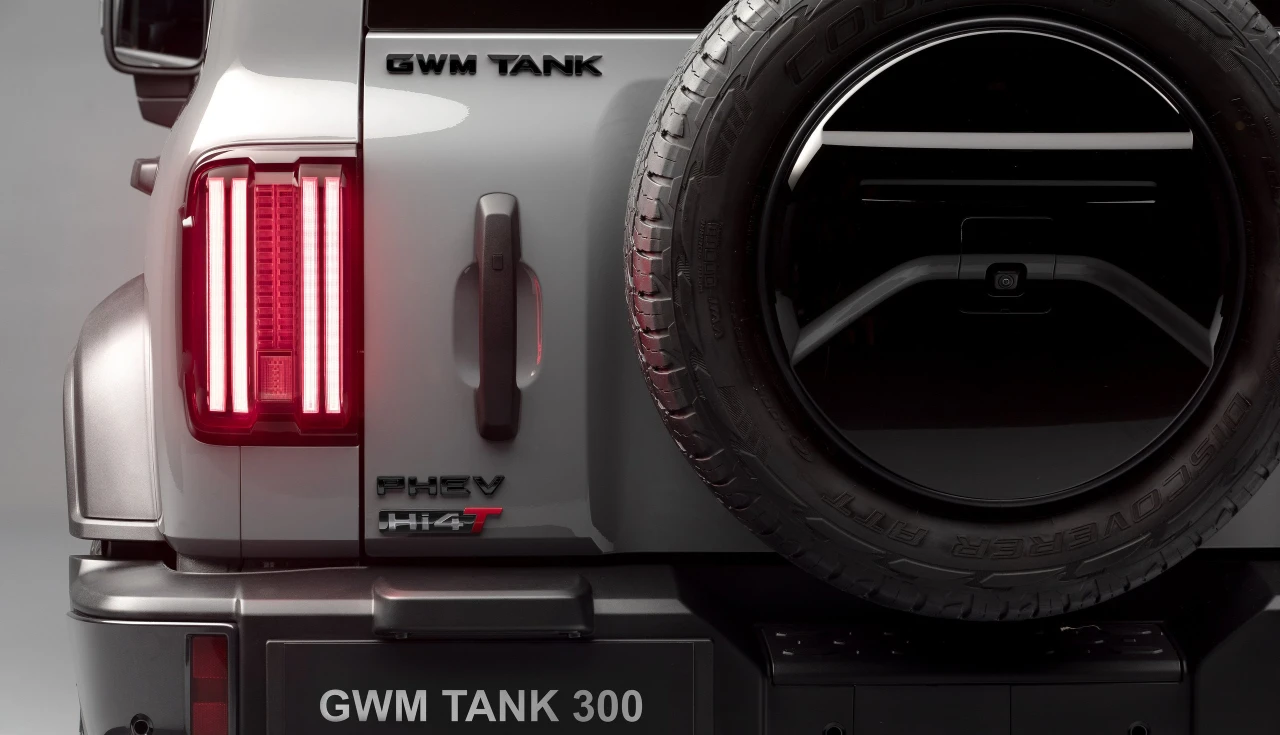
The GWM Tank 300 PHEV Flex 2027 is officially the world’s first flex-fuel plug-in hybrid, combining a turbocharged engine, a 37 kWh battery and 394 hp with serious mechanical 4×4 hardware.

Danniel Bittencourt
26/04/2026
A New Kind of Off-Road Hybrid
The GWM Tank 300 PHEV Flex 2027 was unveiled at the Beijing Auto Show in 2026 and went on sale immediately as a 2027 model. In Brazil, where it launched first, the price sits at approximately $60,000 USD — placing it squarely against body-on-frame SUVs like the Jeep Wrangler, Toyota 4Runner and Mitsubishi Pajero Sport.
What separates this truck from the crowd is not just the hybrid powertrain. It is the combination of a proper mechanical 4×4 system — with a transfer case and three locking differentials — with a 37.1 kWh battery and a turbocharged engine that runs on both gasoline and ethanol. That package does not exist anywhere else right now.
GWM positions the Tank 300 under what it calls a “luxury adventure” philosophy: the idea that serious trail capability and premium interior finish should not be mutually exclusive. The American buyer the brand has in mind is someone who actually uses the low range, but also wants heated seats and a decent sound system on the way back.
Square Body, No Apologies
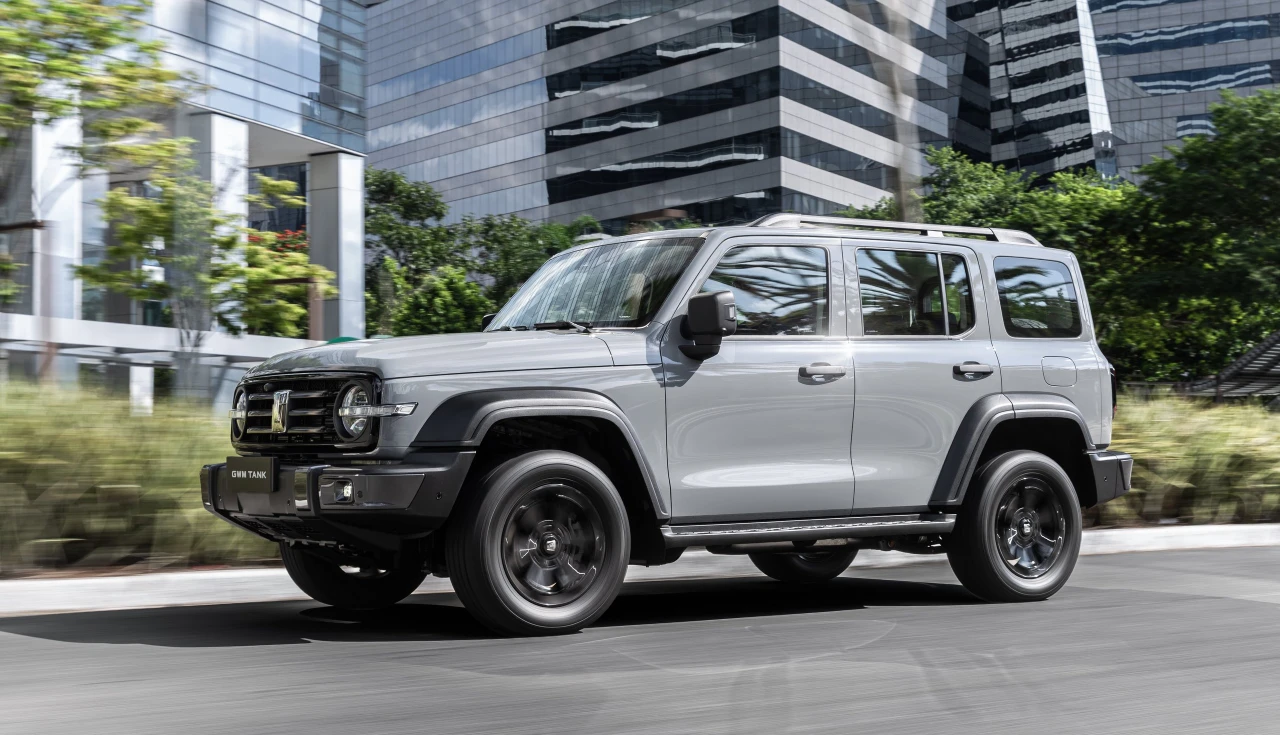
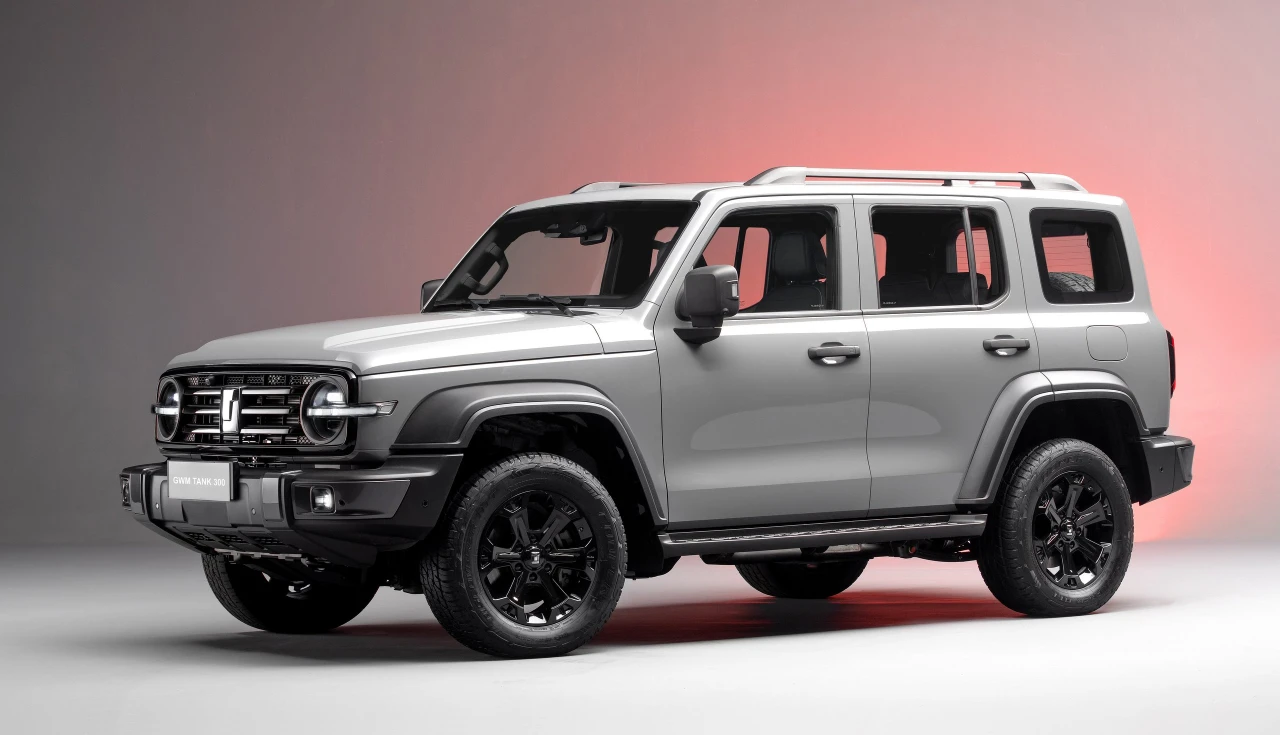
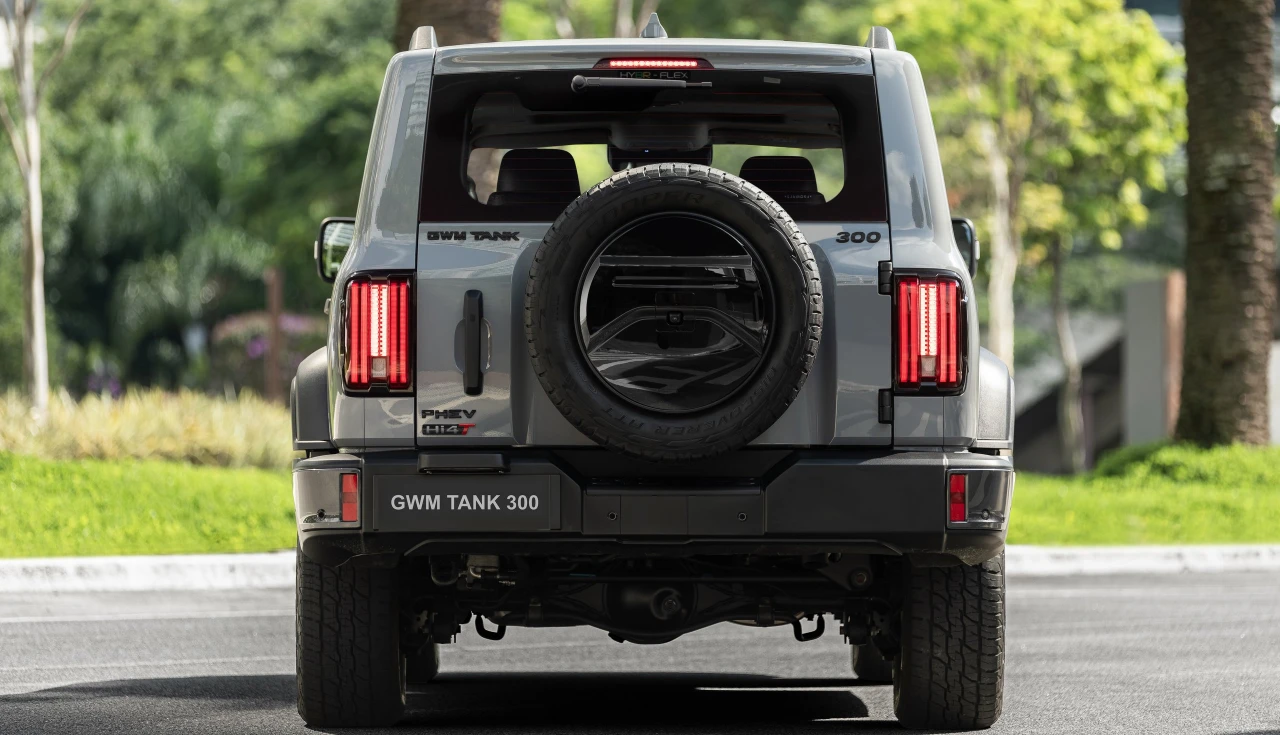
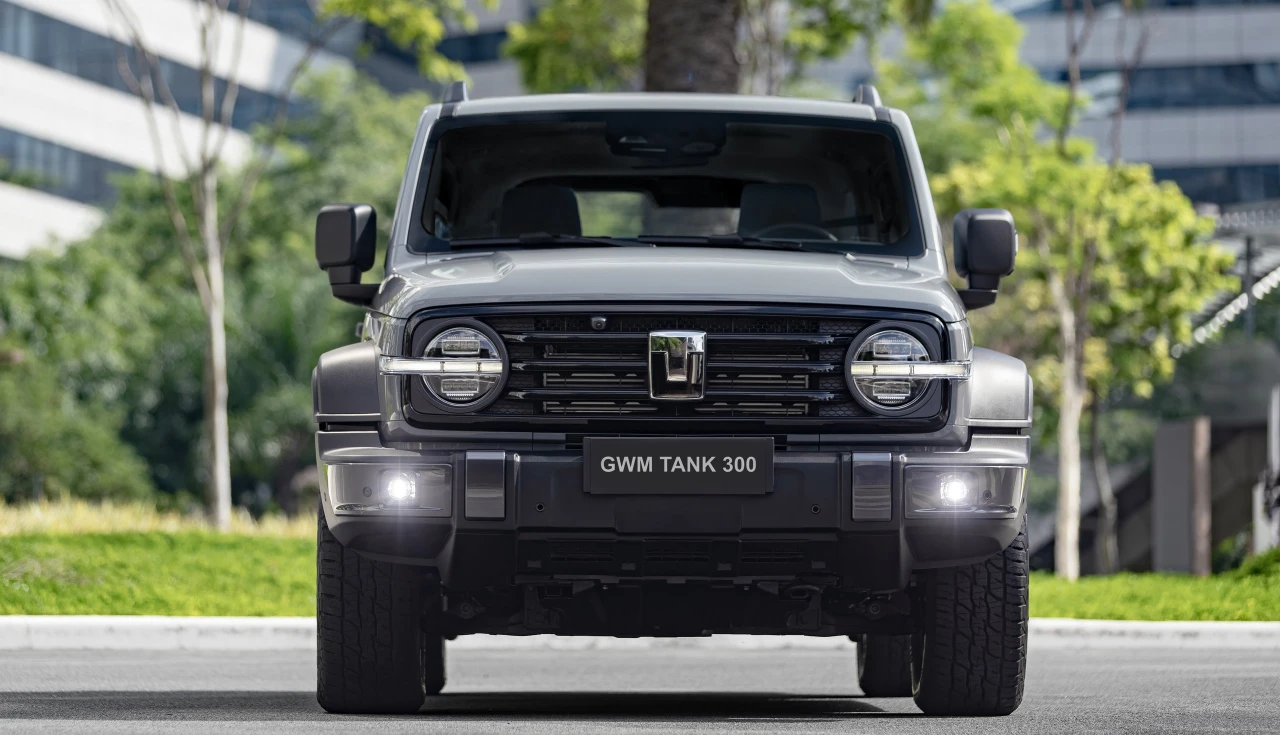
The Tank 300 makes no attempt to look aerodynamic. It is tall, upright and wide, built on a body-on-frame platform with the kind of proportions that make it stand out in a parking lot full of crossovers.
At 187.4 inches long, 76 inches wide and 74.9 inches tall, with a 108.3-inch wheelbase, it sits in the same physical space as a mid-size truck-based SUV. Think Wrangler four-door, not Cherokee.
The front end uses circular LED headlights with a distinctive DRL signature, framed by a wide grille that leans into the retro-truck aesthetic. Automotive press in multiple markets has compared it visually to the Wrangler and the Mercedes-Benz G-Class — not in terms of refinement, but in terms of attitude.
Down the sides, the body lines are straight and deliberate. 18-inch wheels wrapped in 265/60 R18 all-terrain tires, side steps and a roof rack make the working-truck intent clear. The unpainted bumper and fender trim do the same job without shouting about it.
Color options include names tied to geography and terrain — desert, dune, volcanic — which fits the brand narrative well enough without being overbearing.
Inside, It Punches Above Its Class
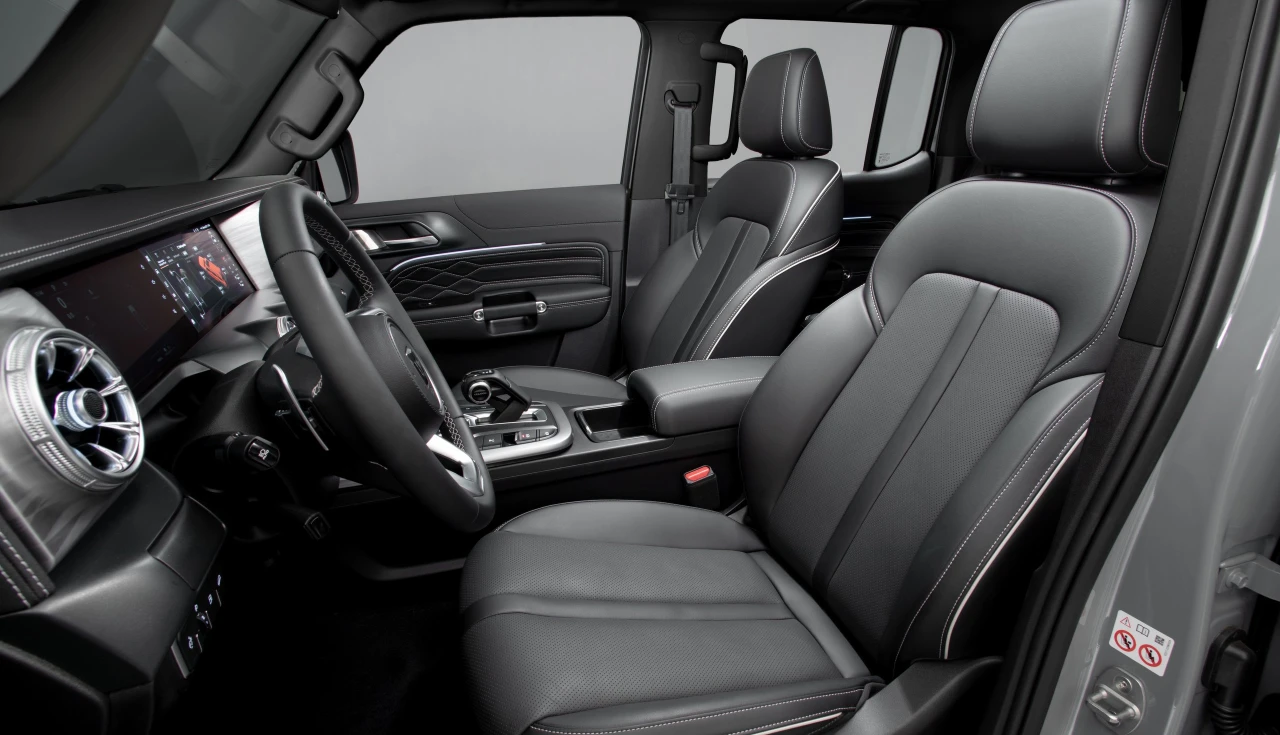
Sitting inside the Tank 300 feels closer to a luxury SUV than to a trail rig. Nappa leather upholstery, diamond-stitched door panels and soft-touch surfaces throughout set a tone that most body-on-frame competitors do not match at this price.
The driver’s seat comes with power adjustment, heating, ventilation, massage, easy-entry and memory functions. That level of seat hardware is more common in a German executive sedan than in a truck that goes mudding on weekends.
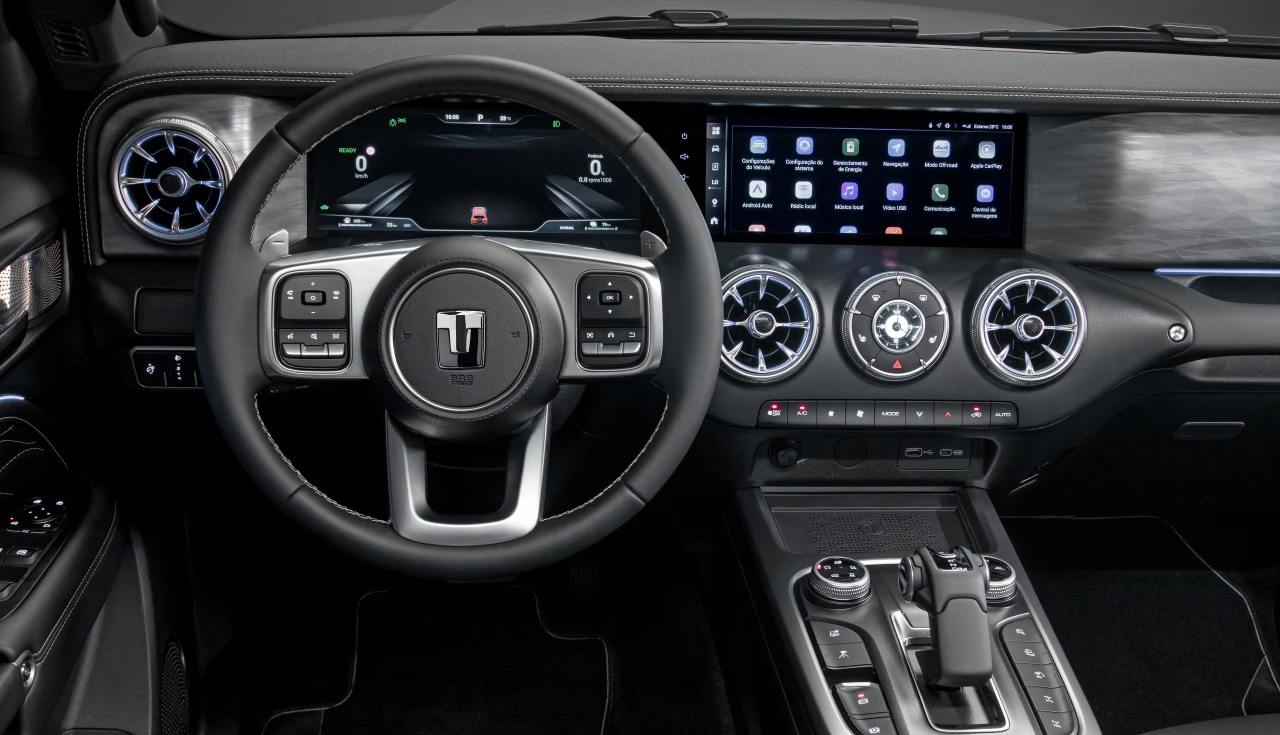
Two 12.3-inch Full HD screens handle instruments and infotainment. The system includes native 3D navigation, wireless Apple CarPlay and Android Auto, 4G connectivity and over-the-air software updates. No cables required, no dealership visit needed for updates.
The audio setup runs nine speakers including a subwoofer, rated at 640 watts RMS. Dual-zone automatic climate control, a cooled center console and a heated multi-function steering wheel round out the comfort package.
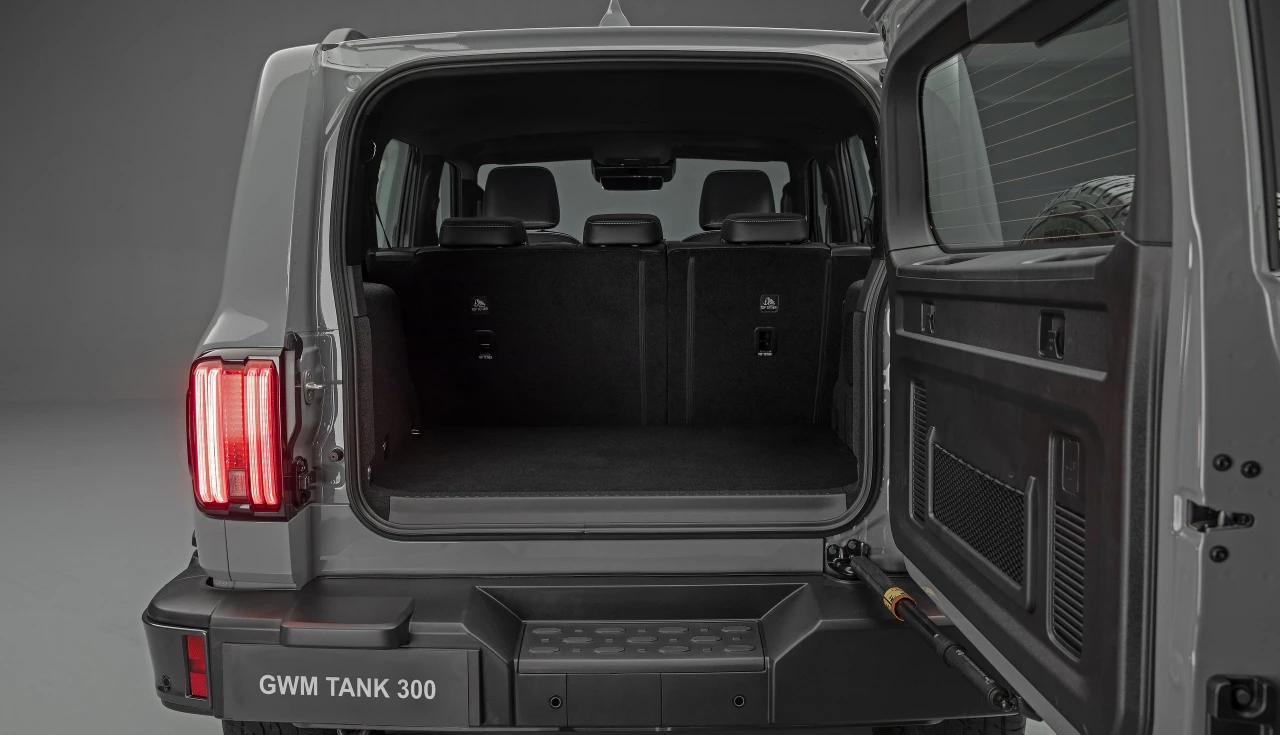
Cargo space is listed at 30.5 cubic feet behind the rear seats, expanding to 53.7 cubic feet with them folded. For a truck-based platform, those are useful numbers.
The GWM companion app handles remote functions including climate pre-conditioning, lock/unlock, charge monitoring and tire pressure — standard territory for a modern PHEV, but well implemented here.
One real criticism from press testing: some of the driver-assistance alerts are intrusive in daily use. That is a calibration issue, not a fundamental flaw, but it is worth knowing.
The Powertrain Is the Main Story
Under the hood sits a 2.0-liter turbocharged direct-injection engine paired with a front-mounted electric motor, running through a 9-speed hybrid automatic transmission with torque converter. Combined output is 394 horsepower and 553 lb-ft of torque.
Those numbers hold whether you fill the tank with gasoline or ethanol — the flex-fuel calibration does not compromise peak output. For markets where ethanol is widely available, that matters. For American buyers, it means the engine runs cleanly on regular gasoline without compromise.
The 37.1 kWh lithium-ion NMC battery delivers 75 miles of electric range per the local certification standard, and approximately 66 miles by WLTP. A CNN Brasil road test recorded around 62 miles on a full charge in real conditions — close to the official figure.
Zero to 60 mph comes in at 6.8 seconds, confirmed by independent track testing. Top speed is electronically capped at 112 mph.
With a depleted battery, real-world fuel economy drops to around 30 mpg combined in hybrid mode. With a full charge, GWM claims up to 47 mpg equivalent in combined use — the kind of number that only makes sense if you charge regularly.
The 4×4 system offers High 2WD, High 4WD and Low 4WD, plus electronic locking differentials front, center and rear. Nine terrain modes cover snow, rock, mud, sand, rough road and a configurable Expert setting. The Tank Turn function tightens the turning radius significantly in tight off-road situations.
The V2L system outputs up to 3,300 watts of external power — enough to run a refrigerator, charge tools or power a campsite setup. For overlanding use cases, that is genuinely useful.
One consistent complaint in testing: when adaptive cruise control is active, regenerative braking is reduced or disabled in certain situations. It does not break the experience, but it limits the efficiency potential of the system.
SPECS
| Item | Spec |
|---|---|
| Engine | 2.0L turbocharged direct-injection flex-fuel |
| System | Plug-in hybrid (PHEV) |
| Combined horsepower | 394 hp |
| Combined torque | 553 lb-ft |
| Transmission | 9-speed hybrid automatic, torque converter |
| Drivetrain | 4WD with 2H / 4H / 4L and front, center, rear locking differentials |
| 0–60 mph | 6.8 seconds |
| Top speed | 112 mph (electronically limited) |
| Battery | 37.1 kWh lithium-ion NMC |
| Electric range | ~75 miles (local cert.) / ~66 miles (WLTP) |
| Fuel economy (gas, charged) | Up to 47 MPGe combined (GWM figure) |
| Fuel economy (battery depleted) | ~30 MPG combined (press testing) |
| Length | 187.4 in |
| Width | 76.0 in |
| Height | 74.9 in |
| Wheelbase | 108.3 in |
| Cargo volume | 30.5 cu ft / 53.7 cu ft (seats folded) |
| Curb weight | Not disclosed for 2027 model |
| Fuel tank capacity | Not disclosed by manufacturer |
| Starting price (Brazil launch) | ~$60,000 USD equivalent |
Read more
FAQ
Is the Tank 300 PHEV Flex really the world’s first flex-fuel plug-in hybrid? That is GWM’s official claim. The system combines a PHEV drivetrain with a flex-fuel combustion engine — a combination that had not been done at production scale before this model. The engineering was led by GWM’s Brazilian team.
What is the real-world electric range? The official figure is around 75 miles. A real-world test by CNN Brasil recorded approximately 62 miles on a full charge, which is close to the certified number and better than most PHEVs in this segment.
How does fuel economy hold up when the battery runs out? It drops noticeably. Independent testing measured roughly 30 mpg in combined hybrid mode with a depleted battery — adequate for the size, but not exceptional. Regular charging is what makes the efficiency case work.
Does it have serious off-road capability or just the styling? It has the hardware. Transfer case with low range, three electronic locking differentials and nine terrain modes give it mechanical capability that puts it in the same conversation as the Wrangler for actual trail use, according to press testing.
What does the V2L system actually power? Up to 3,300 watts of external output — enough for power tools, a refrigerator or campsite electronics. It connects through a standard outlet built into the vehicle.
Who Should Actually Buy This
The Tank 300 PHEV Flex does something specific well: it delivers genuine trail hardware, a large battery and a premium interior in a package that undercuts most luxury truck-based SUVs on price. That is not a small thing.
The weaknesses are real but predictable. A tall body-on-frame truck rolls in corners. A heavy PHEV loses efficiency when the battery is flat. These are engineering trade-offs, not defects.
In the American market context, the Tank 300 sits in an interesting gap. The Wrangler 4xe has a much smaller battery and less interior refinement. The G-Class is significantly more expensive. The 4Runner has no electrification at all. None of them combine all three — trail hardware, serious electric range and a quality interior — at this price.
The buyer who gets the most out of this truck charges it regularly, uses the low range occasionally and values the fact that the back seat is actually comfortable on a four-hour highway stretch. That person does not have many other options right now.
Share this article
Advertisement
Top of the Moment
Posts relacionados

Gigante elétrico: Audi E7X 2027 chega com 5 metros e luxo extremo
A Audi surpreende com o novo E7X, um SUV elétrico de alto luxo com 680 cv e impressionantes 750 km de autonomia. Descubra as tecnologias e o

Conheça o Galaxy Light Gen II: O Flagship de Luxo que Desafia os Super-EVs Americanos
A Geely resolveu parar de brincar. O Galaxy Light Gen II Concept chega como um sedã que mistura estética chinesa contemporânea com mais de 1.000 cv de

Continental GTC S 2027: Bentley aposenta o W12 e lança seu conversível mais potente
O Bentley Continental GTC S 2027 chega com motor V8 híbrido de 680 cv, autonomia elétrica de 80 km e 3,7 segundos para os 100 km/h. O

Porsche fez o Cayenne mais poderoso da história e ele é 100% elétrico, com 1.156 cv
O Porsche Cayenne Coupé Electric chega em 2027 com até 1.156 cv, autonomia de 669 km e o primeiro carregamento por indução da marca. É o Porsche

Ram Dakota Laramie Night Edition 2026 chega ao Brasil com motor 2.2 diesel e câmbio de 8 marchas
A Ram Dakota 2026 chega ao Brasil na versão Laramie Night Edition com motor 2.2 diesel, câmbio automático de 8 marchas e acabamento escurecido para disputar o

Diesel ou elétrico — o Opel Zafira 2026 deixa você escolher como quer viajar
O Opel Zafira 2026 chega com parceria oficial da Tinkervan e permite transformar uma minivan de até 9 lugares em um camper homologado, sem precisar sair da